Chest Freezer Size Calculator
Estimate chest freezer cubic feet, liters, storage weight, basket allowance, headspace, wattage, annual energy, and floor footprint from your household food storage plan.
📦Storage presets
⚙Freezer sizing inputs
🧊Freezer sizing result
📏Freezer spec grid
📊Reference tables
| Food category | Planning density | Typical packages | Sizing note |
|---|---|---|---|
| Meat, poultry, fish, game | 38 lb per ft³ | Vacuum packs, wrapped cuts | Dense and stackable when flat packed |
| Fruit, vegetables, sauces | 32 lb per ft³ | Bags, tubs, jars, trays | Often bulky because shapes vary |
| Prepared meals and soups | 28 lb per ft³ | Containers, trays, freezer bags | Allow more access space for rotation |
| Bread, dough, dessert, staples | 22 lb per ft³ | Boxes, loaves, flour, butter | Lower density and more crush-sensitive |
| Chest freezer class | Nominal capacity | Approx food load | Common footprint |
|---|---|---|---|
| Compact | 3 to 5 ft³ / 85 to 142 L | 105 to 175 lb | 22 x 21 in body |
| Small family | 7 to 9 ft³ / 198 to 255 L | 245 to 315 lb | 38 x 22 in body |
| Medium bulk | 10 to 14 ft³ / 283 to 396 L | 350 to 490 lb | 48 x 28 in body |
| Large harvest | 15 to 18 ft³ / 425 to 510 L | 525 to 630 lb | 60 x 30 in body |
| Extra large | 20 to 25 ft³ / 566 to 708 L | 700 to 875 lb | 74 x 32 in body |
| Household pattern | People | Storage window | Typical size range |
|---|---|---|---|
| Apartment overflow | 1 to 2 | 1 to 2 months | 3 to 5 ft³ |
| Family grocery buffer | 3 to 4 | 1.5 to 3 months | 7 to 12 ft³ |
| Quarter beef or hunting season | 3 to 5 | 3 to 5 months | 12 to 18 ft³ |
| Garden harvest storage | 4 to 6 | 4 to 6 months | 14 to 22 ft³ |
| Shared divided freezer | 4 to 6 | 2 to 4 months | 10 to 18 ft³ |
| Allowance | Low | Typical | Use when |
|---|---|---|---|
| Basket allowance | 4% | 8% to 12% | More bins or divided foods need more space |
| Headspace reserve | 8% | 12% to 18% | Odd boxes, baskets, and air gaps add volume |
| Growth reserve | 10% | 15% to 25% | Use higher reserve for seasonal harvests |
| Floor clearance | 2 in | 3 to 4 in | Add to both length and depth for airflow |
✅Chest freezer sizing tips
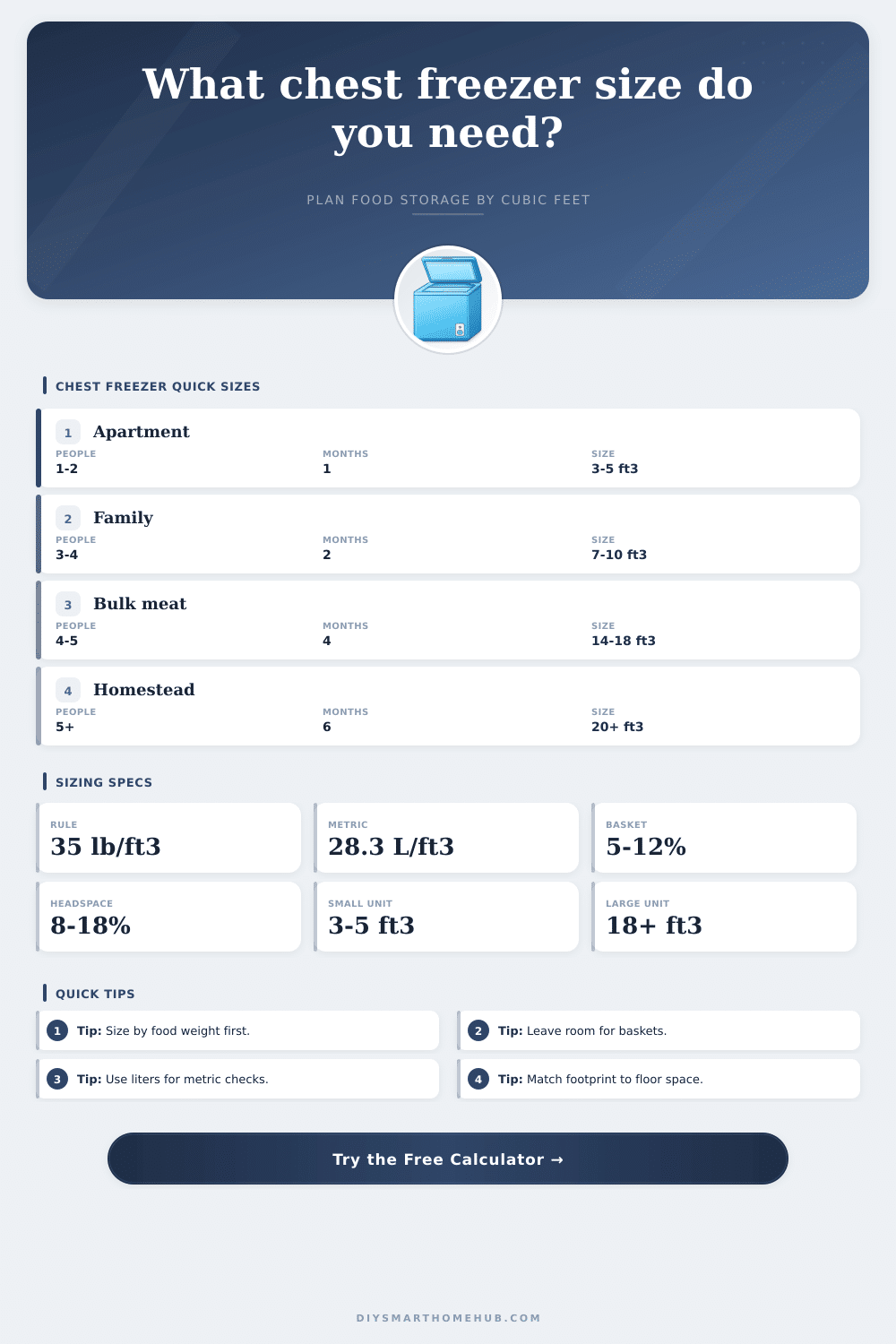
Meat, produce, meals, and bakery items pack differently. This calculator converts each category separately before applying basket and headspace allowances.
Nominal cubic feet do not show lid swing, rear ventilation, or side clearance. Use the footprint estimate to test a utility room, pantry, or garage location.
How many cubic feet? How big is this thing? You might already have some berries in the fridge, or meat in the garage. Maybe it’ll fit in your laundry room. Maybe you’re wondering whether its big enough to be worth the electric bill. Maybe you don’t care, as long as you can fit all the stuff you need into it.
Planning by weight help you avoid common mistakes. First determine how many pounds of produce/meat you’d like to store. The calculator will do the rest for you. Meats is flat and dense. Vegetables in bags aren’t as efficient. This means if you ignore it, you’ll end up with a freezer that is too small. Or, you’ll end up with a freezer that are too large and half empty. And that’s where this tool comes in. With it you can adjust for reality. Tweak your head space reserve and basket allowances.
How to Choose the Right Freezer Size
Plastic bins take up volume but don’t hold any food themselves. Eight percent is a common allowance for standard dividers. If you’re super meticulous about organization, add more. It is similar with headspace. Sounds like you’d be super efficient packing tight, right? No. Retrieval is hard. The ice cream on the bottom never thaw before it needs to be thrown out because there’s no way to get down there. Twelve to eighteen percent air gap will not only speed up the freezing cycle but help things stay accessible.
There’s also the silent variable of energy usage. Moddern freezers don’t necessarily have higher wattage just because they’re bigger. Where you place your freezer matter too. Forcing that compressor to run harder wastes more energy. Putting the thing in hot garage? It’ll suck down a lot more power. Installing it in a cool basement are better. Surrounding temperature profiles is considered by the calculator. Indoor vs. Outdoor installations makes a difference. These numbers is skewed greatly for older freezers. Think of them as a starting point, not gospel.
Physical footprint matters. Before you purchase, read the specs and know dimensions. Then consider additional requirements; manufacturers don’t include ventilation space. Three inches must remains on all sides and the back. Without this, heat accumulates. Heat buildup affects efficiency. Efficiency decrease. Ice forms faster then usual. Tight quarters increase ice accumulation. A “fifty” doesn’t fit into a “fifty”. Do not assume a 50-inch unit fits a 50-inch opening. Measure it first. Installation problems results from improper measurements.
Make sure the lid will open completely. There’s no sense getting a chest freezer that’s too big or too small; it should of be sized for how you use it. It’s meant to fit your habits. Weigh the food you actualy eat and leave some extra space for life. Buy a box so you know it fits. Then double-check it just to be sure. Getting the correct size is now a plan rather than a guess.