Grow Room Air Exchange Calculator
Estimate cultivation room fan CFM, delivered air changes, intake balance, and purge time from room volume, CO2 strategy, humidity load, heat load, and airflow losses.
📌Cultivation room presets
Results use volume airflow, CO2 mode factor, heat and humidity corrections, intake restriction, duct/filter derate, and fan reserve.
🔧Room and airflow inputs
⚙Exchange strategy grid
📊Key formula checkpoints
🌱Cultivation exchange reference
| Room type | Typical ACH | CO2 approach | Airflow note |
|---|---|---|---|
| Propagation rack | 8 to 14 ACH | Fresh air | Gentle exchange protects humidity stability. |
| Seedling tent | 10 to 16 ACH | Fresh air | Low heat load, avoid excessive dry-down. |
| Vegetative room | 14 to 22 ACH | Fresh or assist | Canopy transpiration starts to drive sizing. |
| Flowering or fruiting bay | 18 to 30 ACH | Fresh or assist | Humidity and odor control usually dominate. |
| Dense vertical rack | 22 to 36 ACH | Fresh or assist | Tall heat plume and leaf density add reserve. |
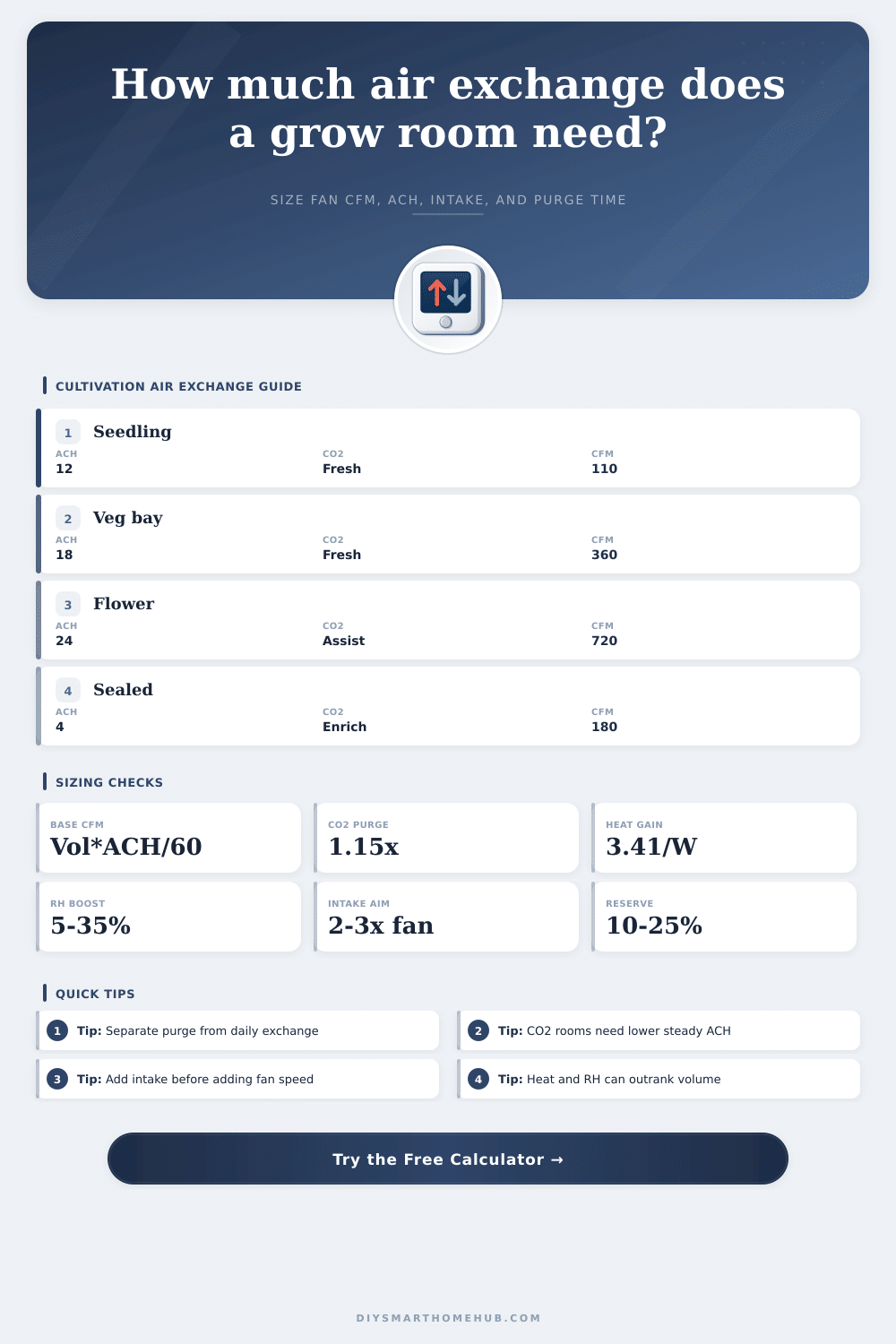
| CO2 enriched sealed room | 2 to 8 ACH | Enriched | Lower steady exchange plus dedicated purge. |
🌡Correction factors table
| Condition | Formula or factor | When it matters | Calculator use |
|---|---|---|---|
| Heat load | Watts x 3.41 / (1.08 x delta F) | Lights or pumps warm the room | Raises CFM if heat CFM exceeds exchange CFM. |
| Humidity load | 1.05x to 1.35x | Wet trays, dense canopy, misting | Multiplies base exchange before reserve. |
| CO2 enrichment | 0.35x to 1.20x | Fresh air conflicts with enrichment | Adjusts steady exchange and purge emphasis. |
| Duct and filter loss | Loss percent derate | Filter, bends, screen, silencer | Installed fan CFM is increased to deliver target flow. |
| Fan reserve | 1.00x to 1.60x | Seasonal heat or aging filters | Adds adjustable headroom to final fan rating. |
🌬Intake balance and purge targets
| Exhaust rating | Passive intake target | Purge use | Balance note |
|---|---|---|---|
| 100 to 250 CFM | 70 to 175 sq in | Small tents and racks | Use light-proof vents with generous free area. |
| 250 to 500 CFM | 175 to 350 sq in | Closets and small rooms | Two intake paths often reduce fan strain. |
| 500 to 900 CFM | 350 to 625 sq in | Mid-size flower rooms | Check door pull and grille free-area ratings. |
| 900 to 1400 CFM | 625 to 975 sq in | Large bays and racks | Consider active intake when passive area is limited. |
| 1400+ CFM | 975+ sq in | Greenhouse zones | Split intake across the room to reduce dead spots. |
📋Common cultivation room examples
| Preset | Volume | Exchange plan | Typical result |
|---|---|---|---|
| Clone Shelf | 96 ft3 | 10 ACH, low heat | 30 to 45 CFM fan |
| Veg Closet | 448 ft3 | 18 ACH, moderate RH | 170 to 240 CFM fan |
| Flower Bay | 1200 ft3 | 24 ACH, high RH | 700 to 950 CFM fan |
| Sealed CO2 Room | 1536 ft3 | 4 ACH plus purge | 180 to 320 CFM steady |
| Greenhouse Corner | 1920 ft3 | 20 ACH, high heat | 900 to 1400 CFM fan |
💡Air exchange tips
A restricted passive intake can make a correctly sized exhaust fan behave like a much smaller fan. Keep free intake area around two to three times the fan outlet area when possible.
CO2 enriched rooms may run low steady ACH, but they still need enough purge airflow to reset CO2, heat, humidity, or odors within the selected purge window.
Moving lots of air around isn’t what’s important in growing a room; it’s moving just the right amount, at the right times. You want plenty of fresh air exchange without dead spots but also without over-drying your plants. It’s easy to waste energy and stress your crop with bad air circulation. This calculator manages the tricky interplay among these factors for you.
It helps you avoid guessing how much each factor matter when choosing fans. But new growers tend to treat all rooms the same. They also fail to consider the specific needs of environment they are trying to create or the specific stages of crop growth they want to support. A bay full of tight buds is not the same thing as a seedling tent.
How to Choose the Right Fan Size for Your Grow Room
Seedlings don’t transpire much; they produce minimal heat. So they need light air flow that helps keep them moist while preventing wind stress. On the other hand, mature flowerers are like mini-heaters and mini-humidifiers. They gives off large amounts of water vapor via their foliage and pick up considerable heat from the lights. Failure to consider this moisture and heat push-pull will transform your room into a sauna with mildew and mold moving in to take up residence.
Not only ventilation but climate control matter. The basic problem with closed environments like a sealed growroom is that every watt of light turns into nearly all heat. That’s why heat load tends to be the first consideration in calculating minimal airflow before any other factors like humidity and CO2 are included. How do you figure out how much?
Once you know the constants, the math is simple: multiply your total wattage by 3.41 to get BTUs per hour. Divide it by a normal constant for air density and then by amount of degree temperature rise you can afford. You get the minimum CFM necessary to prevent your lights from cooking your plants. Many growers only consider desired air exchanges per hour when figuring their fan size and end up with a room that is twenty degrees hotter then they’d prefer.
The tool handles that possibility by testing whether your basic need to remove heat is greater than your need for general air exchange, making sure your concerns about overheating come first. A third complication is that you cannot just plug in a number to get the right fan volume for managing humidity. It depends on the surface area of leaves and moisture content of the soil; some plants transpire gallons of water daily.
How much a plant pumps into atmosphere depends on how densely it’s growing. And so does the fan power needed, since the calculator will adjust its suggested flow by a correction factor to account for this invisible humidity pressure relative to your estimate. That’s why two similarly sized rooms, both receiving same amount of light, may require totally different fans: One contains dense tropical foliage, while the other has compact herbs that use very little moisture. Match your exhaust capacity to what your particular crop actualy outputs biologically.
The silent killer of an efficient ventilation system is intake balance. If a high-powered exhaust fan cannot efficiently draw in air from the room it’s useless. Restricted intakes cause negative pressure, which starves fans of air, leaks light, distorts tents and causes other issues. This is laid out clearly in the reference table on the page, which shows how much free intake area you’ll need based off your exhaust rating. Generally, you don’t want your total intake opening to restrict more than two to three times the diameter of your exhaust duct.
If path is blocked, it doesn’t matter how strong your lungs are. One last wrinkle completely shifts how we think about air exchange: carbon dioxide strategies. If you are adding CO2 during the day, the room should be sealed tight to keep the air exchange rate low so that the CO2 concentration can build up. But this demands a beefy purge system capable of rapidly resetting the gas level and expelling excess heat once the lights shut off.
The calculator separates these two considerations, letting you size a small continuous fan for maintenance and a large purge capability for quick resets. This distinction matters for the sake of the plants and energy efficiency. Mastering air exchange is less about memorizing formulas and more about understanding the dynamic relationship between your environment and your plants. You’ll have more success if you plan for when your plants are at their hottest and most humid (late flower) versus during the quiet comforts of early veg.
Leave the math to your tools, and use them to concentrate on the stuff that really counts, tuning into your plants’ reaction to the air around them and making adjustments from there. The sounds should be constant, never frenetic. The room should feel like a well-controlled ecosystem, not an industrial warehouse.
Begin with the fundamentals. Inspect your intake zone. Allow the numbers to dictate which hardware you buy, not your intuition.