System Boiler Size Calculator
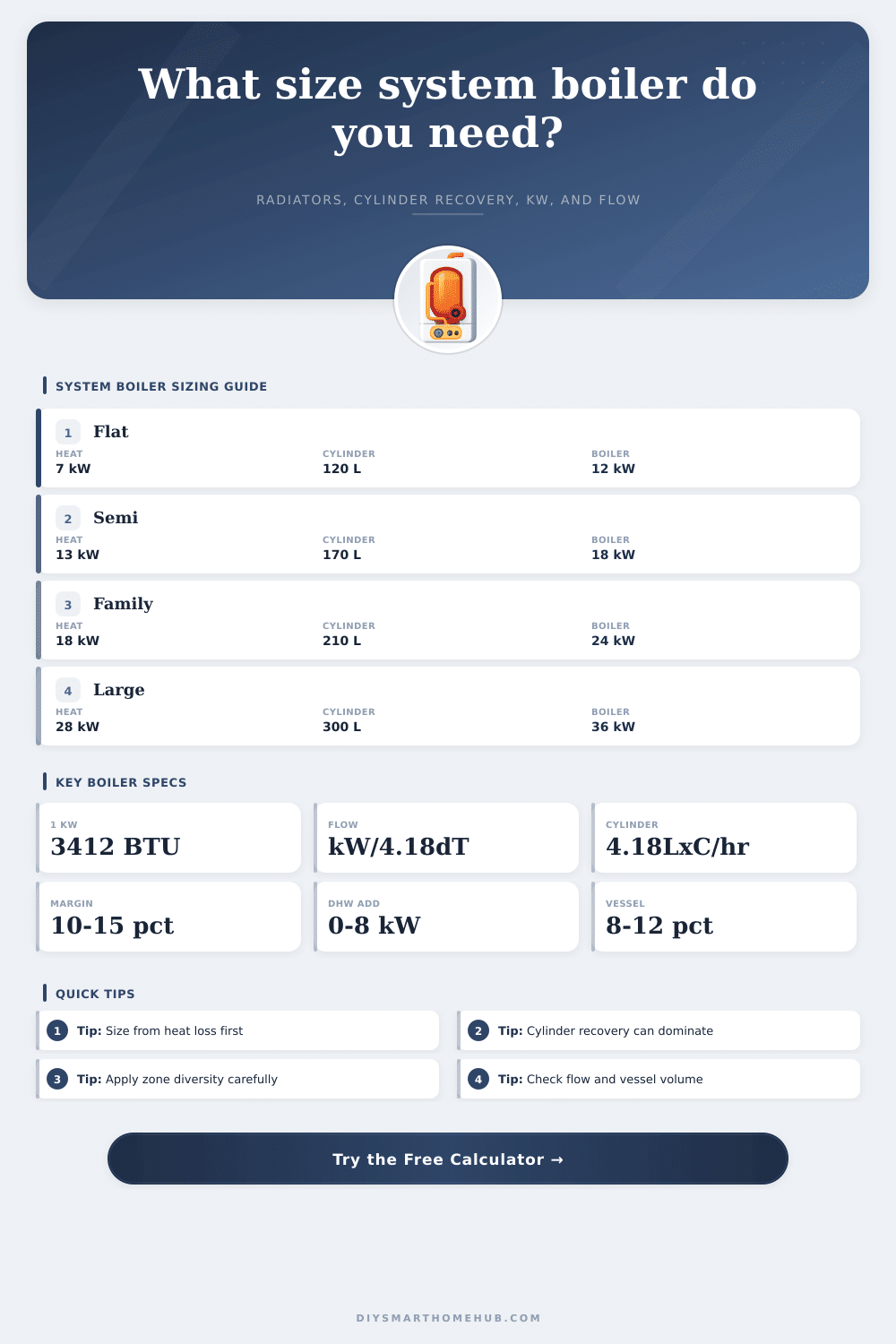
Estimate the heating output, cylinder recovery load, domestic hot water allowance, diversity factor, boiler kW, BTU/hr, flow rate, and expansion vessel guidance for a system boiler with an unvented or vented cylinder.
⚙System boiler presets
Choose a starting point, then adjust the eight inputs to match the served floor area, emitter style, cylinder size, and recovery target.
🔧Calculator inputs
📈System boiler and cylinder spec grid
📋Reference tables
Boiler output presets
| Useful output | BTU/hr | Typical system | Notes |
|---|---|---|---|
| 12 kW | 40,946 | Flat or small house | Usually paired with small cylinders and low heat loss. |
| 18 kW | 61,419 | Small family home | Common when space heat and cylinder recovery are moderate. |
| 24 kW | 81,891 | Medium family home | Often selected where a 170-210 L cylinder recovers briskly. |
| 30 kW | 102,364 | Larger zoned house | Check minimum modulation against the smallest zone. |
| 36 kW | 122,837 | Large cylinder load | Useful when fast cylinder recovery is the limiting load. |
Cylinder recovery guide
| Cylinder | Rise 10-60 C | 30 min kW | 45 min kW |
|---|---|---|---|
| 120 L | 6.97 kWh | 13.9 kW | 9.3 kW |
| 150 L | 8.71 kWh | 17.4 kW | 11.6 kW |
| 170 L | 9.87 kWh | 19.7 kW | 13.2 kW |
| 210 L | 12.19 kWh | 24.4 kW | 16.3 kW |
| 300 L | 17.42 kWh | 34.8 kW | 23.2 kW |
Emitter flow guidance
| Emitter mix | Design delta T | Liters/min per kW | Water volume guide |
|---|---|---|---|
| Panel radiators | 20 C | 0.72 | 10 L per kW |
| Oversized radiators | 15 C | 0.96 | 12 L per kW |
| Radiators plus UFH | 15 C | 0.96 | 13 L per kW |
| Mostly UFH | 10 C | 1.43 | 15 L per kW |
| Fan coils | 10 C | 1.43 | 8 L per kW |
Diversity and DHW allowance
| Strategy | Heating factor | DHW add | Use case |
|---|---|---|---|
| Full DHW priority | Zone diversity only | 0% | Heating pauses while the cylinder recovers. |
| Balanced priority | Zone diversity | 25% | Practical default for many S-plan systems. |
| Parallel heat and DHW | Less diversity | 50% | Allows some cylinder output during heating demand. |
| Bath boost | Less diversity | 70% | When fast recovery is important after deep draws. |
💡System boiler sizing tips
A system boiler with hot water priority often does not need to satisfy peak space heating and full cylinder recovery at the same instant. The calculator applies a visible DHW allowance so the assumption is easy to review.
The final kW output can look correct for the whole home while still being too large for a small towel-rail or bedroom zone. Compare the minimum boiler modulation with the smallest active zone.
To choose the correct boilers size, one must fully understand the heating needs of the home. Should the boiler be too small for the home, it will not be able to supply enough heat for the home during the winter month or to heat a hot water cylinder to the desired temperature. Should a boiler be too large for the homes heating requirements, the boiler will cycle on and off too often (a short-cycling boiler).
Short-cycling boilers wastes fuel and cause the boiler to wear out prematurely. Each of these factor must be considered. One of the main factors to consider is the size of the homes floors, which is a reflection of the heat loss of the home.
How to Choose the Right Boiler Size for Your Home
The larger the floor area of the home, the more heat that will be lost. However, the condition of the building is even more important; a well-insulated home with warm windows will lose less heat than a home with single glazing windows and a draughty loft. Using the calculator to input the homes heat loss will ensure that the boiler size recommendation reflect the heat loss of the home.
Another consideration in determining the size of the boiler that is required will be the recovery of the water in the hot water cylinder. The demand of the hot water cylinder may be the primary demand on the boiler, and may be larger than the demand of the heating systems. A 170-litre water cylinder can require more heat than the radiators in the home, especially if the water is to reach the desired temperature in the shortest amount of time.
Furthermore, the water cylinder recovery is calculated separately from the heating load of the home; each of these demands dont have to occur at the same time. Thus, strategies for domestic hot water systems can be used to decide whether the boiler should focus on providing hot water to the home, or whether it should provide both heating and hot water at the same time. Relatedly, the number of zone in the heating system will impact the boiler size determination.
However, the number of zones does not necessarily mean that the boiler will have to be larger. Homes with multiple zones typically have a more even distribution of heat requirements; a small zone in a large home will not require as much heat as a small area in a small home. Furthermore, if the boiler cannot supply heat to the smallest zone of the home, the boiler will cycle on and off excessive.
Thus, ensuring that the requirements of the smallest heating zone are met will ensure that the boiler can maintain continuous operation of the heating system. The type of emitter (such as radiators versus underfloor heating) will impact the size of the boiler. Underfloor heating systems operate at lower temperatures than radiators, which means that a pump will be required to move a greater volume of water through the underfloor heating system.
Thus, a larger expansion vessel will be required to handle the system with underfloor heating rather than radiators. The calculator makes this adjustment automatic. Another consideration is the efficiency ratings of the boilers.
Efficiency ratings will impact the amount of fuel that the boiler will consume. For instance, a 92 percent condensing boiler will consume less fuel than an 88 percent condensing boiler of the same size. The calculator displays both the input and the output ratings of the boilers.
Each of these ratings must be considered in determining the total efficiency of the boiler. The efficiency of the boiler will impact the fuel costs and running costs of the system. The reference tables can help to determine the efficiency of the boilers.
However, the reference tables are not a replacement for the calculator. These tables indicate the amount of kilowatts that is required to recover a certain amount of litres of water in a hot water cylinder. Furthermore, the reference tables help to indicate the amount of water that will flow through different types of emitters.
Thus, these tables help to indicate whether a larger boiler is required to ensure faster recovery of the water in the hot water cylinder, or whether a larger water cylinder that heats at a slower rate is better for the home. Overall, the goal is to find a boiler that meets the needs of the heating system and the domestic hot water system, but does not have excess capacity. The calculator can help to test various assumptions about the home and the systems that people will utilize to find the best boiler size.
Furthermore, once the individual has utilized the calculator to determine the size of the boiler that should of be used for the home, the individual should walk through the home to ensure that each zone will have enough heat from the boiler, and that the coil for the hot water cylinder will be able to handle the rate of recovery of the water that the calculator calculates. These steps will ensure that the boiler is efficient in its operation, and will last for a long time.