Wood Boiler Size Calculator
Estimate design heat load, cordwood energy, boiler output, thermal storage gallons, burn-cycle recovery, reload interval, and seasonal wood demand for hydronic wood boiler systems.
🌲Wood Boiler and Storage Presets
Load a realistic cordwood boiler profile, then tune heat load, burn duration, wood species, moisture, boiler efficiency, storage temperature swing, and installed gallons.
📏Wood Boiler Inputs
🧮Cordwood, Boiler, and Storage Spec Grid
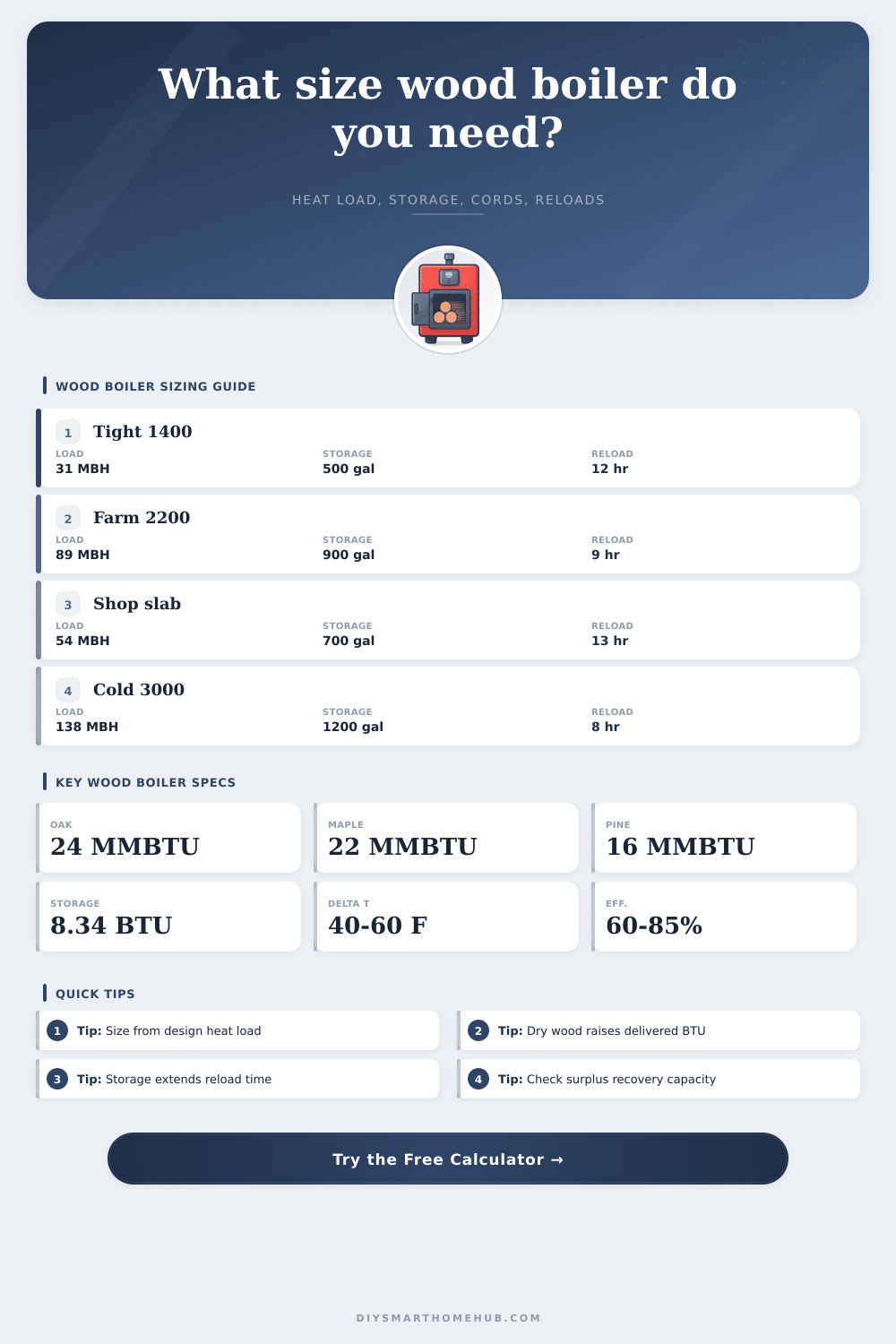
Each storage gallon holds about 8.34 BTU for every usable degree Fahrenheit of tank swing.
Softwood can be near 16 MMBTU per cord, while dense oak can reach about 24 MMBTU.
Simple outdoor units sit lower; modern gasification boilers with storage usually sit higher.
Low-temperature radiant systems can use more of the tank than high-temperature emitters.
⚖System Comparison Grid
Cordwood
- Best sizing valueMMBTU/cord
- Key variableMoisture
- Dense hardwoodLonger burns
- SoftwoodMore reloads
Wood Boiler
- Main ratingOutput MBH
- Load checkPeak BTU/hr
- Burn variableCycle hours
- Recovery checkSurplus MBH
Thermal Storage
- Main ratingGallons
- Energy formula8.34 × gal
- Usable rangeΔT
- Comfort roleReload gap
📚Wood Boiler Reference Tables
Cordwood Energy by Species
| Wood species | Gross energy | At 75% efficiency | Sizing note |
|---|---|---|---|
| White oak | 24.0 MMBTU/cord | 18.0 MMBTU delivered | Dense hardwood, long burn reserve |
| Red oak | 22.1 MMBTU/cord | 16.6 MMBTU delivered | Excellent when fully seasoned |
| Sugar maple | 21.3 MMBTU/cord | 16.0 MMBTU delivered | Strong all-around boiler wood |
| Ash | 20.0 MMBTU/cord | 15.0 MMBTU delivered | Moderate density, seasons predictably |
| Mixed hardwood | 19.0 MMBTU/cord | 14.3 MMBTU delivered | Useful default for varied stacks |
| Pine or spruce | 16.0 MMBTU/cord | 12.0 MMBTU delivered | Lower energy, faster reload rhythm |
Boiler and Storage Pairing Guide
| Design load | Boiler output | Typical storage | Reload behavior |
|---|---|---|---|
| 25-40 MBH | 80-100 MBH | 400-700 gal | Long storage coast, small firebox |
| 40-70 MBH | 100-140 MBH | 600-1000 gal | Common residential gasification range |
| 70-110 MBH | 140-200 MBH | 900-1500 gal | Needs good surplus recovery to recharge |
| 110-160 MBH | 200-300 MBH | 1200-2200 gal | Large home, shop, or multiple loads |
| Outdoor no storage | Match load closely | 0-200 gal | Shorter cycling and tighter reload timing |
| Low-temp radiant | Moderate output | More usable gallons | Lower return temperature extends tank use |
Usable Storage BTU by Tank Size
| Storage volume | 40°F swing | 50°F swing | 60°F swing |
|---|---|---|---|
| 300 gal | 100,080 BTU | 125,100 BTU | 150,120 BTU |
| 500 gal | 166,800 BTU | 208,500 BTU | 250,200 BTU |
| 750 gal | 250,200 BTU | 312,750 BTU | 375,300 BTU |
| 1000 gal | 333,600 BTU | 417,000 BTU | 500,400 BTU |
| 1500 gal | 500,400 BTU | 625,500 BTU | 750,600 BTU |
| 2000 gal | 667,200 BTU | 834,000 BTU | 1,000,800 BTU |
Common Wood Boiler Scenarios
| Scenario | Heat load | Boiler | Storage target |
|---|---|---|---|
| Superinsulated 1800 sq ft | 25-35 MBH | 80-100 MBH | 500-900 gal |
| Average 2200 sq ft home | 50-80 MBH | 120-160 MBH | 700-1200 gal |
| Older farmhouse | 80-120 MBH | 160-220 MBH | 900-1600 gal |
| Radiant shop slab | 35-70 MBH | 100-150 MBH | 600-1200 gal |
| Home plus DHW tank | 60-100 MBH | 140-200 MBH | 900-1500 gal |
| Cold-climate large home | 110-160 MBH | 220-300 MBH | 1400-2400 gal |
💡Wood Boiler Sizing Tips
Wood boiler output should exceed the peak heat load enough to heat the building and recharge storage during the active burn cycle. Oversizing without storage can shorten cycling.
A 1000 gallon tank at a 50°F usable swing stores about 417,000 BTU. Lower-temperature radiant emitters can often use a wider tank range than baseboard.
To determine the necessary size of your wood boiler, you will need to consider many different variable. Choosing the correct size of a wood boiler is important because not all house have the same heating requirement. Houses with high quality insulation may require a smaller wood boiler than houses with poor quality insulation and single-pane windows.
Furthermore, you will have to consider the amount of wood that is available to burn and the amount of storage that the wood boiler will have to store the burned wood. Wood boilers that has to burn and store more wood will operate different than wood boilers with less wood to burn and store. The calculator can help you to manage these different variables.
How to Size Your Wood Boiler
The calculator asks you for your heat load, the length of time that you will burn, the species of the wood that will be burned, and the moisture level of that wood to calculate the size of wood boiler that will meet your homes heating needs. The main function of the calculator is to calculate the necessary capacity of the wood boiler to meet the demand of your home, as well as to provide enough surplus energy to recharge your storage tanks. If the output of your wood boiler is only equal to the amount of heat that your house is losing, then there will not be enough surplus energy from the wood boiler to recharge your storage tanks.
You will have to continually reload your wood boiler. Similarly, if your wood boiler is too large for your home yet your storage tank are small, then your wood boiler may short cycle. Short cycling often causes your wood boiler to experience inefficiently burns.
The calculator allows you to compare your wood boiler’s output to your homes heat load, and then size your storage tanks accordingly. The species of wood that is burned and the moisture content of that wood can change the amount of energy that your wood boiler can produce. For instance, denser hardwoods contain more energy per cord than other type of wood.
However, the hardwood only releases that energy if the hardwood is properly seasoned. Additionally, burning wet wood will reduce the amount of energy that is released by your wood boiler, as well as slow the recovery of the wood boiler. The calculator allows you to adjust for moisture levels to see the effect that a moisture level of 28% will have on the amount of cordwood you need to burn compared to a moisture level of 18%.
This impact on moisture levels will impact your seasonal cordwood estimate, as well as the number of usable heating hours that the cords of wood that you burn will release. Another important variable is the number of gallon of storage tanks that you have for your wood boiler. Not all of the gallons of storage tanks will necessarily be utilized.
The efficiency of your heating system is dependent upon the temperature swing of your system. Systems that use radiators will have a different temperature swing than systems that utilize baseboard heating. For instance, low-temperature radiant heating systems can handle a larger temperature swing than systems with high-temperature baseboard heating.
Therefore, your wood boiler will have different requirement based off your type of heating system. The calculator will ask for the temperature swing that your system exhibits, and will size your storage tanks to accommodate your wood boiler’s output. Additionally, the calculator will check to ensure that your wood boiler has enough surplus output to fill the storage tanks during the time that it is burning wood.
Many people make the mistake of only considering the heat load of their home when determining the size of the wood boiler that they need. However, you should also consider the size of the wood boiler in relation to the frequency with which the wood boiler will be reloaded with wood. If the wood boiler is too large for the load of the house, the wood boiler will likely short cycle.
Additionally, if the wood boiler is too large, the storage tanks for the wood boiler may have to be larger to absorb the surplus energy that the large wood boiler will create. The calculator will help you to avoid this mistake by allowing you to consider the reload interval for your wood boiler in relation to the size of its storage tanks. Additionally, you should also consider the number of design-load days that your home will experience each season.
The number of days each season that your home will have a design load will determine the total amount of wood that will be used each season. The calculator will allow you to enter the number of days that you experience design loads each season to calculate your seasonal cordwood estimate. The reference tables located on this calculator will show you typical wood boiler and storage tank pairings.
While these tables are not rules, they can help you to understand whether your wood boiler and storage tank sizes are within the normal parameters for wood boiler systems. If your calculations indicate that your storage tank size should of be larger than those listed in the tables, it is possible that you will need to reconsider your target reload interval for the wood boiler or the output of the wood boiler. The goal of your wood boiler is to meet the demands of your home during peak period, and to have storage tanks that can provide heat to your home between burns.
The calculator allows you to adjust each of the variable listed above. By using the calculator, you can be sure that you have a logical basis from which to select the size of your wood boiler.