Electric Boiler Size Calculator
Estimate hydronic electric boiler output from design heat loss, then check staged elements, voltage and phase amps, continuous breaker demand, loop flow, and operating cost.
🏠Electric Boiler Presets
Start with a common hydronic electric-boiler scenario, then adjust the heat-loss profile, electrical supply, water delta-T, stage size, runtime, and electric rate.
📏Electric Boiler Sizing Inputs
📊Electric Boiler Spec Grid
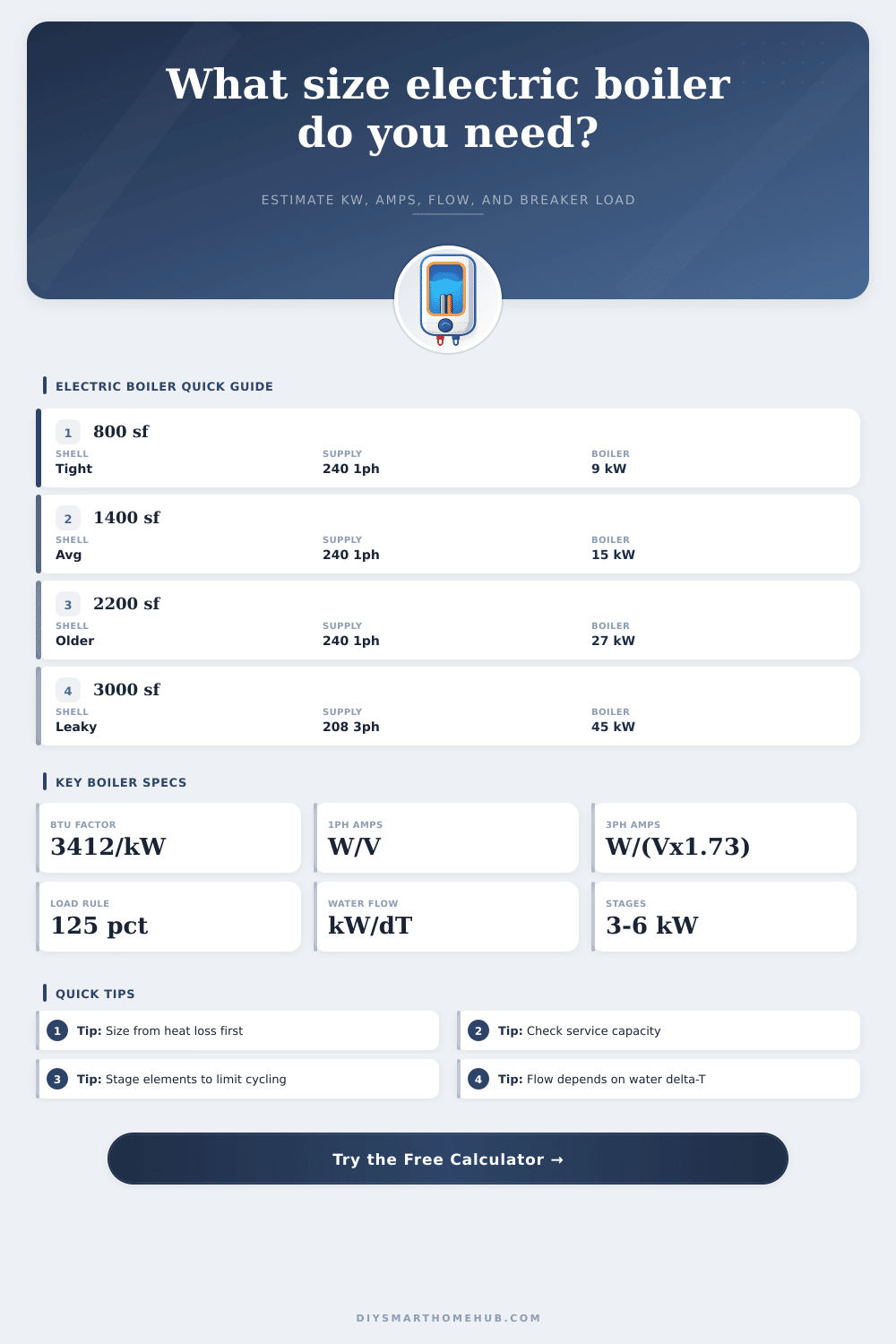
Electric resistance heat converts kW to delivered heat at about 3,412 BTU/hr per kW.
Boiler element load is treated as a continuous heating load for breaker planning.
Hydronic flow in GPM equals BTU/hr divided by 500 times water delta-T in F.
Three-phase current is watts divided by line voltage times the square-root-of-three factor.
🔧Electric Boiler And Spec Comparison Grid
6 to 9 kW compact boiler
- Common useSmall zone
- 240 V 1ph amps25-38 A
- Typical stages2 or 3
- Flow at 20 F2.0-3.1 GPM
12 to 18 kW residential boiler
- Common useCondo or ranch
- 240 V 1ph amps50-75 A
- Typical stages3 or 4
- Flow at 20 F4.1-6.1 GPM
24 to 30 kW high-output boiler
- Common useCold home
- 240 V 1ph amps100-125 A
- Typical stages5 or 6
- Flow at 20 F8.2-10.2 GPM
36 to 54 kW commercial boiler
- Common useShop or large
- 480 V 3ph amps43-65 A
- Typical stages6 to 9
- Flow at 20 F12-18 GPM
📘Reference Tables
These tables show the heat-loss, electrical, hydronic, and operating-cost references used by the calculator.
| Heat-loss profile | BTU/hr per sq ft at 70 F | W per m2 at 39 C | Typical building condition |
|---|---|---|---|
| Super insulated | 12 | 38 | Very airtight shell, high insulation, low infiltration |
| Modern tight | 18 | 57 | Recent construction with good windows and envelope sealing |
| Average insulated | 28 | 88 | Common retrofit with mixed wall insulation and normal leakage |
| Older mixed insulation | 40 | 126 | Older windows, partial insulation, and higher air leakage |
| Leaky high-loss shell | 55 | 174 | High heat loss where room-by-room load is important |
| Garage or shop slab | 35 | 110 | Large slab zone, overhead doors, and intermittent ventilation |
| Voltage and phase | Current formula | 12 kW load | 24 kW load |
|---|---|---|---|
| 120 V single phase | W / 120 | 100.0 A | 200.0 A |
| 208 V single phase | W / 208 | 57.7 A | 115.4 A |
| 240 V single phase | W / 240 | 50.0 A | 100.0 A |
| 208 V three phase | W / (208 x 1.732) | 33.3 A | 66.6 A |
| 480 V three phase | W / (480 x 1.732) | 14.4 A | 28.9 A |
| Hydronic delta-T | Flow formula | 15 kW boiler | 30 kW boiler |
|---|---|---|---|
| 10 F / 5.6 C | BTU/hr / 5,000 | 10.2 GPM / 38.8 L/min | 20.5 GPM / 77.5 L/min |
| 15 F / 8.3 C | BTU/hr / 7,500 | 6.8 GPM / 25.8 L/min | 13.6 GPM / 51.7 L/min |
| 20 F / 11.1 C | BTU/hr / 10,000 | 5.1 GPM / 19.4 L/min | 10.2 GPM / 38.8 L/min |
| 25 F / 13.9 C | BTU/hr / 12,500 | 4.1 GPM / 15.5 L/min | 8.2 GPM / 31.0 L/min |
| 30 F / 16.7 C | BTU/hr / 15,000 | 3.4 GPM / 12.9 L/min | 6.8 GPM / 25.8 L/min |
| Sizing step | Formula | Example | Result |
|---|---|---|---|
| Heat loss | Area x profile x split / 70 | 1,650 x 28 x 65 / 70 | 42,900 BTU/hr |
| Boiler kW | BTU/hr / 3412.142 | 48,000 / 3412.142 | 14.1 kW |
| Single-phase amps | kW x 1000 / V | 15,000 / 240 | 62.5 A |
| Three-phase amps | kW x 1000 / (V x 1.732) | 30,000 / 360.3 | 83.3 A |
| Operating cost | kW x hours x load x rate | 15 x 10 x .55 x $.18 | $14.85/day |
📝Common Electric Boiler Size Reference
| Project size | Common output class | Electrical planning cue | Hydronic cue |
|---|---|---|---|
| Small radiant zone or studio | 4 to 9 kW | Often single-phase branch circuit range | Low flow, staging prevents short cycling |
| Condo or small house | 9 to 15 kW | Verify panel load with other electric appliances | Common for radiant floor or panel radiator loops |
| Average hydronic residence | 15 to 24 kW | Feeder demand becomes a major sizing check | Needs pump and pipe sizing matched to delta-T |
| Cold-climate or older home | 24 to 36 kW | May need multiple heater circuits or service review | Use detailed heat loss before final selection |
| Shop, slab, or large retrofit | 36 to 54 kW | Three-phase supply is often preferred | Large flow and staged control are critical |
💡Electric Boiler Sizing Tips
An electric boiler is almost 100% efficient at the element, so the right output begins with the building heat loss. The electrical side then decides whether the service, feeder, conductors, and breaker strategy can support the selected staged kW.
Radiant floors often run a narrow water temperature drop, while baseboard or panel radiators may tolerate a wider delta-T. That choice changes circulator flow, pipe velocity, and how smoothly staged elements operate.
Electric boilers is used in homes to provide hydronic heat without the use of combustion. However, the electric boiler must be effectively in meeting the heat demand of the home. If the electric boiler are too large, there will be waste in the cost of the electric boiler; if the electric boiler is too small, it wont be able to supply sufficient heat to the home during cold day, and some areas of the home will be much colder then others.
Thus, understanding the heat demand of the building is a must before the electrical planning begin. Heat loss calculations starts with the building envelope. In a new home with good insulation, heat loss is only around twelve BTU per square foot.
How to Size an Electric Boiler
In an older home with poor insulation, heat loss from the same square footage of area may be much higher. The calculator allow someone to choose a building envelope profile so that they dont have to manually calculate the heat loss for each room in the house. The calculator will automatically perform the calculations to find the BTU load of the house and then convert that BTU load to the number of kilowatts that will be required to heat the house.
The relationship between BTU and kilowatts for electric resistance heating element is 3412 BTU per kilowatt. The electrical supply of the house will determine how the electric boiler will be connected. Most homes has a single phase 240-volt supply.
Three-phase power is required if the electric boiler will produce more than thirty kilowatts of heat. According to the continuous load rule, the electric boiler will require 25% more amperage than the amperage that it will run at. Thus, the amperage that is calculated for the electric boiler will always be higher than the amperage that is calculated with the formula of wattage divided by voltage.
The calculator makes this calculation so that one knows the amperage requirements of the electric boiler before the electrical panel of the house is reached. Another consideration is the flow of the water through the system. A typical temperature drop of the water as it exit the emitters is around twenty degrees for baseboard heat emitters.
Radiant heating slabs may have a smaller temperature drop. The formula can find the flow of the water through the BTU that is delivered to the area divided by 500 times the temperature drop of the water. This number will be the amount of gallon of water per minute that will pass through the circulator pump.
If the system has undersized piping or a circulator pump, the electric boiler will short cycle its heating elements. The cost of operation can be calculated from the staged output of the electric boiler. Multiply the number of hours that the electric boiler will be running per day by its load factor.
For example, during the mild seasons, the electric boiler might need to cycle on for six hours per day at thirty-five percent of its maximum capacity. In contrast, on a cold winter day, the electric boiler may need to cycle on for up to twenty hours at ninety percent capacity. Multiply each of these number by the cost of electricity in the area to find the cost of operating the electric boiler each day.
Calculating the cost of operation allows one to compare the cost of electric heat to other fuel. The tables in the calculator provide information that can help the electric boiler designer make sanity check on the design of the electric boiler. For example, the voltage and phase table will allow someone to calculate the amperage draw of the electric boiler at different voltages.
Another table help to determine the flow of the heating fluid if the delta-T of the fluid change. These tables are not rules that an electric boiler designer should memorize, but they can be used as a tool to ensure that the electric boiler is properly sized. Some of the most common mistake with electric boilers are the result of an individual choosing to skip one of these steps.
For example, some individuals will purchase an electric boiler based off only the square footage of the home. However, the electrical panel may not be able to handle the amperage draw of the electric boiler. Other individuals may correctly size the heating elements of the electric boiler, but they may not account for the delta-T of the water that is distributed in the home.
The calculations in this calculator take into account each of these factor to allow one to test each against the others before purchasing. An electric boiler will be only as effective as the information that you use in the sizing of the electric boiler. Use the actual profile of the building envelope to determine the heat loss of the home.
Use the actual voltage that will be supplied to the electric boiler. Calculate the drop in temperature of the water that is distributed in the home. Adjust the size of each bank of heating elements and the size of the circuit breaker to ensure that all component are compatible.
The building will require heat when the outside temperature drop. Thus, the electric boiler will have to be able to supply that heat to the building through proper sizing of its component.