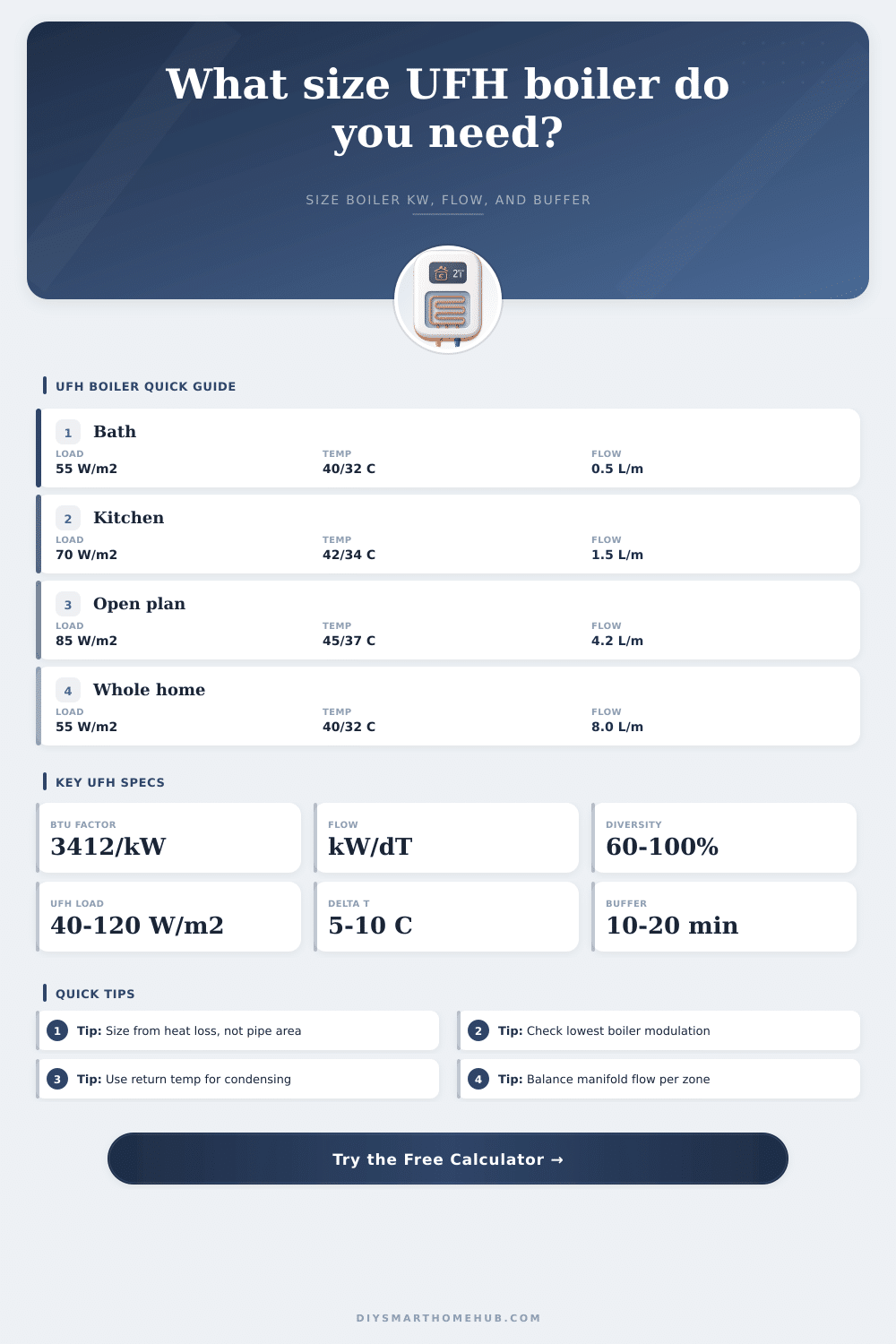
Underfloor Heating Boiler Size Calculator
Estimate hydronic UFH boiler output from heated area, W/m² load, zone diversity, supply and return temperature, manifold flow, minimum modulation, and buffer volume.
🏠UFH Boiler Presets
Choose a hydronic underfloor heating scenario, then adjust the active floor area, heat-load profile, zoning, water temperature, boiler type, and buffer target.
📏UFH Boiler Sizing Inputs
⚙UFH Boiler And Manifold Spec Cards
📊Boiler And Manifold Spec Comparison Grid
Condensing boiler with blending manifold
- Typical UFH temp35-45 C
- Best matchLow return
- Watch pointMin kW
- Control fitWeather comp
Combi boiler with UFH manifold
- Typical UFH temp40-50 C
- Best matchMedium load
- Watch pointHigh min kW
- Control fitZone relay
System boiler with buffer vessel
- Typical UFH temp35-45 C
- Best matchMany zones
- Watch pointVessel size
- Control fitPrimary pump
Mixed radiator and UFH manifold
- Typical UFH temp45-55 C
- Best matchRetrofit
- Watch pointMix valve
- Control fitPriority zones
📘Reference Tables
Use these tables as transparent sizing references for UFH heat density, water temperature, boiler modulation, buffer volume, and manifold flow.
| UFH heat-load profile | Design load | BTU/hr per sq ft | Typical room condition |
|---|---|---|---|
| Very low loss | 40 W/m² | 12.7 | Highly insulated interior rooms or new low-load envelope |
| Modern low loss | 55 W/m² | 17.4 | Recent construction with good glazing and low air leakage |
| Average insulated room | 70 W/m² | 22.2 | Common insulated retrofit with normal exterior exposure |
| High loss perimeter room | 90 W/m² | 28.5 | More exterior wall, cold slab edge, or high ventilation load |
| Glazed or slab-edge room | 115 W/m² | 36.5 | Sunrooms and exposed slabs need detailed heat-loss checking |
| Water profile | Supply / return | Delta-T | Best use |
|---|---|---|---|
| Ultra-low UFH | 35/30 C | 5 C | Dense pipe spacing, low floor covering resistance, very low heat loss |
| Standard UFH | 40/32 C | 8 C | Common screed or plate systems with condensing boiler operation |
| Screed slab UFH | 45/37 C | 8 C | Higher load slab zones and colder perimeter rooms |
| Retrofit plate UFH | 50/40 C | 10 C | Low-profile plates, timber floors, and mixed retrofit systems |
| Mixed manifold | 55/45 C | 10 C | Radiator boiler circuits blended down for UFH manifold supply |
| Boiler profile | Minimum output | Turn-down screen | UFH sizing note |
|---|---|---|---|
| Micro modulating boiler | 1.9 kW | Excellent | Often stable on small UFH zones without much buffer volume |
| Compact modulating boiler | 3.2 kW | Good | Works well with several zones calling or moderate buffer volume |
| Wall combi boiler | 5.0 kW | Moderate | Domestic hot water capacity may exceed UFH space-heating load |
| System boiler | 6.5 kW | Buffer likely | Check smallest zone and add hydraulic separation when needed |
| Older non-condensing boiler | 9.0 kW | High risk | Small UFH loads can short cycle without a buffer or mixed emitters |
| Heat-only boiler | 11.0 kW | High risk | Usually needs enough active load, buffer volume, or radiator demand |
| Project size | Active UFH area | Typical load | Likely manifold flow at 8 C |
|---|---|---|---|
| Small bathroom zone | 5-8 m² | 0.3-0.7 kW | 0.5-1.3 L/min, often below boiler minimum |
| Kitchen extension | 18-28 m² | 1.2-2.5 kW | 2.2-4.5 L/min depending on heat loss |
| Open-plan slab | 40-65 m² | 3.0-5.5 kW | 5.4-9.9 L/min for one large manifold group |
| Apartment UFH | 55-85 m² | 3.0-6.0 kW | 5.4-10.8 L/min with strong diversity check |
| Whole-house UFH | 100-180 m² | 6.0-12.0 kW | 10.8-21.5 L/min across several circuits |
💡UFH Boiler Sizing Tips
A boiler can be correctly sized for the total UFH load and still short cycle when one bathroom, kitchen, or sunroom zone calls by itself. Compare the boiler minimum modulation against the smallest zone load before choosing a buffer vessel.
Underfloor heating is a good match for condensing boilers because it can run with low return temperatures. Oversized boilers, high blending temperatures, and poor flow balancing can reduce that advantage.
Selecting a boiler for an underfloor heating system involve more than choosing one that is large enough to supply heat to the areas that is to be covered by the floor heating system. The underfloor heating system is based upon the zone that are open and the length of time that each of the heating circuit is turned on. While the length of the underfloor heating system pipes or the number of square meter of floor area may determine the size of the boiler, using only the size of the floor area to determine the size of the boiler can lead to short cycling of the boiler.
Short cycling can occur if, for instance, the boiler must supply heat to a small zone like a bathroom for extend periods of time in order to heat that area to the desired temperature. The heat load that each square meter of an area requires change based off a variety of factors, such as the insulation of the area, the glazing of the windows of the area, and whether the area is against an outside wall. For instance, the area that may have a heat load of forty watts per square meter may have a sunroom with large window that require more than one hundred watts per square meter of heat to allow for adequate heating of that space.
How to Choose a Boiler for Underfloor Heating
Each of these zone will require the boiler to deliver a specific temperature to each of the heating circuits. The use of a calculator to determine the amount of heat that each area requires will ensure that the sizing of the boiler isnt based upon guesswork. Another factor that people often dont consider when selecting a boiler is the concept of zone diversity.
Even if a person calculates the total heat load for all of the zones in a home correctly, a boiler only need to provide heat to the zones that are open at any given time. For instance, a home that has a six-zone manifold system with seventy percent diversity will have the boiler running at full capacity for a small period of time each day. The remainder of the time the smallest zone may be the only zone that is open.
The capability of a boiler to provide heat to the smallest zone is important, since if the boiler continues to provide heat to the remaining zones the boiler may begin to cycle on and off or the return temperature of the system may rise. A rising return temperature will cause the boiler to lose it’s condensing advantage. The temperature drop that the system provides determines the flow rate of the fluid within the system.
A small temperature drop, such as eight degree, may provide even temperatures throughout the system, but it will require the system to move more water through the system. A larger drop in temperature will reduce the amount of work that the circulator pump for the system must perform, but the temperature at the far end of a long circuit will be more cool than that at the heating manifolds. The use of a calculator for heating systems allow the designer to determine if the existing pump is capable of moving the amount of water that is required to supply heat to each zone, or if a buffer tank is required to avoid short cycling of the boiler.
A buffer tank will not be a solution for all situation. A buffer tank will help a boiler that has an output that is higher than the heating need of the smallest zone of a building or house. The buffer tank will prevent the boiler from fire for only a few minutes at a time.
The desired run time for a boiler should of been between ten and twenty minutes. A boiler that runs for ten to twenty minutes will maintain a low return temperature, which will allow the boiler to remain in its condensing mode. The size of a buffer tank should not be too large, however.
The large buffer tank will add to the standing heat loss of the system, and will also increase the cost of the system. The smallest buffer tank that ensures that the boiler does not short cycle