Whole House Boiler Size Calculator
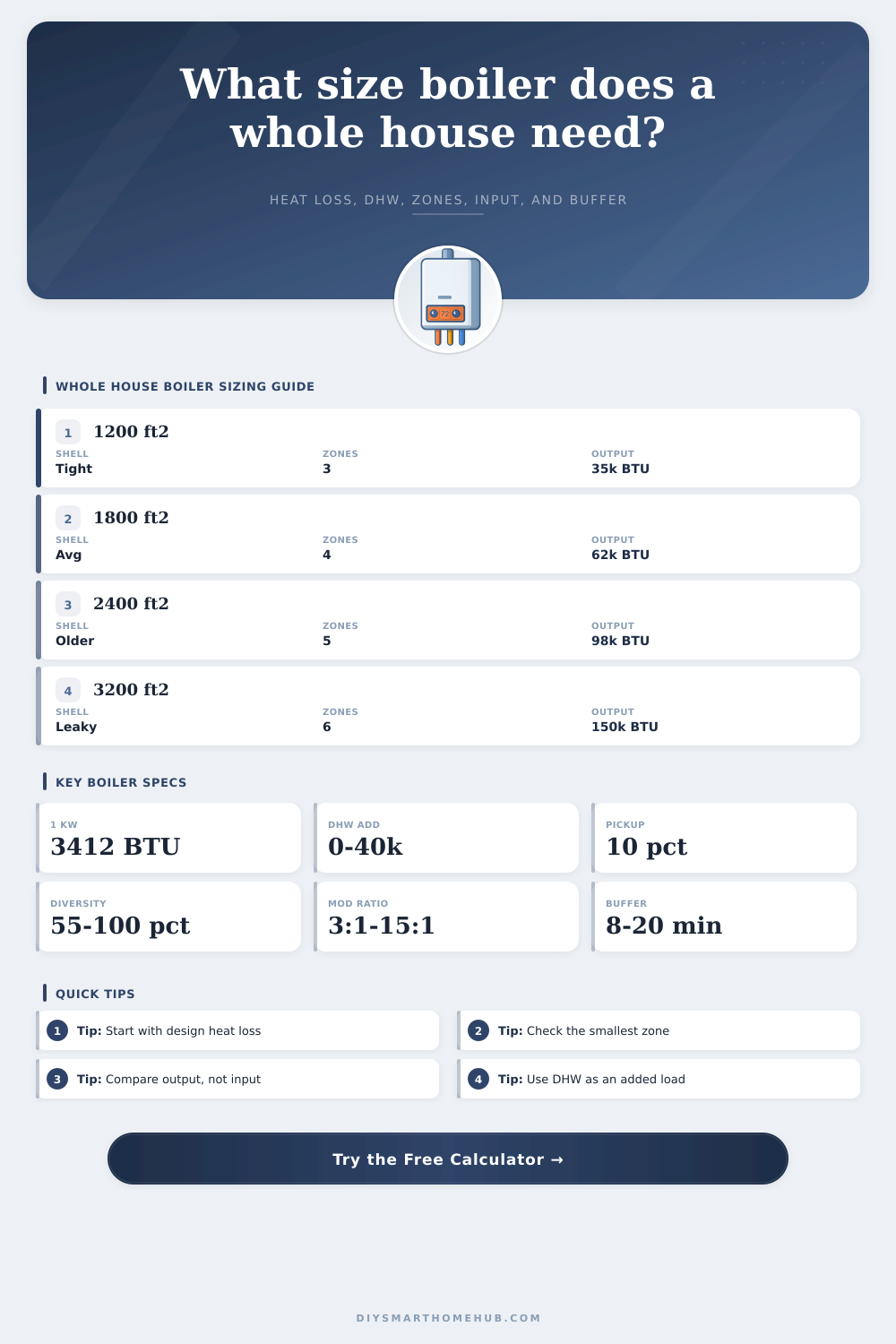
Estimate a whole-home hydronic boiler from design heat loss, zone diversity, domestic hot-water allowance, boiler efficiency, input BTU, modulation ratio, and buffer/check sizing.
🏠Whole-House Boiler Presets
Load a realistic starting point, then tune the area, design temperature split, envelope condition, zoning, DHW allowance, boiler profile, and desired run-time buffer.
📏Whole-House Boiler Inputs
⚙Boiler Formula Spec Grid
Heat loss is floor area multiplied by the selected BTU/hr per square foot profile, corrected for design temperature split.
Diversity reduces design heating load when zoning makes full simultaneous demand unlikely.
Boiler output in kW equals BTU/hr divided by 3412.142.
Domestic hot-water recovery is commonly estimated as 500 x GPM x temperature rise.
📊Boiler Spec Grid
Cast iron atmospheric boiler
- Typical efficiency80-84%
- ModulationLow / staged
- Best fitSteady load
- CheckOversizing
Condensing modulating boiler
- Typical efficiency90-96%
- Modulation5:1 to 15:1
- Best fitZoned systems
- CheckReturn temp
Oil hydronic boiler
- Typical efficiency84-88%
- ModulationLimited
- Best fitHigh loads
- CheckLow cycling
Boiler with indirect DHW tank
- DHW methodPriority or add
- Typical add15k-45k
- Best fitWhole house
- CheckRecovery
📘Reference Tables
The calculator uses these tables for transparent assumptions about envelope heat loss, zone diversity, DHW allowance, boiler profiles, and buffer sizing.
| Envelope profile | BTU/hr per sq ft at 70 F split | W per m² at 39 C split | Typical condition |
|---|---|---|---|
| Super insulated shell | 10 | 32 | Very airtight home with high insulation and high-performance windows |
| Modern tight home | 15 | 47 | Recent construction, good air sealing, low infiltration |
| Good retrofit | 22 | 69 | Updated attic insulation, better windows, some wall insulation |
| Average mixed-age home | 30 | 95 | Common older home with partial improvements and normal leakage |
| Older leaky home | 42 | 133 | Noticeable drafts, older windows, mixed insulation levels |
| Poor underinsulated shell | 55 | 174 | High loss building where room-by-room design is especially important |
| Zone arrangement | Diversity range | Smallest-zone estimate | Boiler sizing note |
|---|---|---|---|
| Single zone whole house | 100% | 100% of heating load | Boiler low fire is usually less critical than total oversizing |
| Two large zones | 85-100% | 40-60% of heating load | Check cycling during shoulder-season calls |
| Three to four zones | 75-95% | 20-35% of heating load | Modulation depth or thermal mass starts to matter |
| Five to six zones | 65-90% | 12-25% of heating load | Buffer or hydraulic separation may be useful |
| Many small zones | 55-85% | 6-15% of heating load | Choose low minimum output and verify control strategy |
| DHW profile | Allowance method | Typical added output | When to use it |
|---|---|---|---|
| No DHW added | Space heat only | 0 BTU/hr | Separate water heater or boiler does not serve DHW |
| Small indirect tank | Heat plus light recovery | 15,000 BTU/hr | Small tank, low simultaneous hot-water demand |
| Standard indirect tank | Heat plus normal recovery | 30,000 BTU/hr | Common whole-house boiler with indirect tank |
| Large recovery demand | Heat plus fast DHW | 45,000 BTU/hr | Large tub, high recovery target, or multiple fixtures |
| DHW priority | Compare, do not add | Use larger load | Heating zones pause while the indirect tank recovers |
| Sizing step | Formula | Example | Result meaning |
|---|---|---|---|
| Design heat loss | Area x BTU/sq ft x split / 70 | 1,600 x 30 x 65 / 70 | Whole-home heating load before margin |
| Zone-diverse load | Heat loss x diversity | 44,571 x 90% | Expected simultaneous heating demand |
| Boiler output | Zone load + pickup + DHW | 40,114 + 10% + 30,000 | Delivered output target |
| Boiler input | Output / efficiency | 74,126 / 0.95 | Fuel input BTU/hr rating estimate |
| Minimum fire | Selected output / modulation ratio | 80,000 / 10 | Lowest boiler output for cycling check |
| Buffer volume | Excess BTU/hr x min / (500 x F) | 8,000 x 12 / (500 x 20) | Gallons needed for run-time target |
💡Whole-House Boiler Sizing Tips
The house load is delivered heat. Boiler labels may show input, so the calculator first estimates required output, then divides by efficiency to estimate input rating.
A boiler can cover the whole house and still cycle when one small zone calls. Compare minimum firing rate to the smallest zone load before deciding whether a buffer tank is needed.
Selecting a boiler require an understanding of the heat requirements of the house. Additionally, to select the proper boiler for a house, you should also understand how a boiler operate. If a boiler is too small for the house, the house will not be able to reach the desired temperature within the house during the winter month.
Additionally, if a boiler is too large for the house, the boiler will turn on for a short period of time before it will turn off for a short period of time. This process are referred to as short cycling, and it can lead to both the boiler wearing out it’s component more quickly as well as wasting fuel. Thus, it is necessary to determine the heating needs of the house.
How to Choose the Right Boiler Size for Your Home
One of the main measurement of a house that is used to determine the size of the boiler that should be present in the residence is its design heat loss. Design heat loss consider the floor area of the house, the insulation of the walls and windows of the house, and the difference between the indoor and outdoor temperatures. For example, a new house that is well insulated will lose less heat than an older house that isnt as well insulated, even if the areas of the houses are the same.
Thus, it is necessary to determine the insulation profile of the walls and attic of the house. Another consideration for the heating system is the concept of zoning. Many houses have heating zone that are established in a way that each of the rooms in the house does not have to be heated at the same time.
For instance, a house that include many heating zones will require the boiler to supply heat to each of those zone, but it does not necessarily have to supply heat to each of those zones at the same time. Thus, if the house have many small heating zones, the boiler will need to be able to provide heat to those zones at low output levels. If the boiler cannot provide heat at low output levels, the boiler will short cycle if it is attempting to supply heat to any small heating zone.
Another consideration for boilers is the provision of domestic hot water for the residence. One way that an indirect tank can supply domestic hot water to a house is through the use of an indirect tank that utilizes the boiler to heat the water that is used for showers and washing dish in the kitchen. In some heating system, the domestic hot water needs are added to the heating needs of the house.
In other systems, priority controls allow for the heating zones to be pause while the domestic hot water tank is being heated. Each of these systems impact the required output of the boiler. Two methods of preventing short cycling of the boiler include the consideration of the modulation range of the boiler and the size of any buffer tank that is use within the system.
Buffers can be used if the boiler does not have a wide modulation range or the ability to adjust the output of the boiler to supply heat to small zone at low output rate. A buffer tank allows the boiler to run for longer periods of time during each cycle of firing. Each of these component should of been considered when purchasing the boiler for the house.
In addition to the factor that are considered within the calculation tool for determining the size of the boiler, there are other variable in the house that may impact how heat move within the structure. For instance, the type of furnitures and rugs that is present in each room can impact how heat moves within those rooms. Additionally, the way that the resident of the house use each of those room may impact the way in which heat move within the house.
Some of the rooms may become warmer than others, and the heating system may not be balance in each of the zones of the house. Thus, another way to determine if the sizing of the boiler is appropriate is to perform a room by room report of the heat loss for each of the room in the house. The goal in selecting a boiler is to ensure that the boiler will meet the heat loss requirements of the house while avoiding short cycling of the boiler.
Additionally, the boiler should be able to supply enough heat to the domestic hot water tank as well as provide enough headroom for the winter months when outdoor temperature may drop significantly. If the size of the boiler match the heat loss of the house, the boiler will remain on continuously during the winter months and will meet the heating needs of the house.