Oil Furnace Size Calculator
Estimate oil furnace output from design heat loss, then compare AFUE input BTU, corrected nozzle GPH, pump pressure, annual heating-oil gallons, and selected-size oversizing margin.
🏠Oil Furnace Presets
Choose a starting profile, then tune the house area, design temperature, envelope leakage, AFUE, fuel oil type, nozzle rating, pump pressure, and selected furnace input.
📏House And Oil Burner Inputs
🧮Oil Furnace Reference Specs
Common planning heat content for No. 2 residential heating oil.
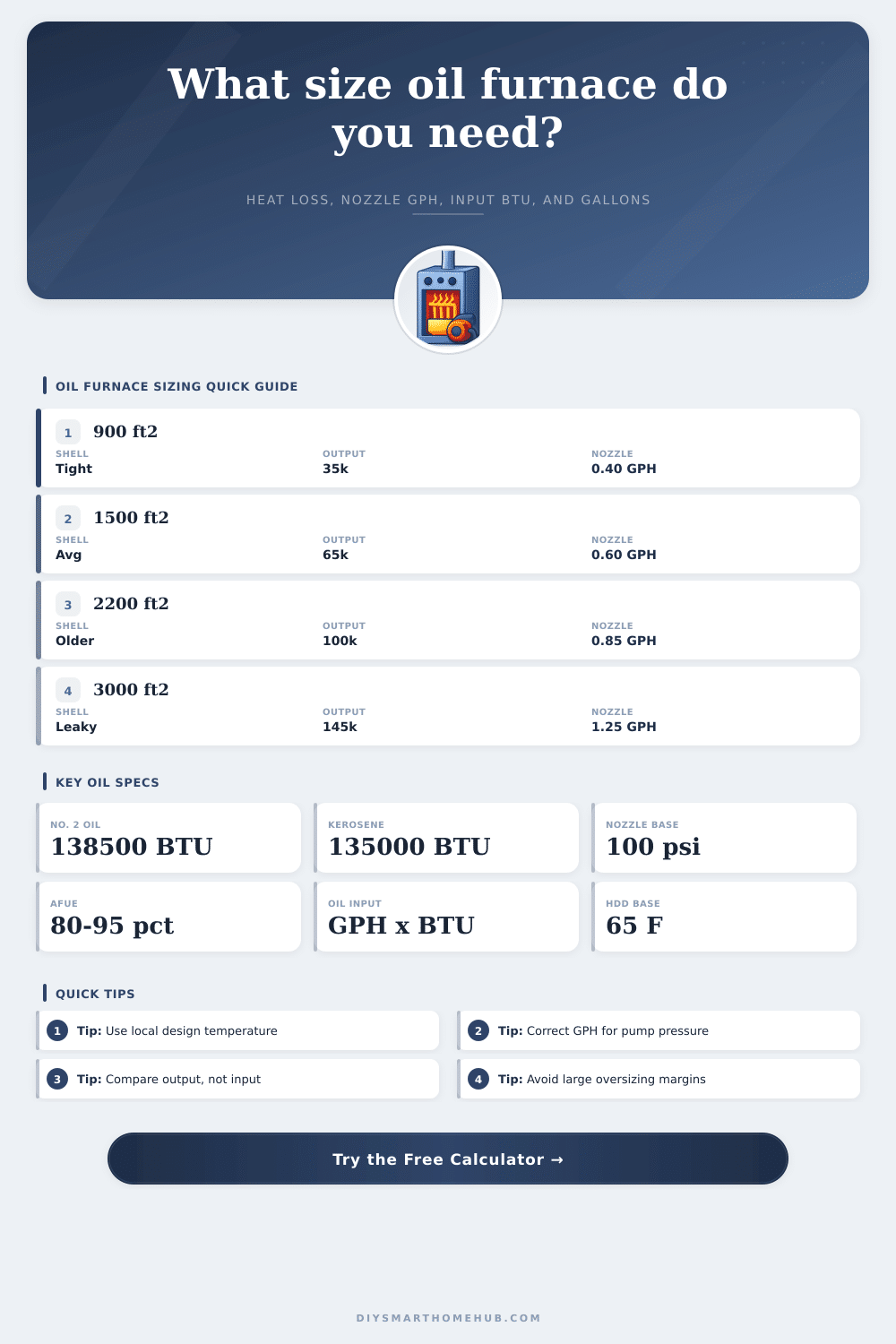
Domestic oil burner nozzles are typically flow-rated at 100 psi.
Flow changes approximately with the square root of pressure ratio.
Useful output headroom without a large short-cycling penalty.
📊Reference Tables
| Envelope profile | Shell factor at 70 F delta | Leakage ACH | Typical use |
|---|---|---|---|
| Excellent modern shell | 10 BTU/hr per sq ft | 0.20 ACH | New tight construction or deep retrofit |
| Good upgraded shell | 14 BTU/hr per sq ft | 0.35 ACH | Air sealed with improved insulation |
| Average mixed-age shell | 19 BTU/hr per sq ft | 0.55 ACH | Typical home with mixed upgrades |
| Older leaky shell | 25 BTU/hr per sq ft | 0.85 ACH | Older home with drafts and partial insulation |
| Leaky underinsulated shell | 32 BTU/hr per sq ft | 1.20 ACH | Drafty or poorly insulated envelope |
| Fuel selection | Planning BTU per gallon | 1.00 GPH input | Output at 85% AFUE |
|---|---|---|---|
| Kerosene / No. 1 fuel oil | 135,000 BTU/gal | 135,000 BTU/hr | 114,750 BTU/hr |
| No. 2 residential heating oil | 138,500 BTU/gal | 138,500 BTU/hr | 117,725 BTU/hr |
| B20 heating-oil blend | 136,700 BTU/gal | 136,700 BTU/hr | 116,195 BTU/hr |
| No. 4 fuel oil | 145,000 BTU/gal | 145,000 BTU/hr | 123,250 BTU/hr |
| Nozzle marked GPH | Actual GPH at 100 psi | Actual GPH at 140 psi | No. 2 oil input at 140 psi |
|---|---|---|---|
| 0.40 GPH | 0.40 GPH | 0.47 GPH | 65,552 BTU/hr |
| 0.50 GPH | 0.50 GPH | 0.59 GPH | 81,940 BTU/hr |
| 0.65 GPH | 0.65 GPH | 0.77 GPH | 106,522 BTU/hr |
| 0.75 GPH | 0.75 GPH | 0.89 GPH | 122,910 BTU/hr |
| 0.85 GPH | 0.85 GPH | 1.01 GPH | 139,298 BTU/hr |
| 1.00 GPH | 1.00 GPH | 1.18 GPH | 163,880 BTU/hr |
| 1.25 GPH | 1.25 GPH | 1.48 GPH | 204,850 BTU/hr |
| Nominal input | Output at 80% AFUE | Output at 86% AFUE | Best-fit heat loss range |
|---|---|---|---|
| 56,000 BTU/hr | 44,800 BTU/hr | 48,160 BTU/hr | 35,000 to 45,000 BTU/hr |
| 70,000 BTU/hr | 56,000 BTU/hr | 60,200 BTU/hr | 46,000 to 56,000 BTU/hr |
| 84,000 BTU/hr | 67,200 BTU/hr | 72,240 BTU/hr | 57,000 to 68,000 BTU/hr |
| 105,000 BTU/hr | 84,000 BTU/hr | 90,300 BTU/hr | 69,000 to 86,000 BTU/hr |
| 140,000 BTU/hr | 112,000 BTU/hr | 120,400 BTU/hr | 92,000 to 115,000 BTU/hr |
| 168,000 BTU/hr | 134,400 BTU/hr | 144,480 BTU/hr | 116,000 to 138,000 BTU/hr |
💡Oil Furnace Sizing Tips
Oil furnace labels often emphasize input BTU/hr. The heat-loss target is delivered output, so the calculator divides by AFUE for required input and then compares selected output.
A 0.65 GPH nozzle does not always fire at 0.65 GPH. If the pump is set above 100 psi, actual flow rises by the square root of the pressure ratio.
When choosing the size of an oil furnace for a home, there are many different factors that should be consider. The size of the oil furnace that is selected for a home will determine how effective that oil furnace can heat the home. If the oil furnace that is selected is too small for the home, the oil furnace will not be able to heat the home to maintain a comfortable temperature within the home during the winter month.
Alternatively, if the oil furnace is too large for the home, the oil furnace will cycle on and off too frequent for that home, leading to the waste of the fuel that is used to operate the oil furnace, as well as the rapid wearing down of the oil furnaces components. The size of the oil furnace that is required for a home should be based off the heat loss of the home, not the capacity of the oil furnace that was present in that same home in the past. A variety of different factor determines the amount of heat that is lost by a home.
Choose the Right Size Oil Furnace
For instance, factors such as the square footage of the home, the height of the ceilings within the home, the amount of insulation within the walls of the home, and the number of drafts within the windows and doors can all influence the amount of heat that is lost by a home. Thus, the size of the home, the type of windows that is present in the home, and the age of those windows will all factor into the determination of the heat loss of the home. Home heating calculators require the user to input the square footage of the home (the floor area) and the profile of the envelope of the home to calculate the heat loss of the home.
In addition to the heat loss of the home, the outdoor design temperature is another factor that should be considered in the calculation of the oil furnace size that is required for that home. The outdoor design temperature of the area where the home is constructed is not the average temperature of winter day outside of the home. Instead, the outdoor design temperature is the temperature of the coldest period within that climate that can be expected during the winter months each year.
If the outdoor design temperature is too mild relative to the climate outside of the home, the oil furnace may not be large enough to heat the home during those cold periods. However, if the outdoor design temperature is too harsh in relation to the climate outside of the home, then the oil furnace will be too large for the home, and the oil furnace will not operate efficienty. Another factor to consider when calculating the size of the oil furnace that should be installed in a home is the heat output of the oil furnace.
Oil furnaces are often labeled with their input BTU. However, the heat output of the oil furnace is not the same than the input BTU of the furnace. You can calculate the output BTU of an oil furnace by multiplying the input BTU of the furnace by the AFUE (Annual Fuel Efficiency) rate of the oil furnace.
For instance, an oil furnace that has an input of 84,000 BTU and an AFUE efficiency of 86% will have an output of approximately 72,000 BTU (84,000 x.86). The output BTU of the oil furnace must be compared to the heat loss of the home. The output BTU is the amount of heat that the oil furnace will deliver to the home.
The nozzle sizing and the pump pressure of the oil furnace are additionally factors that can influence the operation of the oil furnace. The nozzle size and the pump pressure of the oil furnace influence the amount of oil that the burner within the oil furnace uses each hour. If the pressure of the oil furnace is above the rating of the nozzle that is used within the oil furnace, the oil furnace will burn too much oil and may not function efficienty.
Thus, accounting for the pump pressure is one more factor that should be considered to ensure that the oil furnace burns the appropriate amount of oil. The annual fuel use that is required for an oil furnace can be estimated based upon the heat loss of the home. The heating degree days for the region where the home is constructed can be used to determine the seasonal difference in temperature between the inside of the home and outside of the home.
The heating degree days can be multiplied by the heat loss coefficient of the home to determine the fuel input requirement of the oil furnace for the winter months. This number can then be divided by both the AFUE efficiency of the oil furnace and the heat content of the oil fuel to determine the estimated gallons of oil that will be used within the home each year. Thus, the heating calculator can determine the estimate of the annual fuel use for an oil furnace, but such an estimate isnt a guarantee that the oil furnace will use that amount of fuel each year.
One more factor to consider when determining the size of the oil furnace that will be installed in a home is the amount of extra capacity that the oil furnace should have beyond the heat loss of the home. In general, a small amount of extra capacity is beneficial to the oil furnace to ensure it can heat the home during periods of extreme cold. However, providing too much extra capacity to the oil furnace can lead to the furnace having short run times during operation, which can lead to additional losses of heat from the oil furnace with each cycle of the furnaces operation.
The oil furnace calculations will indicate whether the oil furnace will have an output that is much higher than the heat loss requirement of the home; this will allow an individual to decide whether or not the oil furnace should have such extra capacity. An individual should of understand each of these factor prior to installing an oil furnace to ensure that the oil furnace matches the requirements of the home.