Shop Furnace Size Calculator
Estimate the delivered BTU/hr a workshop furnace must provide from shop volume, envelope heat loss, insulation quality, slab loss, infiltration, and overhead-door recovery.
⚙Shop Presets
Choose a workshop profile, then adjust the dimensions, insulation, door use, slab condition, and preferred furnace type.
📏Furnace Sizing Inputs
🔧Shop Heater Spec Comparison Grid
Common shop choice for 30,000 to 400,000 BTU/hr input ranges. Good for fast air recovery when combustion venting is available.
Higher delivered output per input BTU. Works well for tighter shops with ducted air or filtered recirculation.
Nearly all input becomes heat at the furnace. Electrical service capacity often becomes the limiting factor.
Useful in tall bays because radiant energy warms surfaces and people, but output still must cover shell and door losses.
📊Reference Tables
| Insulation package | Wall U-factor | Roof U-factor | Base ACH |
|---|---|---|---|
| Excellent insulated shop | 0.045 BTU/hr sq ft F | 0.026 BTU/hr sq ft F | 0.35 air changes/hr |
| Good insulated shop | 0.060 BTU/hr sq ft F | 0.035 BTU/hr sq ft F | 0.55 air changes/hr |
| Average mixed shell | 0.090 BTU/hr sq ft F | 0.055 BTU/hr sq ft F | 0.85 air changes/hr |
| Poor or thin metal shell | 0.140 BTU/hr sq ft F | 0.090 BTU/hr sq ft F | 1.30 air changes/hr |
| Very leaky shop | 0.180 BTU/hr sq ft F | 0.120 BTU/hr sq ft F | 1.80 air changes/hr |
| Door profile | Area used | Open time | Recovery method |
|---|---|---|---|
| No opening during heat | 0 sq ft | 0 sec/hr | No added door recovery load |
| Light garage use | 56 sq ft | 90 sec/hr | Average open-door CFM x 1.08 x rise |
| Standard two-bay use | 72 sq ft | 240 sec/hr | Higher air exchange from repeated vehicle entry |
| Busy shop door | 144 sq ft | 450 sec/hr | Large open area increases recovery BTU/hr |
| Industrial sectional door | 196 sq ft | 900 sec/hr | Door recovery can exceed envelope load |
| Heater type | Typical efficiency used | Best shop fit | Sizing note |
|---|---|---|---|
| Vented gas unit heater | 80 percent | Garage, mechanic bay, pole barn | Round input up to the next listed furnace size. |
| Condensing gas furnace | 93 percent | Tight shop, ducted workspace | Use delivered output after vent and duct losses. |
| Electric resistance furnace | 98 percent | Small shop with sufficient electrical service | Convert BTU/hr to kW with 3,412 BTU/hr per kW. |
| Gas radiant tube heater | 82 percent | Tall bay or slab-focused comfort | Radiant comfort can feel warmer, but envelope load remains. |
| Oil-fired shop furnace | 83 percent | Cold detached shop or rural service | Allow extra recovery capacity for door openings. |
| Common shop | Dimensions | Typical rise | Delivered output range |
|---|---|---|---|
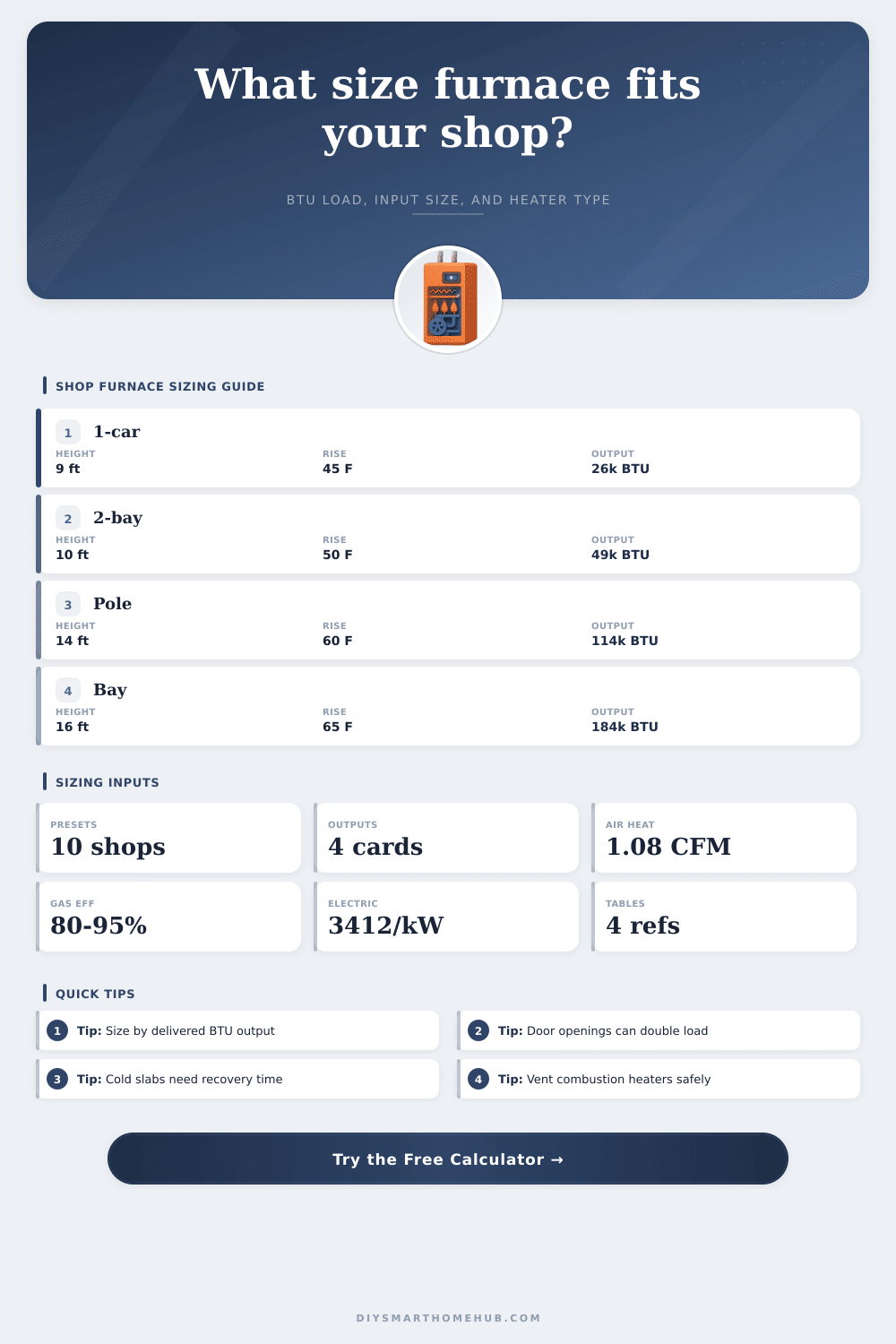
| Single-car hobby shop | 12 x 22 x 9 ft | 40 to 50 F | 20,000 to 35,000 BTU/hr |
| Two-bay garage shop | 24 x 25 x 10 ft | 45 to 55 F | 40,000 to 65,000 BTU/hr |
| Insulated pole barn | 36 x 50 x 14 ft | 50 to 65 F | 90,000 to 150,000 BTU/hr |
| Fabrication bay | 40 x 60 x 16 ft | 55 to 70 F | 140,000 to 230,000 BTU/hr |
| Farm repair shop | 40 x 80 x 16 ft | 55 to 70 F | 180,000 to 320,000 BTU/hr |
ℹShop Furnace Sizing Notes
Shop heat loss is the delivered output requirement. A gas heater input rating must be divided by efficiency before it can be compared with the calculated room load.
A warm, tight shop may need a modest furnace until the overhead door starts cycling. For vehicle work, include the door pattern so recovery capacity is not undersized.
Selecting an furnace for a workshop require understanding the heat requirements of that workshop. If the furnace are too small, the workshop will not be able to maintain the necessary temperature. If the furnace is too large for the workshop, the furnace will cycle on and off too frequent and the air in the workshop will feel dry.
Using too larger of a furnace mean paying for heating capacity that isnt needed for the workshop. Understanding the cause of heat loss allow for the correct sized furnace for a workshop to be selected. The first step in determining the size of the furnace that is needed for a workshop is to determine the volume of the workshop.
How to Choose the Right Furnace for a Workshop
This value will be used to calculate the amount of heat that are required for the workshop. However, the volume of the workshop is not the only factor in heat loss. Heat loss can also occur through the wall, the roof, the doors and the concrete slab that make up the workshop floor.
The quality of the insulation that is used in the walls and the roof of a workshop is a factor in heat loss. High-quality insulation mean that the workshop will lose little heat through the walls and the roof. This will allow for the furnace in the workshop to not have to running as often.
Poor insulation in the walls and the roof, however, will lead to the workshop losing heat at a rapid rate. A workshop with poor insulation will require a larger furnace. This factor has to be consider in the calculator to ensure that the heat loss calculations for the workshop reflect the actual loss of heat from the workshop.
The number of times that the workshop door open is another factor in the loss of heat from a workshop. Each time that a workshop door opens, heat from the workshop will escape. A workshop with doors that remain closed will require a smaller furnace than a workshop whose doors opens more often.
You must enter this factor into the calculator to account for the recovery load of the workshop. The recovery load is the amount of heat that is lost when the door open and it can be as great as the amount of heat that is lost through the walls and the roof of the workshop. The loss of heat through the slab of a workshop is another factor in heat loss.
Heat from the workshop will travel through the concrete slab to the ground outside of the workshop. The more greater the temperature difference between the workshop and the outside ground, the greater the loss of heat from the workshop. Insulating the workshop to include insulation at the edge of the concrete slab will reduce the loss of heat.
If there is no insulation at the edges of the slab, the workshop will continue to lose heat. This factor must be considered in the calculator so that the size of the furnace are sufficient for the workshop to reach the desired temperature in the cold morning. Once heat output is calculate for a workshop, you will have to determine the type of heater that will be use in the workshop.
Gas unit heaters is often used in workshops. Gas unit heaters can heat the workshop quickly and are effective in workshops with high ceilings. Condensing furnace are also an efficient choice of heater for workshops.
Electric units dont require venting but electrical service may be required for the workshop. Radiant tube may be used in a workshop and provide heat direct to the people in the workshop. The type of heater that is selected will be suggested based on the load calculations for the workshop.
However, the availability of fuel and venting option for the workshop will also factor into the choice of heater for the workshop. Many person make mistakes when they size a furnace for a workshop. One of the most common error is to only use one measurement to size the furnace.
People who size the furnace according to the volume of the workshop will find that the furnace is too small if the doors of the workshop are opened. Other people may size a workshop according to the input rating of the heater. However, the input rating of the heater does not necessarily reflect the amount of heat that will be deliver into the workshop.
The delivered output of the heater must be used to determine the amount of heat that the heater will provide. Calculators indicate these value so that people can select the correct heater for their workshop.