Kitchen Exhaust Fan CFM Calculator
Estimate range hood airflow from hood width, cooktop BTU or watts, capture velocity, duct length, elbows, static pressure allowance, and the 400 CFM makeup-air trigger.
🏠Kitchen Hood Presets
Pick a real kitchen range-hood scenario, then adjust the eight sizing inputs. Presets include wall, island, under-cabinet, insert, and pro-style hood cases.
⚙Hood, Heat, Capture, And Duct Inputs
Kitchen exhaust fan CFM results
📊Hood And Fan Spec Summary
Common HVI recommended planning rate for wall-mounted kitchen range hoods.
Open-side capture generally needs more airflow than a back-wall canopy.
Many IRC-based jurisdictions screen range hood systems above this rating.
Residential kitchen ducts are usually quieter when kept out of extreme velocity.
📘Kitchen Hood Reference Tables
| Hood location | Minimum rate by width | Recommended rate by width | Calculator use |
|---|---|---|---|
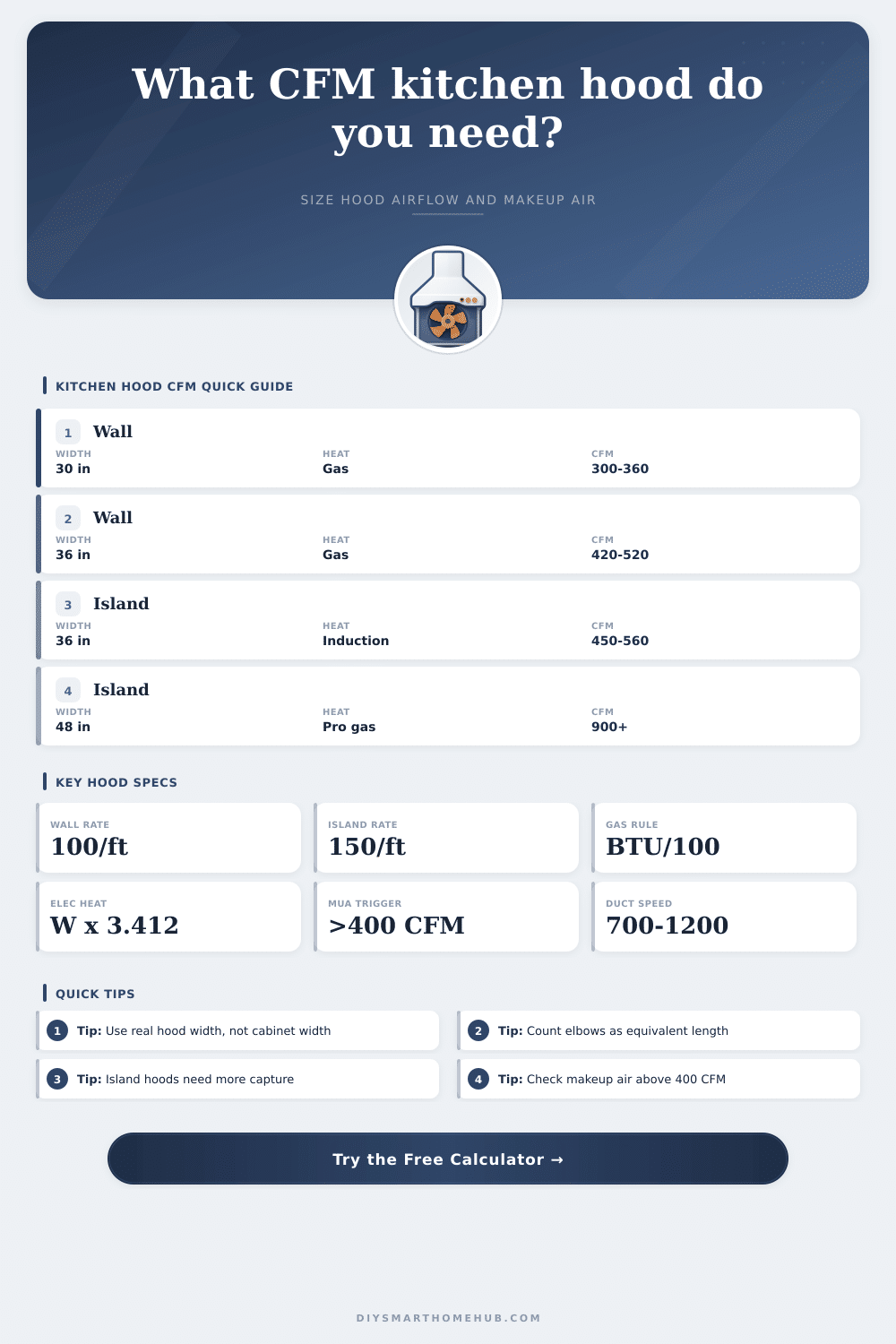
| Against a wall | 40 CFM per linear ft | 100 CFM per linear ft | Width CFM = hood width in ft x 100, then adjusted for undersized capture width. |
| Island or peninsula | 50 CFM per linear ft | 150 CFM per linear ft | Open sides raise capture loss, so island presets use the stronger width rule. |
| Under-cabinet hood | 40 CFM per linear ft | 90 to 100 CFM per linear ft | Cabinet depth helps containment, but short hoods still need enough face capture. |
| Downdraft exhaust | Varies by product | Higher velocity path | The calculator adds a downdraft capture penalty and duct static allowance. |
| Cooktop heat input | Heat cross-check formula | Typical result | Sizing note |
|---|---|---|---|
| Gas range, 35,000 BTU/hr | BTU/hr / 100 | 350 CFM | Often close to a 30 in wall hood recommendation. |
| Gas cooktop, 65,000 BTU/hr | BTU/hr / 100 | 650 CFM | May exceed the 400 CFM makeup-air screen after duct allowance. |
| Electric, 8,000 watts | Watts x 3.412 / 100 | 273 CFM | Width and capture velocity commonly control more than heat input. |
| Induction, 11,000 watts | Watts x 3.412 / 100 | 375 CFM | Island exposure can still push the final recommendation higher. |
| Duct profile | Elbow equivalent | Static allowance | Best fit |
|---|---|---|---|
| Direct 6 in wall cap | 0 ft fittings | 0.04 in. w.c. | Short under-cabinet or wall hood below about 350 CFM. |
| Standard 7 in roof run | 30 ft for two 90s | 0.10 in. w.c. | Common wall hood path with roof cap and moderate turns. |
| Long 8 in route | 45 ft for three 90s | 0.16 in. w.c. | Island or remote exterior wall routes needing extra rating margin. |
| Tight 6 in route | 60 ft for four 90s | 0.24 in. w.c. | Restrictive retrofits where rated CFM may not equal delivered CFM. |
| Capture condition | Velocity screen | Area basis | Calculator effect |
|---|---|---|---|
| Light wall cooking | 50 to 65 fpm | Hood width x shallow capture depth | Usually does not exceed the HVI width rate. |
| Normal wall cooking | 65 to 85 fpm | Hood width x typical canopy depth | Useful cross-check for smoke and steam containment. |
| Island or open side | 85 to 110 fpm | Wider, deeper exposed capture zone | Open-room air currents raise recommended airflow. |
| High heat searing | 100 to 125 fpm | Large canopy face or downdraft slot | May require remote blower, larger duct, and makeup air review. |
🔧Hood And Fan Spec Comparison Grid
| Hood or fan type | Common rated CFM | Duct and static behavior | Best calculator match |
|---|---|---|---|
| Under-cabinet axial or compact blower | 150 to 400 CFM | Short runs only; small wheels lose airflow quickly under static pressure. | Apartment, 24 to 30 in electric, or mild gas cooking below 400 CFM. |
| Wall canopy centrifugal blower | 300 to 700 CFM | Handles normal 6 to 8 in ducts, one or two elbows, and roof caps. | Most 30 to 36 in wall gas ranges and mixed-fuel cooktops. |
| Island hood blower | 500 to 1,000 CFM | Needs more width and airflow because the plume is exposed on all sides. | 36 to 48 in island induction, gas, and high-output cooktops. |
| Remote inline or exterior blower | 700 to 1,500 CFM | Better for long ducts, larger diameters, and noise-sensitive kitchens. | Pro-style ranges, long duct runs, and large custom canopy hoods. |
| Downdraft fan system | 400 to 1,200 CFM | High turns and slot capture often need more static pressure allowance. | Island cooktops where overhead capture is not used. |
💡Kitchen Exhaust Sizing Tips
A hood that is wide enough but connected to a tight 6 in duct with several elbows can miss its delivered airflow. The calculator raises the fan rating when equivalent length and static allowance increase.
The makeup-air result is a code screen, not a complete design. A tight home, fireplace, or atmospherically vented combustion appliance can make pressure balance important even near the threshold.
Range hoods must be able to move a specific amount of air from the kitchen to remove the smoke, steam, and grease from cooking. The amount of air that a range hood can move is measured in units of Cubic Feet per Minute, or CFM. The CFM of a range hood is the measurement of how many cubic feet of air that the range hood can pull through the hood every minute.
It is important to ensure that the range hood that is selected for the kitchen has the appropriate CFM because using a range hood with too little CFM will not effectively remove the smoke and grease from the kitchen, while using a range hood with too much CFM may lead to problems in the home due to the excess noise that it creates. When selecting a range hood, there is a few factor to consider. One of the main factor is the heat output of the cooktop that you will install in the range hood.
How to choose the right range hood CFM
Gas cooktops will create more heat and more smoke then induction cooktops, so more CFM is required from a range hood with a gas cooktop than with an induction cooktop. Additionally, the range hood should be wide enough to cover the cooking area of the cooktop. As the hot air rise from the cooktop, it will spread outward from the cooktop.
If the range hood is too narrow for the cooktop, the hot air will go past the range hood and enter the kitchen instead. Another factor that can impact the CFM of the range hood are the ductwork and the resistance of that ductwork. Any elbow in the ductwork will create resistance for the range hoods fan to move the air through the ductwork.
Additionally, any length of the ductwork will create resistance for the fan of the range hood. For instance, if the range hood is connected to a long duct full of elbows, the range hood will have to work harder to move the air than if it was connected to a short straight duct. Thus, two kitchen may require different CFM ratings for the same range hood if the ductwork in each range hood creates different amount of resistance for the fan to move the air.
Another consideration for CFM is the makeup air that must be provided for the home. Building code require makeup air in homes with high-capacity appliances like range hoods because if the range hood continuously pulls the air out of the home, the home may become negatively pressurized. If the home is negatively pressurized, the range hood may pull air down the chimney or impact other appliance in the home.
Thus, it is important to make sure that the home has a way to provide makeup air for the kitchen when the range hood is operating at high CFM rating. Range hoods are also rated according to the velocity at which the hood pull the air from the cooking area towards the hood. This velocity is measured in feet per minute.
The mounting style of the range hood can impact the requirement for the velocity of the range hood. For instance, if the range hood is mounted on the wall, there will be a wall behind the hood that will help to contain the air that the range hood pulls. Range hoods that is installed on kitchen islands, however, are located in an open area.
Thus, the rising hot air will drift away from the range hood more easy than if it were behind a wall. Therefore, island range hoods will have to move more air to maintain an appropriate capture velocity so that smoke and grease will be removed from the island. Finally, people can make a few mistake when selecting a range hood.
For instance, many people will purchase a range hood with a very high CFM rating because they think that high CFM ratings are always better. In reality, range hoods with high CFM ratings will not work well if the ductwork of the range hood is too small. Additionally, some people will undersize the range hood in that they will only consider the width of the cooktop that will be installed in the range hood but fail to consider the impact of the ductwork.
Thus, the CFM ratings of the range hood have to be set to the proper airflow rating for the range hood, the cooktop, and the ductwork that the installation of the range hood will be create by to ensure the kitchen is free of smoke and grease and that the range hood does not cause grease to settle on the kitchen cabinet. Actually, you should of checked the vent size first. Most people dont realize how much it matters for the furnitures in the room too.