Steam Boiler Size Calculator
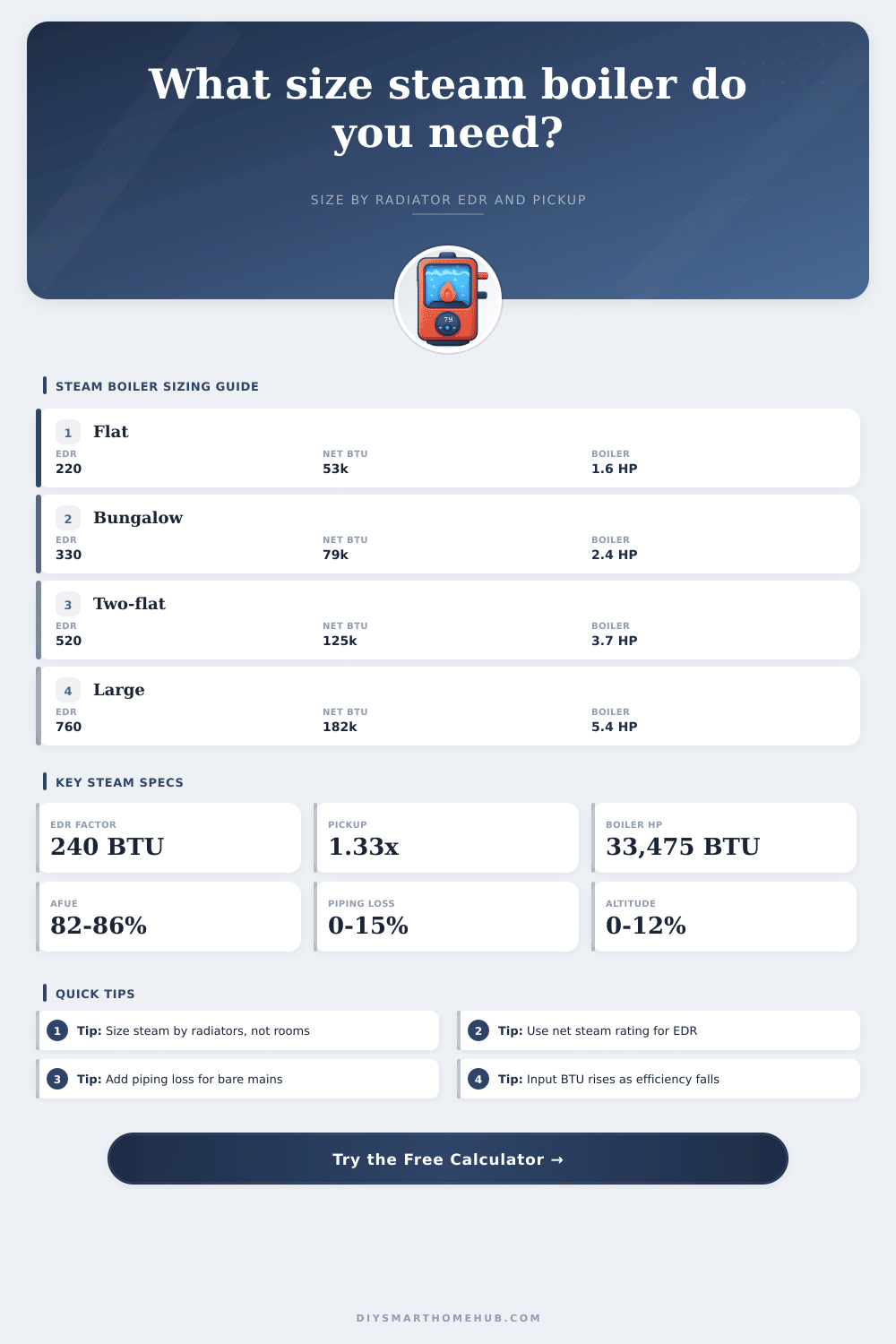
Estimate a replacement steam boiler from connected radiator EDR, 240 BTU/hr per sq ft EDR, pickup factor, piping loss, boiler horsepower, and net versus input BTU/hr.
Steam system presets
Pick a starting point, then adjust the radiator count, sections, pickup, and efficiency to match the actual system.
Calculator inputs
Steam boiler results
Steam boiler and radiator spec comparison grid
Reference tables
Radiator EDR reference
| Radiator type | Quick factor | How to use |
|---|---|---|
| 2-column cast iron, 20 in | 2.25 EDR/section | Sections x 2.25 |
| 3-column cast iron, 25 in | 3.00 EDR/section | Sections x 3.00 |
| 4-column cast iron, 25 in | 4.00 EDR/section | Sections x 4.00 |
| 5-tube tall, 38 in | 5.00 EDR/section | Sections x 5.00 |
| Steam convector cabinet | 3.50 EDR/ft | Cabinet feet x 3.50 |
Steam sizing factors
| Factor | Typical value | Use |
|---|---|---|
| Radiator output | 240 BTU/hr per EDR | Net steam radiation |
| Pickup factor | 1.33 | Warm mains and risers |
| Extra piping loss | 0% to 15% | Bare or long piping |
| Boiler HP | 33,475 BTU/hr | Gross steam output |
| Input BTU/hr | Output / efficiency | Fuel input rating |
Boiler rating conversions
| Connected EDR | Net steam | Gross at 1.33 | Boiler HP |
|---|---|---|---|
| 200 sq ft | 48,000 BTU/hr | 63,840 BTU/hr | 1.9 HP |
| 350 sq ft | 84,000 BTU/hr | 111,720 BTU/hr | 3.3 HP |
| 500 sq ft | 120,000 BTU/hr | 159,600 BTU/hr | 4.8 HP |
| 750 sq ft | 180,000 BTU/hr | 239,400 BTU/hr | 7.2 HP |
Common steam system presets
| System | Typical EDR | Radiators | Input range |
|---|---|---|---|
| Apartment or small flat | 180-260 | 5-7 | 70k-105k BTU/hr |
| Bungalow or cape | 280-390 | 7-10 | 110k-160k BTU/hr |
| Colonial house | 400-520 | 9-13 | 155k-220k BTU/hr |
| Two-flat or large house | 540-780 | 12-18 | 215k-335k BTU/hr |
Steam sizing tips
When selecting a steam boiler for a home heating system, performing calculations of the heating needs of the home are require. The wrong size of steam boiler for a home will create various problems for the resident of those homes in relation to comfort and fuel costs. If the steam boiler is too small for the home, the radiators will not reach the necessary temperature to provide heat to the homes in the mornings.
If, however, the steam boiler is too large for a home, the steam boiler will short cycle. Short cycling of a steam boiler leads to the waste of gas that the steam boiler burns, as the steam boiler will cycle too frequent to reach the proper temperature for the home. Additionally, short cycling also cause the steam boiler to wear out more quickly due to the excessive cycling of the boiler.
How to Size a Steam Boiler for Your Home
The size of the steam boiler should not be based off the number of rooms in the home. Instead, the amount of cast iron radiation that is present and connect to the steam boiler should be the basis for the size of the steam boiler. Steam boilers is sized according to the amount of radiation that the steam boiler will have to supply to each of the radiators in the home.
Each square foot of the radiation radiators in the home are rated to emit 240 BTU per hour when the radiators are filled with steam. The total amount of square feet of radiation in the home can be calculated with a calculator that estimates the total EDR (Equivalent Direct Radiation) of the home. This calculation of the total square footage of the radiation in the home is necessary to determine the amount of steam that the steam boiler will need to supply to each of the radiators in the home.
In addition to supplying heat to the home’s radiators, a steam boiler must also account for the heat that is necessary to warm the steam boiler’s piping within the home. This amount of heat is referred to as the pickup load of the steam boiler. The pickup load of a steam boiler is calculated as 1.33 times the amount of heat that is radiated by the radiators in the home.
If the steam boiler system within the home contains any long piping or bare piping, an additional percentage of heat loss due to the piping must be accounted for in the calculations. This additional percentage of heat loss will ensure that the steam boiler does not fall behind in supplying heat to the radiators in the home, especially on cold mornings when the radiators are not able to efficienty retain the heat that is supplied to the radiators. The total amount of heat that must be supplied to the radiators in the home is referred to as the gross output of the steam boiler.
The gross output of the steam boiler can be used to calculate the horsepower of the steam boiler by dividing the gross output by 33,475 BTU per hour. Additionally, the input of the steam boiler (in BTU) can be calculated by dividing the gross output of the steam boiler by the seasonal efficiency of the steam boiler. If the steam boiler will be installed in a home that is located at a high altitude, the calculations must also be adjusted to account for the fact that less dense air at high altitudes will reduce the capacity of the burner within the steam boiler to ignite enough gas to reach the gross output of the steam boiler.
A calculator that will provide the steam boiler with the net steam rating in BTU as well as the amount of gas or oil that will be required to supply the steam boiler with the gross output that is necessary for the steam boiler can perform the calculations of the gross output, the horsepower, and the BTU input of the steam boiler. Common mistakes include not measuring the radiation that is installed within each home. Many homes have had their radiators removed.
Additionally, many homes have had their radiators replaced with smaller convectors that do not provide the same amount of heat to each home. By measuring the radiation that is currently installed in a home, one can determine if the old steam boiler that was installed in that home was sized too large for the home. Additionally, measuring the amount of radiation that is installed in each of the homes allows for the determination of whether the mains within those homes have decreased in insulation, which would have also decreased the requirement for steam to warm the homes.
Two of the most common mistake in the sizing of steam boilers are sizing the steam boiler according to the input rating of the old steam boiler that was installed in the home, or sizing the steam boiler according to the number of rooms within the home. Each of these sizing methods for steam boilers is incorrect, as each method ignores the current radiation level of the home as well as the current state of the piping within the home. If either of these factors is ignored, the steam boiler may short cycle (if too large for the home) during periods of mild weather, or the steam boiler may not be able to reach the necessary temperature within the home during periods of cold weather.
The altitude at which the steam boiler will be installed within the home has an impact upon the fuel consumption requirement of that steam boiler. If the steam boiler is to be installed in a location that is at an altitude of 4,000 feet, the steam boiler will require approximately eight percent more input for the burner within the steam boiler to produce the same amount of output as the steam boiler would produce at sea level. Additionally, if the steam boiler that is being installed into the home has a lower efficiency than the old steam boiler that was installed in that home, the new steam boiler will have to burn more fuel to achieve the same amount of output as that of the old steam boiler.
Thus, these factors will impact the fuel costs of the steam boiler, as well. Finally, one should perform a visual inspection of the piping and the venting near the steam boiler to ensure that the steam is properly venting from the radiators. Even with the correct sizing of the steam boiler, the steam must exit the steam boiler at the correct pitch, the header to which the steam pipes connects must be correctly placed, and the combustion air must meet the requirement of the local codes.
You should of checked the pipes for leaks too. It’s important that you’re measurements are accurate, because the wrong size can be alot of trouble. If the boiler isnt right, the home wont stay warm.
This is more important then most people realize. Make sure you dont miss any details when you are checking the homes size.