Mini Split Energy Consumption Calculator
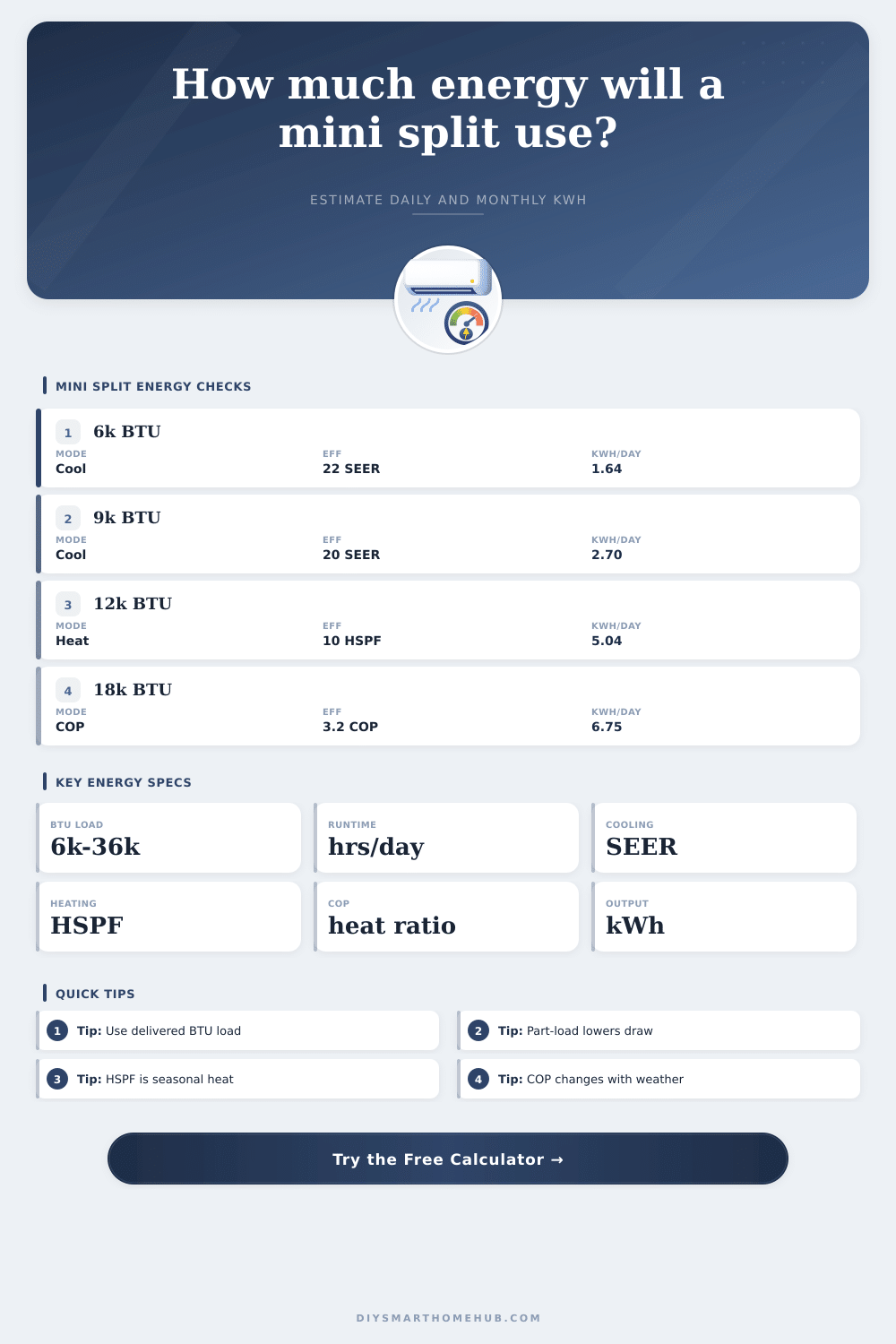
Estimate mini-split kWh per day and month from delivered BTU load, cooling SEER, heating HSPF or COP, daily runtime hours, and inverter part-load behavior.
📌Mini-split usage presets
⚙Energy inputs
🔎Live energy model
📊Mini-split efficiency spec comparison grid
📘Reference tables
| Runtime | kWh per day | kWh per 30-day month | Average running watts |
|---|---|---|---|
| 4 hours | 0.00 kWh | 0 kWh | 0 W |
| 8 hours | 0.00 kWh | 0 kWh | 0 W |
| 12 hours | 0.00 kWh | 0 kWh | 0 W |
| 24 hours | 0.00 kWh | 0 kWh | 0 W |
| Rating | What it describes | Formula used here | Best for |
|---|---|---|---|
| SEER or SEER2 | Seasonal cooling output in BTU per watt-hour | Watts = cooling BTU/h / SEER | Cooling season estimates |
| HSPF or HSPF2 | Seasonal heating output in BTU per watt-hour | Watts = heating BTU/h / HSPF | Heating season estimates |
| COP | Heat moved divided by electric energy input | Watts = BTU/h / (COP x 3412.142) | Outdoor-temperature snapshots |
| Part-load factor | Inverter correction for low-speed operation | Adjusted watts = base watts x factor | Rooms that rarely run at full load |
| Delivered load | Cooling at 20 SEER | Heating at 10 HSPF | Heating at COP 3.0 |
|---|---|---|---|
| 6,000 BTU/h | 300 W before part-load factor | 600 W before part-load factor | 586 W before part-load factor |
| 9,000 BTU/h | 450 W before part-load factor | 900 W before part-load factor | 879 W before part-load factor |
| 12,000 BTU/h | 600 W before part-load factor | 1,200 W before part-load factor | 1,172 W before part-load factor |
| 18,000 BTU/h | 900 W before part-load factor | 1,800 W before part-load factor | 1,758 W before part-load factor |
| Scenario | Useful inputs | Energy tendency | Watch point |
|---|---|---|---|
| Small bedroom cooling | 6k to 9k BTU, 18 to 28 SEER, 4 to 8 hours | Low daily kWh when load factor stays moderate | Oversized units may short-cycle instead of cruising |
| Open living area cooling | 12k to 24k BTU, 16 to 24 SEER, 8 to 14 hours | Runtime dominates the monthly total | Solar gain and air leaks can raise load factor |
| Shoulder-season heating | 9k to 18k BTU, 9 to 13 HSPF, 4 to 10 hours | HSPF gives a seasonal heating estimate | Outdoor temperature changes real COP |
| Cold-weather heating | 12k to 30k BTU, COP 1.8 to 3.2, long runtime | COP method shows heavier draw at low COP | Use delivered heating capacity at the chosen temperature |
💡Calculation tips
Mini split systems provides heating and cooling to a room. Mini split systems is often more energy efficient than central air conditioning systems because mini splits dont require duct to distribute air to each room. The cost to operate a mini split system can depend on several different variable.
These variables includes the thermal load for the room, the efficiency rating for the mini split system, and the total runtime for the mini split system. Each of these variables can be entered into the calculator to estimate the daily and monthly kilowatt-hour (kWh) usage for the system. The delivered BTU load for the room is one of the main variables that you should enter into the calculator.
How to Calculate Mini Split Energy Use
The delivered BTU load represents the amount of heating or cooling that the room will requires. The mini split system may be rated for higher amounts of BTUs, but the actual BTU load for the room may be lower. The load factor entry field allow for the cooling or heating capacity of the mini split system to be adjusted to the BTU load for the room.
Failure to adjust the load factor to the BTU load for the room will result in the calculation of the maximum efficiency for the mini split system rather than the actual efficiency for the room. The efficiency ratings for the mini split system impact the energy that the system will use to provide heating and cooling to the room. The SEER (Seasonal Energy Efficiency Ratio) rating for a mini split system determine the efficiency of the cooling function of the system and considers seasonal changes in outdoor temperatures.
The HSPF (Heating Seasonal Performance Factor) measures the efficiency of the heating function of the mini split system and also seasonal changes in outdoor temperatures. The COP (Coefficient of Performance) rating for mini split system is a measurement of the efficiency of the system at a specific outdoor temperature. Each of these efficiency ratings is entered into the calculator separately to ensure that the cooling efficiency ratings are not used for calculations of the heating performance of the system.
The inverter driven compressor that helps to distribute cooling or heating to the room often works at reduced speed during operation of the system. As such, the part load factor for the system is another variable that should be entered into the calculator. A part load factor that is less than 1.0 indicate that the system is operating at a reduced level of output and uses fewer watts than if it was operating at full capacity.
A part load factor that is greater than 1.0 indicate that the mini split system is working harder than the manufacturer rate for there system. This could be due to external factors such as high solar gain for the room or poor insulation for the mini split system. Small changes in the part load factor can have a major impact on the cost of operating the system each month, as much as 20% or more in some cases.
The runtime for the mini split system represents how many hour each month that the system will be running to provide cooling or heating to the room. Homeowners must consider this factor because the more hours that the system is used each month, the more energy the mini split system will use. A mini split system that runs for six hour each day will use less energy each month than a system that runs for ten hours each day.
By entering the runtime for the mini split system into the calculator, homeowners can visualize the additional cost that will be incurred by adding more hours of runtime to the system each month. There are external condition for each room that can impact the load factor for that room and the efficiency of the mini split system. For instance, rooms with large windows may require higher load factors for the mini split system to compensate for the increase in solar gain for that room.
Poor insulation for a room will also increase the load factor for that room, as well as cause the mini split system to work longer hours each to maintain a desired indoor temperature. Good insulation for the room will decrease the load factor and the number of hour that the mini split system will need to work in order to maintain that same indoor temperature. The reference tables that are provided on the calculator allow the user to compare the efficiency of the mini split system under different conditions and with different variables entered.
These tables provide a range of expected kilowatt-hours each month for a mini split system with various efficiency ratings. Comparing the calculated kilowatt-hours to these reference tables will allow a homeowner to ensure that the calculations was properly performed. If the calculated numbers are drastically different from those indicated in the reference tables, then the load factor for the room or the runtime for the mini split system may need to be adjusted.
The goal of mini split system manufacturers and makers is to ensure that the mini split system meets the thermal needs of the room. Additionally, those needs should of been met without significantly increasing the cost of operation of that system. If the variables are not aligned with the capacity of the mini split system, then the system may either be running too much for the room, or the occupants may remain uncomfortable.
By using the calculator, the relationship between the mini split system and the room can be made visible to the homeowner. As a result, cost to operate the mini split system can be made visible to the homeowner as well.