LED Driver Calculator
Size a constant-voltage or constant-current LED driver from strip wattage, run length, supply voltage, conductor voltage drop, headroom, and dimming minimum-load behavior.
📌LED driver presets
⚙Driver sizing inputs
Choose the LED product profile first, then override watts, voltage, wire, and dimming details to match the actual tape or module datasheet.
🔎Live model checkpoints
LED driver result
Enter the LED load details and calculate to size the driver.
📊LED strip spec grid
Low-density accent tape, usually easy to power in short cabinet runs.
Common task strip density where 24 V helps reduce current.
Bright white or RGBW tape that usually needs more feed planning.
High-output COB and dense strip loads where driver heat and drop matter.
🧮LED driver and spec comparison grid
Best for LED tape, under-cabinet strips, RGBW controllers, and parallel zones.
Best for LED modules where current must be fixed and voltage floats with the load.
Best for strip dimming when the driver and controller are both rated for PWM operation.
Useful when a project is intentionally split into smaller limited-power LED zones.
📋Voltage drop and feed method table
| Feed method | Current path model | Best use | Calculator effect |
|---|---|---|---|
| Single-end feed | Full strip current starts at one end | Short low-watt strips | Highest strip drop factor |
| Both-end feed | Current enters from both strip ends | Long cove and shelf runs | Lower far-end drop estimate |
| Center feed split run | Run divides into two shorter halves | Mirrors, coves, and toe-kicks | Shorter effective strip length |
| Parallel home-run zones | Zones receive separate feed pairs | Stairs and multi-shelf systems | Lead drop is shared by zone current |
⚡Common driver size reference
| Nominal driver | 12 V max current | 24 V max current | Typical LED strip use |
|---|---|---|---|
| 36 W | 3.0 A | 1.5 A | Short under-cabinet or shelf accents |
| 60 W | 5.0 A | 2.5 A | Small task-lighting zones |
| 96 W | 8.0 A | 4.0 A | Medium cove or bright cabinet runs |
| 150 W | 12.5 A | 6.25 A | Longer 24 V strips and RGBW accents |
| 240 W | 20.0 A | 10.0 A | High-output zones with careful feeds |
| 320 W | 26.7 A | 13.3 A | Large multi-zone layouts or split outputs |
🔧Formula reference table
| Formula | Use it for | Expression | Important check |
|---|---|---|---|
| LED watts | Strip load | W/m multiplied by length | Use full-output rating |
| Driver watts | Headroom sizing | Load watts multiplied by 1 plus margin | Round up to driver size |
| CV current | Power supply amps | Load watts divided by volts | Compare to output rating |
| Voltage drop | Wire and strip loss | Current multiplied by round-trip ohms | Keep below target percent |
| CC voltage | Current driver window | Load watts divided by LED current | Must fit driver range |
| Dimming load | Low-end stability | Full watts multiplied by dim percent | Above minimum load |
💡LED driver sizing tip boxes
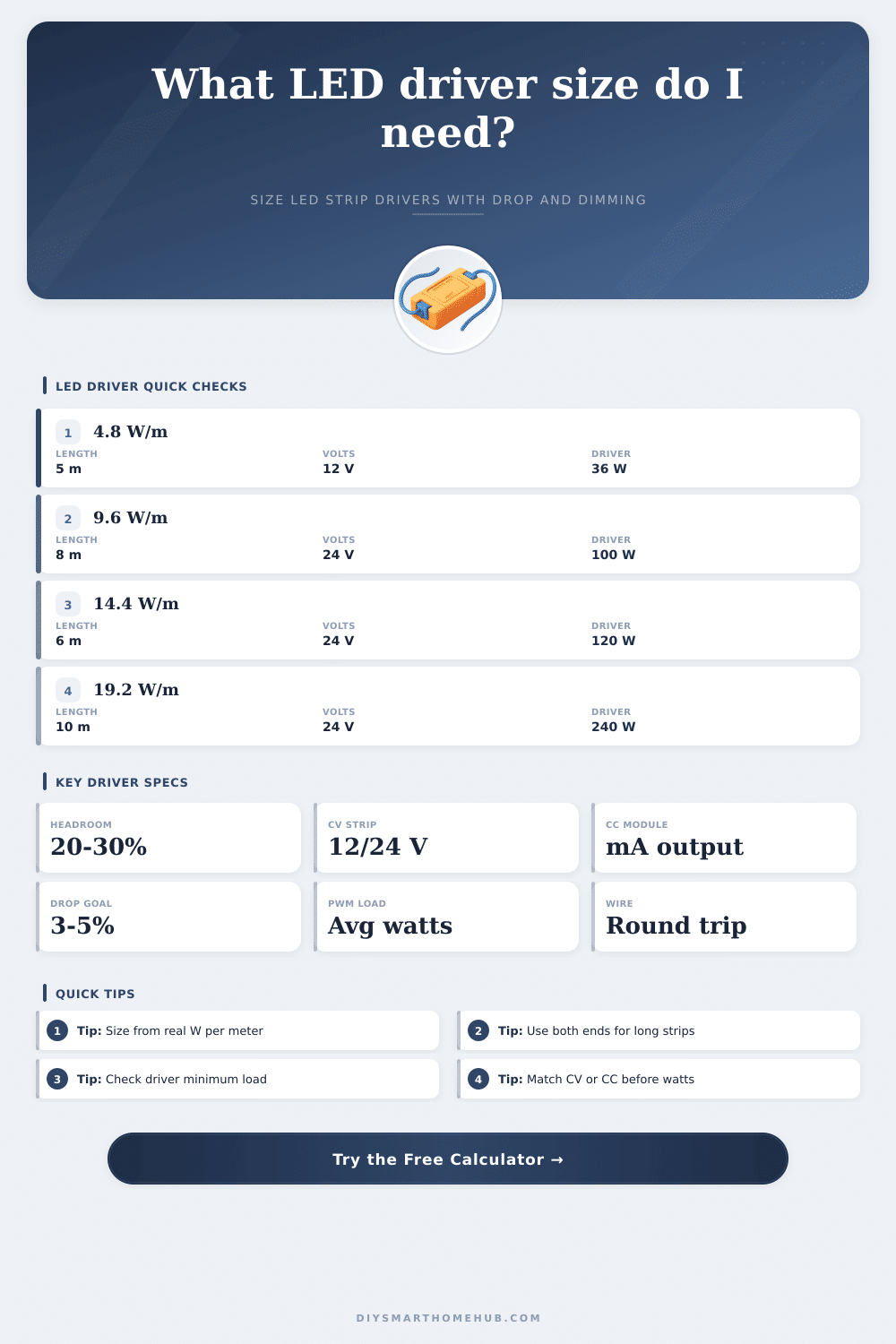
A constant-voltage LED strip wants a fixed 12 V or 24 V output, while a constant-current module wants a fixed milliamp output and a voltage range that covers the LED stack.
If the calculated driver wattage looks fine but voltage drop exceeds the target, split the run, feed both ends, raise the system voltage, or use larger conductors before upsizing the driver.
When choosing an LED driver for an LED strip, there are several factors to consider. Many people may thinks that all that is necessary is to calculate the total wattage of the LEDs in the strip based on the length of the strip. However, using such a method to determine the appropriate LED driver can cause problem with the strip.
For instance, uneven brightness along the strip or flickering can result. Uneven brightness means that the LEDs at the far end of the strip may be significantly more dimmer than those at the beginning of the strip. Flickering means that the LED driver are not maintaining an adequate output for the strip.
How to Choose an LED Driver for an LED Strip
You can avoid both of these problems by ensuring that the LED driver for the strip is correctly matched to the strip. There are two main types of LED drivers: constant-voltage and constant-current drivers. LED strips are constant-voltage devices, meaning that the voltage supplied to the strip remains constant, while the current changes based on the temperature of the strip and the length of the strip.
Constant-current drivers works in the opposite way, maintaining a constant current for the strip and allowing the voltage to change within a certain range. It is essential to determine whether the strip require a constant-voltage or constant-current driver. Any other choice of LED driver can lead to drift in the electrical output from the driver.
Another critical consideration is voltage drop. This occurs because the copper wires that carries the electrical current from the driver to the strip have electrical resistance. As the current travels through the wire and the strip, the voltage drop.
This is a round-trip phenomenon; the current must travel to the far end of the strip and then travel back to the driver. If the strip uses a single-end feed to the strip, the voltage drop may be significant enough that the LEDs at the far end of the strip may exhibit a different color of light or may not turn on at all. Using thicker wire for the LED strip or changing the way that the driver feeds the strip with power will help to manage voltage drop.
Another important aspect of LED drivers is that they should have extra capacity. Because LED drivers get hotter than the LED strips and wear down faster, they requires extra capacity to allow for operation at maximum capacity. If the driver operate at maximum capacity for extended periods, it will overheat.
Therefore, providing the driver with twenty percent extra capacity will allow it to remain cooler and to handle the change in electrical draw of the strip. As the strip age or as the temperature of the strip changes, the electrical draw of the strip will change. By providing the LED driver with extra capacity, you provide a safety margin for these changes.
In addition to the factors mentioned above, you must also consider the LED strip’s dimming requirements. For instance, if you want to dim the LED strip, the LED driver may require a minimum load to remain stable at low light levels. For LED drivers that use Pulse Width Modulation to dim the light, the driver may lose regulation of the light levels if those levels are too low.
It is essential to ensure that the LED driver can maintain the strip’s light levels to avoid flickering of the LEDs when dimming the strip. Finally, the real world is not the same than the LED strip specifications stated on the manufacturer’s datasheet. For instance, the temperature of the strip change the forward voltage of the strip.
Changes in the temperature of the strip also change the current draw of the strip. In addition, moisture in the environment can alter the resistance of the strip; this is especially true of outdoor LED strip lights that are exposed to the elements. Although you can use a calculator to account for these variable, it is also necessary to observe the LED strip when it is at full brightness and dimmed to ensure that the LED driver is functioning correctly.
The purpose of choosing an LED driver for an LED strip is to ensure that the LED driver remains within its operational capacity and that the strip remains within its required voltage or current limits. By ensuring that these two components are correctly matched, the LED strip will have even brightness throughout its length and the dimmer will be able to effectively control the brightness of the strip.