Swamp Cooler CFM Calculator
Estimate evaporative cooler airflow from room volume, air changes per hour, dry-bulb and wet-bulb temperatures, cooler effectiveness, climate humidity, and available pad area.
🏠Swamp Cooler Presets
Choose a starting point that matches the space and climate, then adjust the dry-bulb, wet-bulb, ACH, effectiveness, and pad area for your actual cooler.
📏Airflow And Cooling Inputs
Use this as a planning calculator for airflow and pad sizing. Final equipment choice should match the cooler data plate, duct losses, and available exhaust openings.
⚙Evaporative Cooler Spec Comparison
📊ACH And Airflow Reference
| Space type | Planning ACH | Why it changes | 500 sq ft at 8 ft |
|---|---|---|---|
| Bedroom or small office | 20-28 ACH | Lower load, quieter airflow, short distribution path | 1,333-1,867 CFM before humidity margin |
| Living room or open plan | 30-38 ACH | More solar load, more occupants, larger mixing zone | 2,000-2,533 CFM before humidity margin |
| Garage or workshop | 35-45 ACH | Hot slab, doors, stored heat, and dust-tolerant noise level | 2,333-3,000 CFM before humidity margin |
| Whole-house ducted unit | 25-40 ACH | Balanced against duct losses and window or relief exhaust area | 1,667-2,667 CFM before humidity margin |
🌡Dry-Bulb, Wet-Bulb, And Humidity Table
| Outdoor condition | Dry bulb | Wet bulb | Expected effect |
|---|---|---|---|
| Very dry desert afternoon | 100 F | 60-64 F | Large wet-bulb depression; a good cooler can make a strong drop. |
| Dry western summer | 95 F | 64-68 F | Solid evaporative performance with moderate airflow margin. |
| Mixed monsoon shoulder | 92 F | 70-74 F | Smaller drop; airflow and exhaust paths become more important. |
| Humid edge climate | 88 F | 75-78 F | Limited cooling drop; comfort depends heavily on fast air movement. |
💧Pad Area And Media Comparison
| Pad or cooler style | Planning face velocity | Effectiveness range | Best use |
|---|---|---|---|
| Thin aspen side pads | 220-280 fpm | 60-75% | Window units and small direct-flow coolers. |
| Rigid cellulose media | 300-400 fpm | 75-90% | Ducted or larger direct evaporative coolers. |
| High-flow portable unit | 250-350 fpm | 55-70% | Spot cooling when doors or windows stay open. |
| Undersized or dry pad face | Over 450 fpm | Often reduced | Flag for poor wetting, carryover risk, or weak cooling. |
📋Common Swamp Cooler Sizing Examples
| Project size | Volume assumption | Typical airflow | Pad area note |
|---|---|---|---|
| Single room, 12 x 14 ft | 1,344 cu ft | 450-750 CFM | 2-3 sq ft pad face is usually enough. |
| Two-car garage zone | 3,600 cu ft | 2,100-3,000 CFM | Use a larger pad face to keep velocity controlled. |
| Open plan, 20 x 30 ft | 4,800 cu ft | 2,800-4,000 CFM | Exhaust openings should be distributed across the space. |
| Whole house, 1,800 sq ft | 14,400 cu ft | 7,200-11,500 CFM | Duct and relief area often decide usable delivered airflow. |
💡Practical Sizing Notes
A swamp cooler does not cool by compressor tonnage. It moves outdoor air across wet media, so the dry-bulb to wet-bulb gap sets the available temperature drop before effectiveness is applied.
If the pad face is too small, air rushes through the media and cooling effectiveness falls. If exhaust openings are too restricted, the rated fan CFM will not become useful room airflow.
A swamp cooler use outdoor air passing over wet pads to cool interiors via evaporation. No refrigerant or compressor are used in this process. Instead, a swamp cooler system rely on the evaporation process to allow the cooling of indoor space.
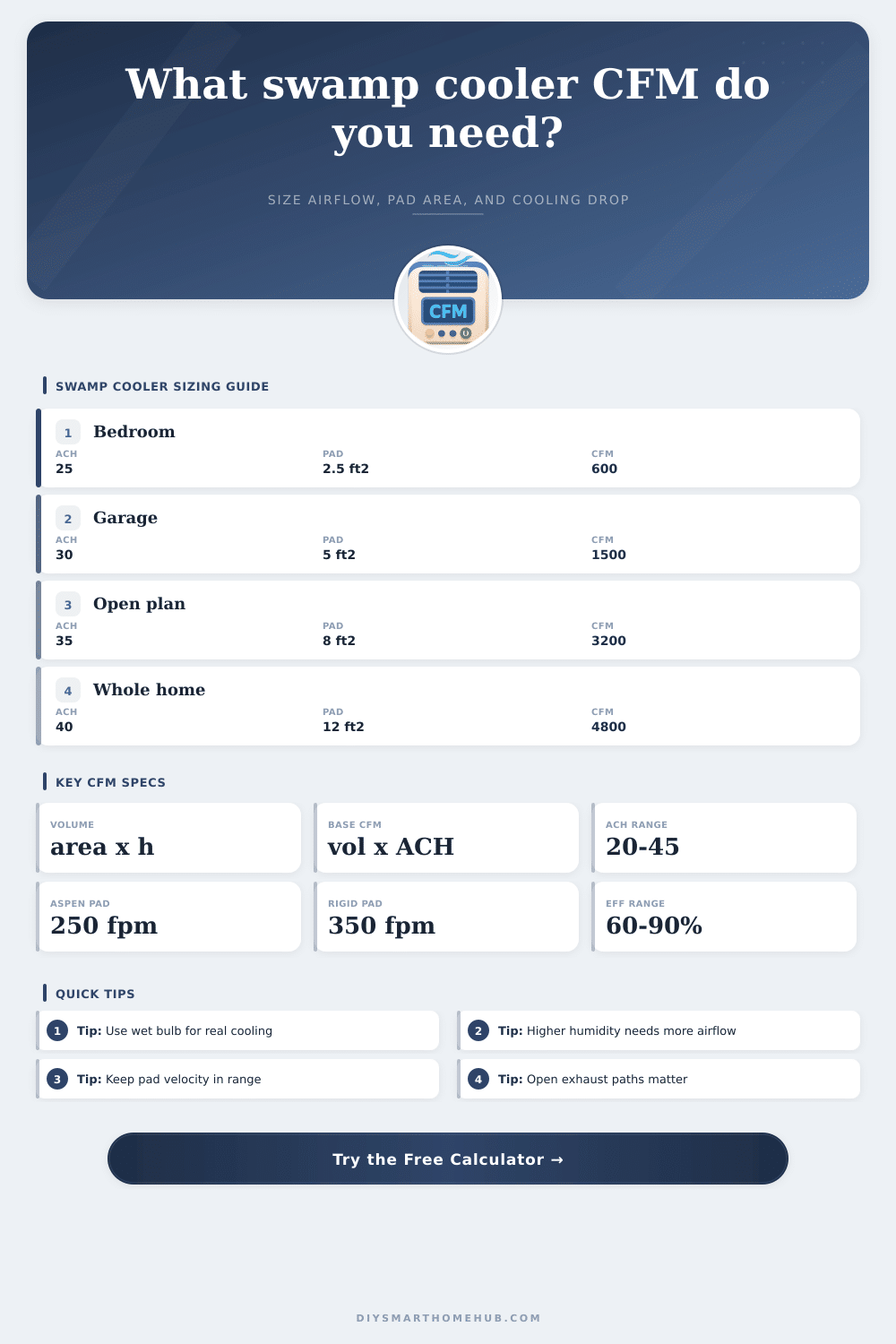
To ensure that a swamp cooler work correctly, it is essential to perform a CFM calculation. The CFM calculation will determine how much air must move through the swamp cooler to cool the desired space. The first step in determining the needed CFM for a swamp cooler is to calculate the volume of the space to be cooled.
How to Find the Right CFM for Your Swamp Cooler
You can find the volume of the space by multiplying the floor area of the space by the height of the ceiling in that space. Once you have calculated the total cubic feet of the space, the next step is to determine the target air changes per hour that is required for that space. For example, if the space is a shaded bedroom, around twenty air change per hour will likely be required.
In contrast, a garage with a hot floor may require forty air changes per hour. If there are to few air changes per hour, some areas of the room will become overheat. If there are too many air changes per hour, the swamp cooler may waste energy and potentially blow air that has not yet had time to fully evaporate from the wet pads.
Another factor to consider in calculating the required CFM for a swamp cooler is the wet-bulb temperature of the outdoor air. The wet-bulb temperature will indicate how much cooling the swamp cooler can achieve with the outdoor air. If the dry-bulb and wet-bulb temperatures has a large gap, the swamp cooler can achieve more cooling.
A narrow gap between these two temperatures indicate that less cooling will be achieved. This can occur in climates with high humidity. Another factor to include in you calculation is the cooling effectiveness of the swamp cooler.
Cooling effectiveness refers to how much of the available wet-bulb temperature depression a swamp cooler can achieve. For instance, aspen pads may reach a cooling effectiveness of around 70%, while rigid media can reach around 80%. The area of the wet pads that a swamp cooler use can also impact the required CFM for the swamp cooler.
The face velocity of the air moving through the swamp cooler is an essential factor. If the face velocity is too high, the air will move too quick through the wet pads for complete evaporation of the water on the wet pads. If the face velocity is too low, the air will not effectively move the air through the swamp cooler; some areas of the pads will remain dry while other may have water pooling on them.
A calculator can make it easier to calculate the necessary CFM of a swamp cooler. Such a calculator will account for the dimensions of the space to be cooled, the humidity of the area, and the area of the wet pads of the swamp cooler to determine whether the swamp cooler will maintain an appropriate face velocity. The humidity of the area where the swamp cooler will be installed play a crucial role in the cooling potential of a swamp cooler.
In dry areas like deserts, swamp coolers have considerable leeway in terms of sizing errors. In contrast, in areas with mixed and humid climate, a swamp cooler will require an extra margin of airflow to facilitate effective cooling. Additionally, swamp coolers in humid climates will require that you size the exhaust openings of the swamp cooler correctly to ensure that the fan can effectively move the amount of air the swamp cooler will produce.
Many people make mistake when calculating the necessary airflow for their swamp cooler. One of the most common mistake is assuming that the CFM that is printed on the swamp cooler is the same as the amount of airflow that will actualy be deliver into the space. The CFM of swamp coolers is often lower than the nameplate CFM due to high face velocity and high exhaust losses.
Another mistake with swamp coolers is to ignore the height of the ceilings. Swamp coolers with ten-foot ceilings will cool more air than swamp coolers with shorter ceilings. Therefore, if the room holds more air, more CFM are required.
By calculating the necessary CFM for a space, an individual can purchase a swamp cooler that has the correct pad area and the correct exhaust area. This will ensure that the interior of the space remain at a comfortable temperature, the wet pads dont become too dry or too wet with pooled water, and the swamp cooler fan does not work too hard to push air through the space.