Whole House Fan CFM Calculator
Size delivered airflow from house volume and air changes per hour, then back-calculate the rated fan CFM needed after attic relief, duct path, climate, and open-window derates.
🏠Real house presets
⚙Fan sizing inputs
📊Live sizing cues
🧮Calculated fan/spec snapshot
📐ACH target reference
| Cooling goal | Typical ACH | 1,800 sqft x 8 ft example | Use when |
|---|---|---|---|
| Gentle evening draw | 10-12 ACH | 2,400-2,880 delivered CFM | Quiet operation matters more than fast flushing. |
| Balanced whole-home cooling | 14-18 ACH | 3,360-4,320 delivered CFM | Most homes with usable outdoor temperature drop. |
| Fast night purge | 20-24 ACH | 4,800-5,760 delivered CFM | Hot-dry climates, larger thermal mass, open windows. |
| Large or noise-sensitive home | 8-14 ACH | 1,920-3,360 delivered CFM | Bedrooms near the fan or long overnight operation. |
🌀Fan and spec comparison grid
| Fan style | Useful rated CFM range | Planning derate | Best fit |
|---|---|---|---|
| Direct ceiling mounted | 2,000-6,000 CFM | 0.92-0.97 | Short path, simple attic opening, high airflow per opening. |
| Belt-drive high volume | 4,000-9,000 CFM | 0.90-0.95 | Large homes where raw CFM matters more than compact size. |
| ECM direct-drive | 1,800-5,500 CFM | 0.93-0.98 | Quiet control, lower speed operation, tighter bedroom layouts. |
| Insulated ducted fan | 1,500-4,800 CFM | 0.78-0.90 | Noise isolation, remote attic mounting, sealed winter damper. |
| Long duct / remote fan | 1,200-4,000 CFM | 0.70-0.82 | Complex attic path where static pressure must be budgeted. |
💨Attic vent relief reference
| Rated fan CFM | Minimum NFA at 1 sq ft per 750 CFM | Equivalent square inches | Relief note |
|---|---|---|---|
| 2,000 CFM | 2.7 sq ft | 384 in² | Often reachable with existing gable plus ridge relief. |
| 3,500 CFM | 4.7 sq ft | 672 in² | Check net ratings, not gross vent dimensions. |
| 5,000 CFM | 6.7 sq ft | 960 in² | Many homes need added roof, gable, or dormer relief. |
| 7,500 CFM | 10.0 sq ft | 1,440 in² | Large fans need deliberate attic exhaust planning. |
🏘Common home size examples
| Home example | Volume basis | Delivered CFM at target | Likely rated fan range |
|---|---|---|---|
| Small ranch, 1,200 sqft | 9,600 ft³ at 8 ft | 3,200 CFM at 20 ACH | 3,700-4,400 CFM after normal derates. |
| Mid-size two-story, 2,000 sqft | 17,000 ft³ at 8.5 ft | 5,100 CFM at 18 ACH | 5,800-7,000 CFM depending on duct path. |
| Vaulted plan, 2,600 sqft | 24,700 ft³ at 9.5 ft | 6,175 CFM at 15 ACH | 7,300-9,200 CFM if ducted or relief-limited. |
| Large home, 3,200 sqft | 28,800 ft³ at 9 ft | 5,760 CFM at 12 ACH | 6,400-8,000 CFM for a quieter lower ACH plan. |
💡Sizing notes
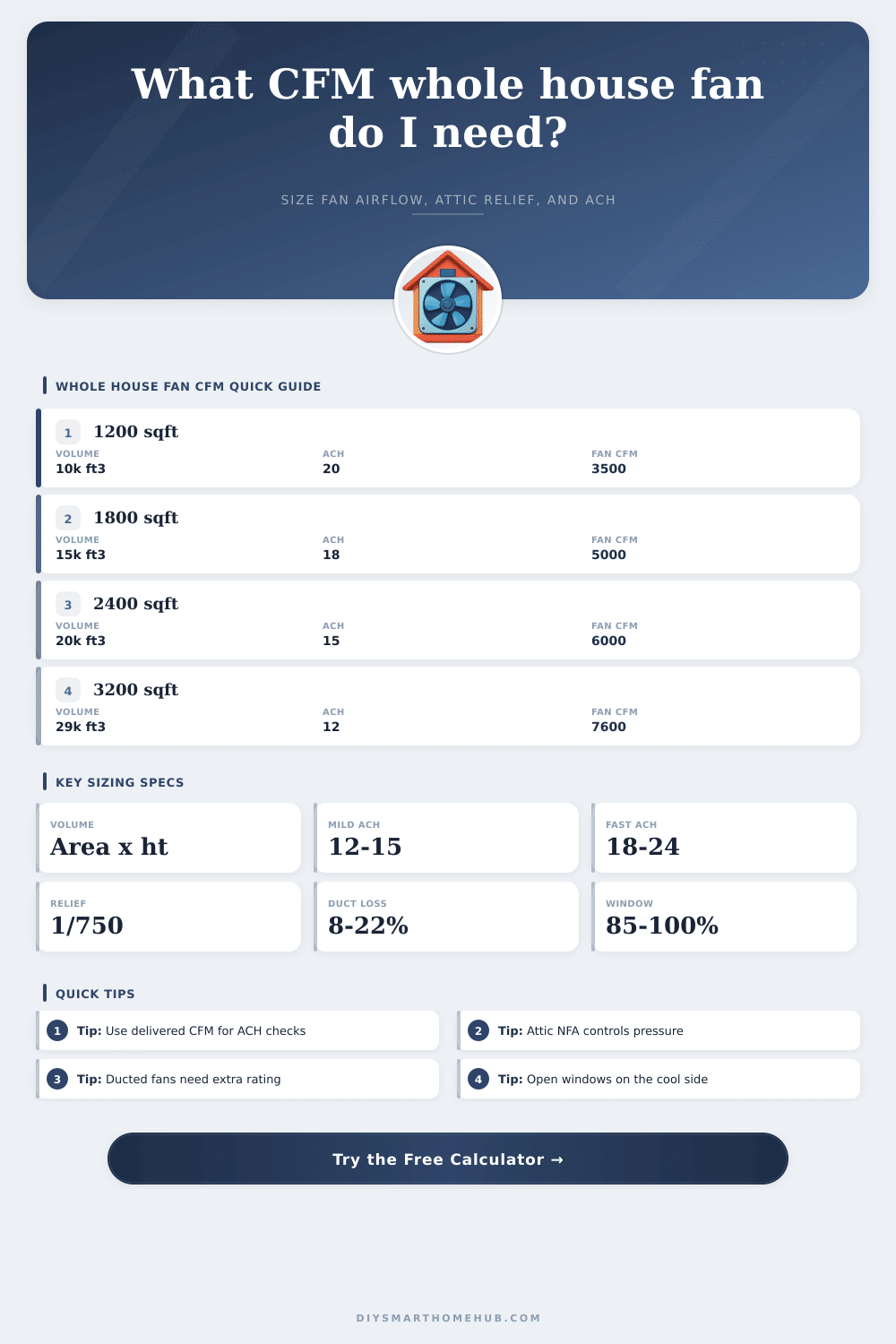
When choosing a whole house fan, you must match the airflow of the whole house fan to an air volume of your house. Many peoples choose the largest whole house fan available. However, you must consider the square footage of your house and the ceiling height of your house.
The more higher the ceiling of your house, the more air volume your whole house fan must be able to move. Furthermore, you must also consider how many time the air in your house should be changed each hour. You must also consider the attic ventilation of your house when you are choosing your whole house fan.
How to Choose the Right Size Whole House Fan
If you do not take these factors into consideration when you are buying a whole house fan, then you risk either buying a whole house fan that will work too hard to cool your house, or buying one that will fail to supply you with the amount of cooling that you desire from your whole house fan. To calculate the air volume of your house, you must find the square footage of your house, and you must multiply that by the height of your ceilings in feet. That will provide the total cubic feet of air in your house.
After you have calculated the total cubic feet of air in your house, you must calculate how many time the air in your house should be changed each hour. If you live in an area where it is quite cool during the evenings, you may want to opt for a target of 12 to 15 air changes per hour. In hot climates, however, air changes of 18 to 24 per hour may be more apropriate.
To calculate these numbers, you can use a calculator to determine the total CFM that your whole house fan should have. Now that you have calculated the required CFM for your house, you will want to purchase a whole house fan that has a higher CFM than the target that you have calculated for your house. When you install a whole house fan into a house, air tends to leak out of the structure of the house.
If your house has direct-mounted whole house fans, you will lose the least amount of air. However, if you have ducted or remote whole house fans, there will be additional air loss due to the bends in the ducts that the fans move the air through. Additionally, if you have poorly constructed windows that dont allow air to intake into your house efficiently, the effective intake of your whole house fan will also drop.
When purchasing a whole house fan, use a tool that calculates for these factors so that you can ensure that the whole house fan that you purchase is of the correct size for your house. One factor that you should consider when purchasing a whole house fan is the relief that your attic can provide. A whole house fan will push air into the attic, and the attic must have vents that release that air from the attic.
If your attic does not provide sufficient relief for the whole house fan that you select for your house, the attic will become increasingly hot to the point where the whole house fan must work harder to push air into the attic. Additionally, in the summertime, when the attic reaches high temperatures, the heat will flow into the living spaces of the house through the ceiling of the house. You should check the number of attic vents in your house prior to purchasing your whole house fan so that you do not buy a whole house fan that is too strong for the ventilation of your attic.
The climate in which you are to install your whole house fan will have a great influence upon the target CFM that it should have. If your area has mild climates with significant coastlines, the temperature will not drop significantly during the evening. Thus, a lower CFM is all that will be required from your whole house fan.
If you live in one of the hottest and driest climates, however, you will want your whole house fan to provide a strong flush of air to remove the heat that is stored in the walls and the floors of your house. In humid climates, however, you will likely want to use your whole house fan with moderation, as the incoming air from the whole house fan may not be cooler than the air that is already circulating in the house. When using a whole house fan calculator to calculate the size of the whole house fan that you need, you should consider the climate profile of your area.
In addition to the climate in which you live, your strategy for using your house windows is another factor that will impact the effectiveness of your whole house fan. If your house has windows on the shaded side of the house, and if they can be left open to allow cool air to enter your house, you will have cross ventilation in your home. If you do not have the luxury of having windows on the shaded side of your house, or if they do not open on the side of the house, your effective intake of air will shrink.
Thus, the air change rate that your whole house fan provides will drop. In this case, you should plan your windows to remain open when your whole house fan is running. Additionally, there are some other factors to consider when purchasing a whole house fan.
For instance, direct-mounted whole house fans will move the most air in your house if you install them in the central hallway of your house. However, since direct-mounted whole house fans are loud, they may not be the best choice if you are concerned about the sound that will travel into your sleeping areas. In comparison, insulated ducted whole house fans will be quieter than direct-mounted models, but they will require a higher CFM to effectively move the air in your house.
Two-speed whole house fans offer the advantage of having both high and low settings for the fan so that you can use the high setting in the summer when the air change rates should be high, but use the low setting to circulate the air overnight. Finally, you will have to purchase a well-sealed insulated cover for your whole house fan so that it doesnt take the energy of your home to heat the attic in the winter.