Arc Flash Energy Calculator
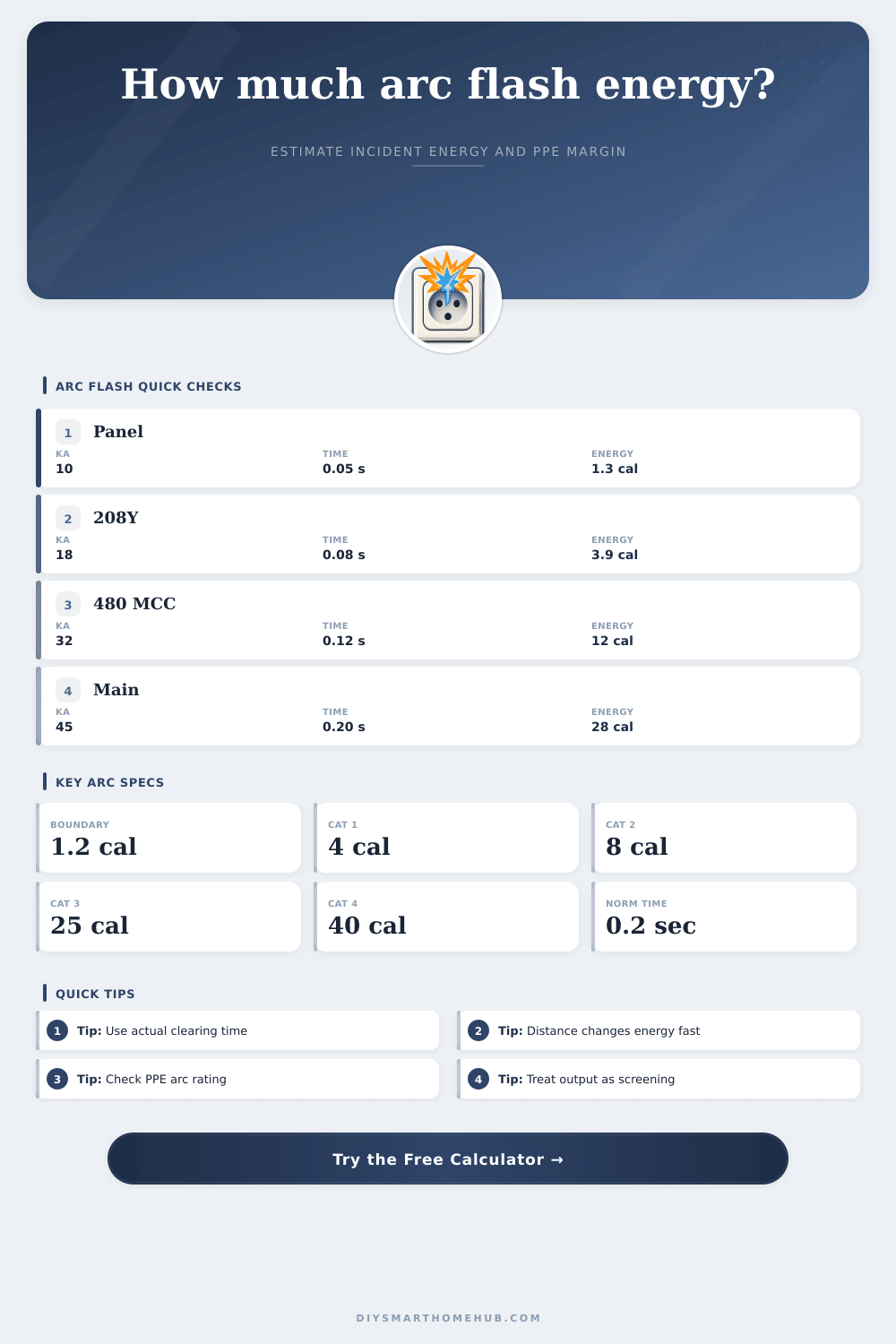
Estimate incident energy, normalized energy, arc flash boundary, PPE arc-rating margin, and clearing-time sensitivity from available fault current, clearing time, working distance, voltage, gap, and enclosure behavior.
📌Arc flash presets
⚙Arc flash inputs
🔍Live model notes
🧰Electrical and PPE spec comparison grid
📊Incident energy approximation table
| Step | Formula used here | Main input | Planning meaning |
|---|---|---|---|
| Normalize | En = 0.0105 x kA0.92 x voltage x gap x gear x enclosure | Fault current and gear shape | Creates a screening energy at 0.2 s and 24 in. |
| Time scale | Et = En x clearing time / 0.2 | Breaker or fuse clearing time | Longer clearing time raises energy nearly linearly. |
| Distance scale | E = Et x (24 / D)x | Working distance and exponent | Closer work distance increases exposure quickly. |
| Boundary | Boundary = D x (E / 1.2)1/x | Incident energy and exponent | Estimates distance where exposure falls to 1.2 cal/cm². |
🛡PPE arc-rating reference
| Arc rating band | Calculator cue | Typical PPE comparison | Important limit |
|---|---|---|---|
| Less than 1.2 cal/cm² | Below burn-threshold boundary value | Arc-rated clothing may not be triggered by energy alone | Shock, blast, molten metal, and task rules can still apply. |
| 1.2 to 4 cal/cm² | Low energy, above threshold | Compare with 4 cal/cm² arc-rated clothing | Face, hand, hearing, and voltage PPE still need task review. |
| 4 to 8 cal/cm² | Common category 2 range | Compare with 8 cal/cm² arc-rated set | Rating must meet or exceed calculated incident energy. |
| 8 to 25 cal/cm² | Elevated flash-suit range | Compare with 12 or 25 cal/cm² systems | Verify exact arc rating on all garments and face protection. |
| 25 to 40 cal/cm² | High energy range | Compare with 40 cal/cm² flash suit | Consider whether energized work can be avoided or reduced. |
| Above 40 cal/cm² | Extreme screening result | Beyond common 40 cal/cm² comparison | Needs engineered mitigation and qualified analysis. |
📐Voltage, gap, and enclosure factors
| Factor | Low setting | Medium setting | Higher setting |
|---|---|---|---|
| Voltage factor | 208 V: 0.82 | 480 V: 1.00 | 600 V: 1.10 |
| Gap factor | 13 mm: about 0.88 | 32 mm: 1.00 | 76 mm: about 1.17 |
| Enclosure factor | Open air: 0.72 | Typical box: 1.00 | Small/deep box: 1.15 to 1.28 |
| Distance exponent | Open air: 2.0 | Typical box: 1.8 | Focused box: 1.65 to 1.72 |
🔌Common equipment screening ranges
| Equipment | Common work distance | Fault-current cue | Clearing-time sensitivity |
|---|---|---|---|
| Residential load center or meter-main | 18 in / 45.7 cm | Often under 25 kA, site dependent | Fast main clearing can keep energy low, but source data matters. |
| 208 V panelboard | 18 in / 45.7 cm | 10 to 35 kA is common in buildings | Panelboard energy rises sharply when upstream delay is long. |
| 480 V MCC bucket | 18 to 24 in / 45.7 to 61 cm | 20 to 50 kA is common near transformers | Motor control gear often needs a close protective-device review. |
| 480 V switchboard or service gear | 24 to 36 in / 61 to 91.4 cm | 30 to 100 kA is possible | Main-device short-time delay can dominate incident energy. |
| Open bus or cable termination | 18 to 36 in / 45.7 to 91.4 cm | Depends on transformer and conductor impedance | Lower enclosure gain may be offset by close working distance. |
💡Arc flash calculation tip boxes
Arc flash energy occur at the moment the fault becomes an arc, and arc flash energy releases extreme heat during that same moment. The heat from an arc flash is dangerous to the electrical equipment and also dangerous to a person standing near that arc flash. A person standing a short distance from an arc flash will be exposed to the thermal energy from that arc flash, and the thermal energy from an arc flash is measured in calories per square centimeter.
Because arc flash energy can cause injury to electrical equipment and personnel, the energy level of an arc flash must be determined. Thus, it is necessary to determine both the amount of incident energy that the arc fault will release, and to also determine if the personal protective equipment worn by the employee can handle that amount of incident energy. Several variable will determine the amount of incident energy that is released from an arc flash fault.
How Arc Flash Energy Is Measured
The fault current will determine the amount of electricity that will supply the arc flash once the arc forms. The clearing time will determine how long that arc flash will last, and is another variable that must be considered in calculating the total incident energy. The working distance from the arc flash will also have an impact on the amount of incident energy that is released, as well as the type of environment in which that arc flash occurs; arcs in open air will have less incident energy than arcs that occur within a metal enclosure.
Finally, other variables includes the voltage of the electrical system, the gap between those conductors, and the physical shape of the enclosure in which the arc forms. Each of these variables will impact the amount of incident energy that is released from the arc flash fault; thus, altering any of those variables will alter the incident energy levels, and the change in that incident energy may require changes in personal protective clothing from standard clothing to a full-flash suit. The calculator included on this page will allow for the estimation of incident energy.
The incident energy calculator considers the variables of time, distance, and enclosure shape, and applies a normalized approximation to those variables. The incident energy calculator will provide estimates of the amount of incident energy that will be released at a specific working distance from the arc fault, the distance at which the incident energy will reach a threshold of 1.2 calories per square centimeter, and it will compare the calculated incident energy to the arc rating of the personal protective equipment that the employee will utilize. The calculator will display both the margin of safety between the calculated incident energy and the arc rating of the personal protective equipment, as well as the amount of clearing time that will be required to ensure that the personal protective equipment will have an adequate arc rating.
These calculations provide a general idea of the incident energy levels of an arc fault, but are not a replacement for a final and thorough study of the electrical system to be performed by a qualified engineer. The arc flash calculator will help provide an early indication of the energy levels of the arc fault to allow the engineer to make a determination as to whether the arc fault require a closer review. The clearing time will have a large effect upon the total incident energy of an arc fault.
For instance, a circuit breaker may be set to clear a fault in eight cycles of the electrical system, but that circuit breaker may take twenty or thirty cycles to clear a fault if those settings are altered. Thus, increasing the clearing time will increase the total incident energy of the arc fault. The incident energy will double or triple if the clearing time is increased, even if all other variables are held constant.
This relationship between clearing time and incident energy is displayed within the clearing time field of the incident energy calculator. Distance from the arc fault will also have a large effect upon the incident energy levels of that arc fault. For instance, increasing the working distance between the employee and the arc fault by a small distance will increase the amount of incident energy that the employee will be exposed to.
Moving from a working distance of twenty-four inches to eighteen inches, for instance, may appear to be a small distance, but the incident energy levels will increase by as much as thirty or forty percent. Thus, if the working distance of the employee is beyond the boundary distance calculated by the incident energy calculator, the arc rating of the employee personal protective equipment may be too low for that specific task. The type of enclosure in which the arc occurs will also have an effect upon the incident energy of that arc fault.
For instance, an open bus will have a different distance exponent in its arc flash calculation than a deep cabinet. Other variables that are considered within the calculation of incident energy include the multiplier and exponent for the different classes of enclosures; these variables help to determine the effect of the shape of the enclosure upon the incident energy levels of the arc fault. An arc flash incident energy calculator does not replace the requirement for a qualified arc-flash study to determine the incident energy of a specific electrical system.
A qualified arc-flash study will be required of any electrical work to be performed on energized electrical equipment. The arc flash calculator is simply a tool to help the electrical engineer to remove guesswork from the planning of electrical work, to determine if that work can be performed in category two clothing, or if some changes to the electrical work plan are required. The arc flash calculator can help an engineer to determine whether the electrical equipment will need to be de-energized, the settings of the protective devices may need to be altered, or the working distance from the electrical equipment may need to be increased.
Therefore, these calculations should of been performed in advance of performing the electrical work. By becoming aware of how each of these variables can change the incident energy levels, the electrical engineer will be able to maintain a safe distance or personal protective equipment from electrical faults.