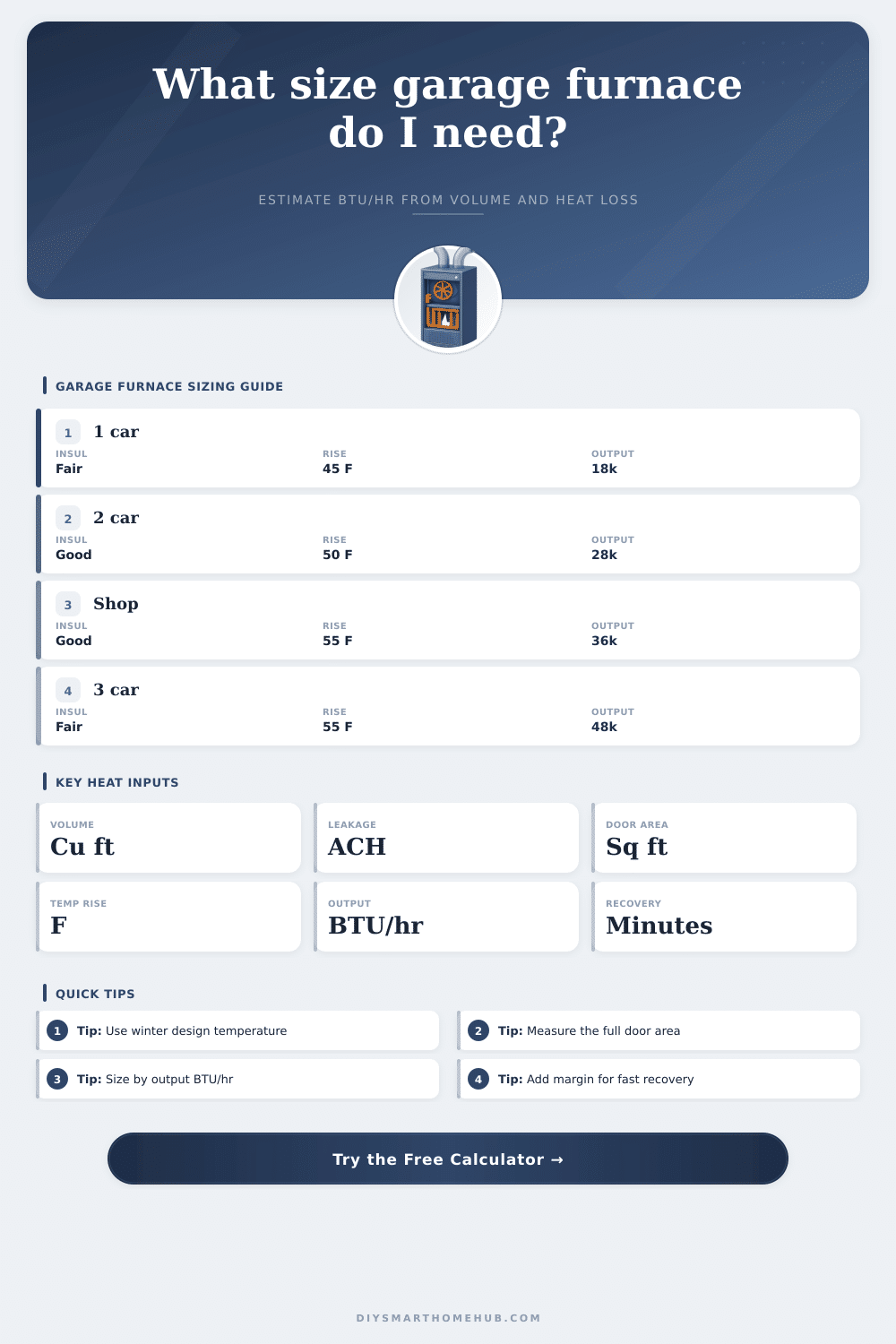
Garage Furnace Size Calculator
Estimate garage heater output from volume, insulation, design temperature rise, air leakage, door area, warm-up recovery time, and furnace efficiency.
🏠Real Garage Presets
Choose a starting point, then adjust the exact dimensions, winter design temperature, leakage, and door area for your garage.
📏Garage Heat Load Inputs
🔥Live Sizing Notes
Use the output BTU/hr result when comparing unit heaters, forced-air furnaces, hydronic fan coils, or electric garage heaters. Input BTU/hr is fuel-side demand after efficiency losses.
⚙Garage Furnace Spec Comparison Grid
🔧Garage Heater Type Comparison
Gas unit heater
- Typical output30k to 75k
- Efficiency range80% to 95%
- Best load shapefast recovery
- Compare byoutput BTU/hr
Forced-air furnace
- Typical output40k to 100k
- Efficiency range80% to 98%
- Best load shapelarger zones
- Compare byduct output
Electric fan heater
- Typical output17k to 34k
- Efficiency rangenear 100%
- Best load shapesmall garages
- Compare bykW and BTU/hr
Hydronic fan coil
- Typical output20k to 80k
- Efficiency rangeboiler based
- Best load shapesteady heat
- Compare bycoil output
📊Reference Table: Insulation Assumptions
| Insulation profile | Wall U-factor | Ceiling U-factor | Door U-factor |
|---|---|---|---|
| Uninsulated shell | 0.300 BTU/hr sq ft F | 0.220 BTU/hr sq ft F | 0.500 BTU/hr sq ft F |
| Poor or partial insulation | 0.180 BTU/hr sq ft F | 0.120 BTU/hr sq ft F | 0.330 BTU/hr sq ft F |
| Fair insulated garage | 0.100 BTU/hr sq ft F | 0.060 BTU/hr sq ft F | 0.200 BTU/hr sq ft F |
| Good insulated garage | 0.060 BTU/hr sq ft F | 0.035 BTU/hr sq ft F | 0.120 BTU/hr sq ft F |
| Excellent garage envelope | 0.040 BTU/hr sq ft F | 0.025 BTU/hr sq ft F | 0.080 BTU/hr sq ft F |
🌬Reference Table: Air Leakage Impact
| Leakage profile | ACH used | When it fits | Formula effect |
|---|---|---|---|
| Tight, weatherstripped | 0.45 ACH | Insulated door, sealed plates, minimal gaps | 1.08 x CFM x temp rise |
| Normal attached garage | 0.80 ACH | Typical sectional door and average weatherstrip | Higher CFM through shell gaps |
| Drafty detached garage | 1.35 ACH | Visible door gaps or unsealed wall penetrations | Infiltration may dominate load |
| Very drafty doors | 2.10 ACH | Older wood doors, loose jambs, frequent air wash | Can exceed envelope BTU/hr |
📝Reference Table: Common Garage Outputs
| Garage case | Typical volume | Design rise | Common output range |
|---|---|---|---|
| Compact one-car | 1,800 to 2,200 cu ft | 40 to 50 F | 14,000 to 24,000 BTU/hr |
| Two-car attached | 3,800 to 4,800 cu ft | 45 to 55 F | 24,000 to 40,000 BTU/hr |
| Detached workshop | 4,800 to 6,500 cu ft | 50 to 65 F | 34,000 to 55,000 BTU/hr |
| High-ceiling lift bay | 7,500 to 10,000 cu ft | 45 to 60 F | 45,000 to 75,000 BTU/hr |
🧮Reference Table: Formula Breakdown
| Load part | Formula used | Inputs | Result unit |
|---|---|---|---|
| Garage volume | Length x width x height | Interior dimensions | cu ft |
| Envelope heat loss | Area x U-factor x temp rise | Walls, ceiling, slab, door | BTU/hr |
| Air leakage heat loss | 1.08 x CFM x temp rise | Volume and ACH | BTU/hr |
| Recovery heat | 0.018 x volume x rise x 60 / minutes | Air mass and warm-up target | BTU/hr |
| Input rating | Output BTU/hr / efficiency | Selected efficiency | BTU/hr input |
💡Sizing Tips
A 45,000 BTU/hr input heater at 80% efficiency delivers about 36,000 BTU/hr. The calculator reports both so equipment labels can be compared correctly.
The overhead door adds conductive heat loss through its U-factor and often signals higher air leakage. Measure the full door panel area before choosing a heater size.
Choosing an garage furnace requires you to understand how heat leave a garage. Choosing a garage furnace requires that you look at various factor beyond the square footage of the garage floor. Many people looks only at the square footage of the garage floor.
However, there are other factors related to heat loss, such as the height of the ceiling, the quality of the insulation, how often the door to the garage are opened, and the outside air temperature in the winter months. For instance, a garage that shares a wall with a house will experience different levels of heat loss than a detached shop. Similarly, a detached shop that use an old door that does not fit the frame will lose heat differently than a garage that share a wall with a house.
How to Choose the Right Garage Furnace
The first step in calculating the heating load for a garage is to determine the volume of air in the garage that must be warmed. The length, width and height of the garage determine the volume of air in the garage. Once you know the length, the width and the height of the garage, you can calculate the volume of air that must be warmed from the winter design temperature to the target temperature that you would like the workshop to reach and maintain.
The difference between the design temperature and the target temperature is a critical number in the calculation of the heating load for the garage. For instance, maintaining a temperature of sixty degrees in the garage when the outside temperature is ten below zero is different than maintaining a temperature of fifty-five degrees in the garage when the outside temperature is twenty degrees. A heating load calculator take care of the math for you so you dont have to calculate the math by hand.
Next, you must consider how well insulated the garage is. Insulation controls the rate at which the heat is conducted through the walls, the ceiling and the edge of the garage slab. A garage with fair insulation will naturaly lose heat through one or more of the overhead doors or uninsulated walls, while a garage with excellent insulation will lose significantly less heat.
The level of heat loss due to poor insulation will determine the size of the furnace that you need in the garage. Air exchange is another factor that naturally works in the same manner as poor insulation. For instance, a garage that features tight seals around the door with weather-stripping will naturally lose less heat than a garage whose door is drafty and allows for significant air exchange.
Additionally, because air contains heat, the greater the amount of air movement in the garage, the more heat that the garage furnace must replace. Recovery time is another factor that must be considered in the heating load calculation. For instance, if you desire the garage to reach the target temperature in forty-five minutes instead of two hours after the garage door is opened, the heating load calculation must factor in the extra capacity that the furnace will require to reach that target temperature in the shortened period of time.
The output rating for the furnace will reflect that extra capacity. Thus, the output rating is the number that you use to compare different models of garage furnaces. A different number, known as the input rating, indicates the amount of fuel that the furnace will consume during the heating cycle.
These two numbers are related to each other by the efficiency of the furnace. For instance, an eighty-two percent efficient furnace will consume more fuel than a ninety-five percent efficient furnace to accomplish the same level of heat output. Many people tend to purchase a garage furnace that is sized larger than the heating load calculation.
The desire for a powerful garage heater or the memory of one of the coldest periods in the past couple of years may cause these homeowners to purchase a furnace that is too large for their needs. You must provide a margin above the original heating load calculation to account for the opening of the garage door, but a margin that is too large can cause the furnace to short cycle, especially on days when the outdoor temperature is relatively mild. Reference tables on the webpage illustrate the level of insulation and air exchange in various rates to the heat loads that they produce.
These tables can help you to understand if your garage experiences typical conditions or extreme conditions relative to heat loss. There are different types of garage heaters from which to choose. Electric garage heaters do not involve combustion.
However, because electric heaters are typically more expensive to operate than gas heaters, they may cost more to operate in many regions of the country. Gas unit heaters can quickly heat a garage and can typically be connected to the gas lines that supply fuel to vehicles in the garage. Hydronic garage heaters work well if you already have a boiler in your home, but the response time for temperature changes with hydronic heaters is relatively slow.
The type of furnace that you decide to purchase will depend upon how you use the garage and the type of fuel that is available at the site where the garage is located. Once you know the different factors that impact the heating load for the garage, the decision process for purchasing a furnace becomes relatively simple. For instance, you must purchase a garage heater whose output rating is similar to the heating load that the load calculator calculated.
The input rating for the furnace must also meet your requirements for fuel supply. Finally, the type of heater must meet any requirements that exist in relation to how you use the garage. By following these steps, you will ensure that you do not purchase a garage furnace that is too small to heat the garage in the winter months or that you dont overspend on purchasing a furnace that is too large for the heating requirements of the garage.