Sensor Size Crop Factor Calculator
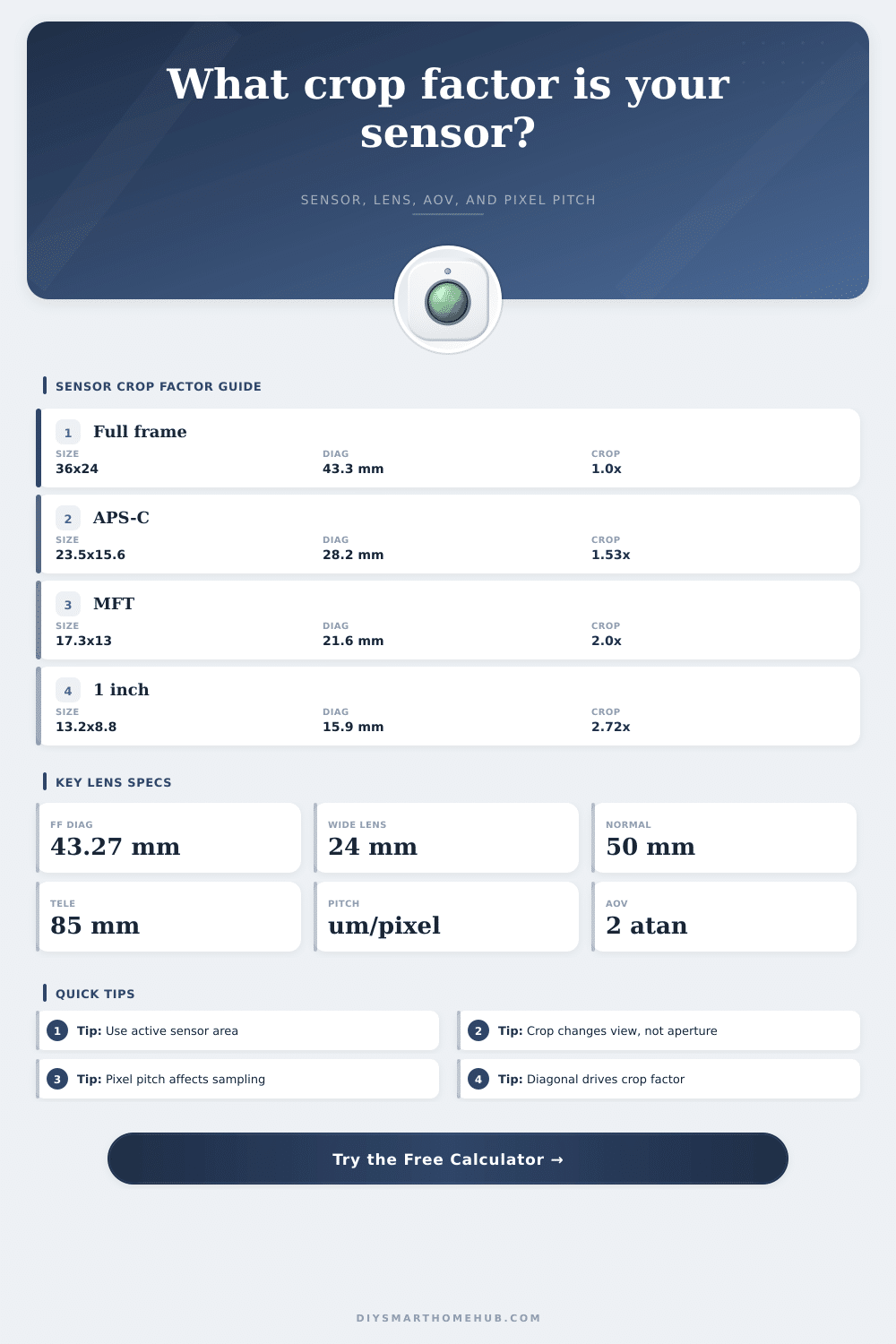
Compare camera sensor diagonal, crop factor, full-frame equivalent focal length, horizontal and vertical angle of view, pixel pitch, and diffraction sampling from real sensor dimensions.
🎯Real camera and sensor presets
⚙Sensor, lens, and sampling inputs
Sensor crop and lens equivalence results
📊Current sensor and optics snapshot
🗂Camera and sensor spec comparison grid
| Preset / format | Active sensor | Resolution example | Diagonal | Crop factor | Pixel pitch |
|---|---|---|---|---|---|
| Full frame 45MP stills | 36.0 x 24.0 mm | 8192 x 5464 | 43.27 mm | 1.00x | 4.39 microns |
| Sony APS-C 26MP | 23.3 x 15.5 mm | 6192 x 4128 | 27.99 mm | 1.55x | 3.76 microns |
| Fujifilm APS-C 40MP | 23.5 x 15.6 mm | 7728 x 5152 | 28.21 mm | 1.53x | 3.04 microns |
| Canon APS-C 32MP | 22.3 x 14.9 mm | 6960 x 4640 | 26.83 mm | 1.61x | 3.20 microns |
| Micro Four Thirds 20MP | 17.3 x 13.0 mm | 5184 x 3888 | 21.64 mm | 2.00x | 3.34 microns |
| 1 inch type compact | 13.2 x 8.8 mm | 5472 x 3648 | 15.86 mm | 2.73x | 2.41 microns |
| 44 x 33 medium format | 43.8 x 32.9 mm | 11648 x 8736 | 54.78 mm | 0.79x | 3.76 microns |
| Super 35 video crop | 24.6 x 13.8 mm | 4096 x 2304 | 28.20 mm | 1.53x | 6.00 microns |
📐Reference tables
| Sensor class | Typical active size | Diagonal | Crop factor | What changes in framing |
|---|---|---|---|---|
| 44 x 33 medium format | 43.8 x 32.9 mm | 54.78 mm | 0.79x | Wider view than full frame from the same focal length. |
| Full frame | 36.0 x 24.0 mm | 43.27 mm | 1.00x | The calculator reference for equivalent focal length. |
| APS-C large | 23.5 x 15.6 mm | 28.21 mm | 1.53x | A 35 mm lens frames like about 54 mm on full frame. |
| APS-C Canon | 22.3 x 14.9 mm | 26.83 mm | 1.61x | Slightly tighter than 1.5x APS-C formats. |
| Micro Four Thirds | 17.3 x 13.0 mm | 21.64 mm | 2.00x | A 25 mm lens frames like a 50 mm full-frame lens. |
| 1 inch type | 13.2 x 8.8 mm | 15.86 mm | 2.73x | Short actual lenses create familiar compact-camera views. |
| 1/1.3 phone type | 9.6 x 7.2 mm | 12.00 mm | 3.61x | Very short actual focal lengths can still look wide. |
| Actual focal length | Full frame | APS-C 1.5x | Micro 4/3 2x | 1 inch 2.7x | Common reading |
|---|---|---|---|---|---|
| 12 mm | 12 mm equivalent | 18 mm equivalent | 24 mm equivalent | 33 mm equivalent | Ultra-wide to wide depending on sensor. |
| 16 mm | 16 mm equivalent | 24 mm equivalent | 32 mm equivalent | 44 mm equivalent | Wide on full frame, normal-ish on 1 inch. |
| 24 mm | 24 mm equivalent | 36 mm equivalent | 48 mm equivalent | 65 mm equivalent | Classic wide becomes normal or short tele. |
| 35 mm | 35 mm equivalent | 53 mm equivalent | 70 mm equivalent | 95 mm equivalent | Documentary lens becomes portrait-leaning. |
| 50 mm | 50 mm equivalent | 75 mm equivalent | 100 mm equivalent | 136 mm equivalent | Normal lens becomes portrait or tele. |
| 85 mm | 85 mm equivalent | 128 mm equivalent | 170 mm equivalent | 232 mm equivalent | Portrait lens becomes tight telephoto. |
| Calculation | Formula | Input variables | Why it matters |
|---|---|---|---|
| Sensor diagonal | sqrt(width² + height²) | Active sensor width and height in mm | Diagonal is the basis for the crop factor. |
| Crop factor | 43.27 / sensor diagonal | Full-frame diagonal and active diagonal | Converts actual focal length to equivalent framing. |
| Equivalent focal length | actual focal length x crop factor | Lens focal length and crop factor | Compares angle of view across sensor sizes. |
| Angle of view | 2 x atan(sensor side / (2 x focal length)) | Width, height, diagonal, and lens focal length | Shows the real horizontal, vertical, and diagonal view. |
| Pixel pitch | sensor side microns / pixels | Sensor dimensions and recorded pixels | Connects resolution density with sampling and diffraction. |
| Airy disk diameter | 2.44 x wavelength x f-number | 0.55 micron light and aperture | Flags when diffraction spot size exceeds pixel pitch. |
| Equivalent focal band | Horizontal AOV signal | Typical use | Pixel pitch interaction |
|---|---|---|---|
| Under 24 mm equivalent | Very wide field | Rooms, architecture, action cameras, drone establishing shots | Small pixels may still resolve fine center detail, but edges depend on lens quality. |
| 24 to 35 mm equivalent | Wide natural view | Travel, interiors, street, smart camera context views | Higher pixel counts help crop while keeping broad coverage. |
| 35 to 60 mm equivalent | Normal perspective | General stills, product photos, home documentation | Pixel pitch mainly affects noise and diffraction tolerance. |
| 60 to 135 mm equivalent | Tight perspective | Portraits, details, distant objects | Dense sensors demand steadier technique and stronger optics. |
| Over 135 mm equivalent | Narrow telephoto | Wildlife, moon, license-plate-style detail, far subjects | Pixel pitch and focal length make motion blur more visible. |
💡Crop factor planning tips
Crop factor is a measurement that compares the sensor sizes of a specific camera to that of a traditional full-frame sensor. Full-frame sensors contain a diagonal measurement of approximately 43 millimeter. If the sensor sizes of a specific camera is smaller than that of a full-frame sensor, the crop factor will be a number greater than one.
A crop factor that is greater than one indicates that the lens will cover a smaller area of the scene. If the sensor size of the camera is larger than that of a full-frame sensor, such as if it is a medium format sensor, the crop factor will be a number less than one. A crop factor that is less than one, however, indicates that the lens will cover a wider area of the scene.
How crop factor changes what your camera sees
Thus, crop factor is a measurement that determine the amount of a scene that a specific cameras lens will record. The angle of view of a scene is also affected by the crop factor of the sensor. As the crop factor increase, the horizontal and vertical angles of view will decrease.
A decreased angle of view means that the scene that the sensor captures appears more zoom in. For instance, if a photographer use a 50 millimeter lens on a sensor with the same size as a full-frame sensor, the angle of view will be normal. However, using the same 50 millimeter lens on a sensor that is smaller than a full-frame sensor will result in a more zoomed-in image.
Thus, cameras with high crop factors, such as smartphones, often use lenses with a short focal length to provide the viewer with a wide angle of view. The crop factor is also related to the pixel pitch of the sensor. Pixel pitch is a measurement of the distance between the photosites of the sensor.
Pixel pitch is important in that pixel pitch determines the resolution of the sensor. Sensors with high pixel densities has many small pixels on the sensor. High pixel densities allow for high resolutions, but the small size of the pixels relates to the concept of diffraction.
If the pixels of a sensor have a small pixel pitch, diffraction will occur more easily when using a small aperture to gain depth of field. Diffraction is the spreading of light waves as they pass through the aperture of a lens. As the f-number increases, the diameter of an Airy disk increases.
An Airy disk is a pattern of bright spots created by diffraction. If the diameter of the Airy disk is larger than the pixel pitch of the sensor, the resulting image will appear softly. By entering the pixel pitch of the sensor into a calculator that calculates the diameter of the Airy disk, the photographer can determine if using an aperture with a high f-number will negatively impact the sharpness of the image.
Thus, using an increased depth of field can result in a loss of image sharpness. Finally, crop factor is related to video recording. Many cameras that record video dont utilize the entire sensor of the camera for recording video.
For instance, video cameras utilize only a portion of the sensor to record 4K video. By utilizing only a portion of the sensor for recording video, the effective crop factor is increased. This increased crop factor results in a field of view while recording video that is narrower than that of the still images of the camera.
By entering the extra video multiplier of the sensor into a calculator that calculates the sensors field of view, photographers can understand how the video will appear to the viewer. Additionally, the distance of the subject of the photograph and the width of the scene in the photograph is also affected by crop factor. For instance, at a certain distance from the subject, a lens will cover a certain width of the scene.
A lens on a full-frame sensor will cover a wider area than a lens on a smaller sensor at the same distance. Thus, crop factor affects the area of the environment that is included in the photograph. The pixel density of the sensor also affects how much cropping is allowed in post-production software.
For instance, an APS-C sensor with 40 megapixels will have a higher pixel density than a full-frame sensor with 24 megpixels. Thus, the APS-C sensor will allow for more cropping. High pixel densities, however, also indicate that the pixels of the sensor are small in size.
Small pixels also indicate that more diffraction will occur in relation to the aperture of the lens. Many photographers make mistake when they confuse the actual focal length of the lens with the equivalent focal length. The actual focal length is the physical length of the lens.
The equivalent focal length is the focal length after the crop factor is applied to the lens. Thus, a 35 millimeter lens will always be a 35 millimeter lens. On an APS-C sensor, however, a 35 millimeter lens will cover the same angle of view as a 53 millimeter lens.
By entering both the crop factor and the equivalent focal length into the calculation software, photographers can avoid making the mistake of confusing these two different measurements. You should of checked the specs first.