TV Wall Mount Height Calculator
Estimate the screen center, bottom edge, top edge, and wall plate center from seated eye height, screen diagonal, aspect ratio, viewing distance, tilt angle, and VESA center offset.
Recommended wall marks
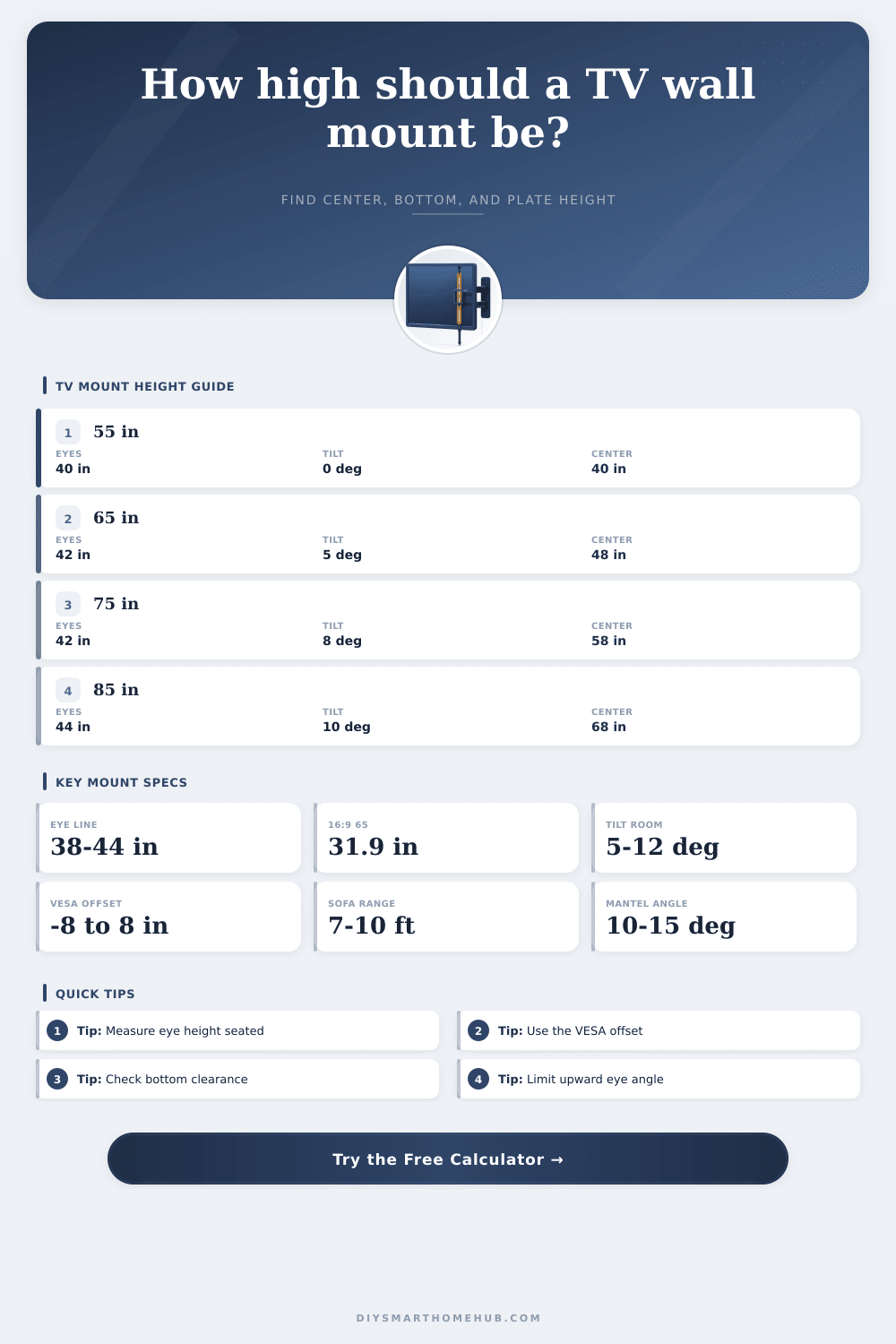
A 55 in 16:9 TV with level seating places the screen center near seated eye height.
| Screen diagonal | 16:9 width | 16:9 height | Half height | Center at 42 in gives bottom |
|---|---|---|---|---|
| 43 in | 37.5 in / 95 cm | 21.1 in / 54 cm | 10.5 in / 27 cm | 31.5 in / 80 cm |
| 55 in | 47.9 in / 122 cm | 27.0 in / 69 cm | 13.5 in / 34 cm | 28.5 in / 72 cm |
| 65 in | 56.7 in / 144 cm | 31.9 in / 81 cm | 15.9 in / 40 cm | 26.1 in / 66 cm |
| 75 in | 65.4 in / 166 cm | 36.8 in / 93 cm | 18.4 in / 47 cm | 23.6 in / 60 cm |
| 85 in | 74.1 in / 188 cm | 41.7 in / 106 cm | 20.8 in / 53 cm | 21.2 in / 54 cm |
| Mount situation | Typical eye height | Useful center target | Angle cue | Calculator input to watch |
|---|---|---|---|---|
| Standard sofa | 38-42 in / 97-107 cm | center near eye line | 0-5 deg upward | eye height and center offset |
| Deep sectional | 39-44 in / 99-112 cm | slightly above eye line | 3-7 deg upward | viewing distance |
| Bedroom reclined | 44-54 in / 112-137 cm | above seated sofa height | 5-10 deg upward | eye height from pillow position |
| Over mantel | 38-44 in / 97-112 cm | clearance often dominates | 8-15 deg upward | tilt angle and bottom edge |
| Meeting room | 44-58 in / 112-147 cm | raised for rear viewers | depends on first row | standing visibility priority |
| Bracket or rail layout | Common VESA pattern | Likely offset | What the calculator does | Field check |
|---|---|---|---|---|
| Centered fixed plate | 200x200 to 600x400 | 0 in / 0 cm | plate mark equals screen center | confirm rails are symmetrical |
| Low-hook tilt rails | 300x200 to 600x400 | +2 to +5 in / +5 to +13 cm | raises plate mark above screen center | measure hook line after rails attach |
| Full-motion arm | 200x200 to 400x400 | -2 to +4 in / -5 to +10 cm | moves lag-bolt layout from visual center | check arm plate centerline |
| Soundbar or adapter rails | varies | -6 to +6 in / -15 to +15 cm | keeps screen height separate from accessory hardware | mark TV center first, hardware second |
| Preset | Display | Distance | Recommended center | Wall plate note |
|---|---|---|---|---|
| 55 in sofa wall | 55 in 16:9 | 8 ft / 2.44 m | 40 in / 102 cm | plate follows VESA offset |
| 65 in family room | 65 in 16:9 | 9 ft / 2.74 m | 48 in / 122 cm | mild tilt has reserve |
| 75 in media room | 75 in 16:9 | 10.5 ft / 3.20 m | 43 in / 109 cm | low bottom for theater feel |
| 65 in over mantel | 65 in 16:9 | 10 ft / 3.05 m | 61 in / 155 cm | use measured positive offset |
| 49 in ultrawide | 49 in 32:9 | 4 ft / 1.22 m | 43 in / 109 cm | short height changes edge marks |
Mounting a television at the correct height require specific measurements. Mounting a television at the correct height will help to avoid developing neck strain while watching the television. Many peoples will likely skip the necessary measurements to determine where to mount the television.
The measurements of eye height, viewing distance, and screen height will all be used to determine where to mount the television. If these measurements are not used to mark the wall, the television will not be mounted at the correct height for the viewer’s eyes. The size of the television does not necessarily provide information regarding where to mount the television at it’s correct height.
How to Mount a TV at the Right Height
The aspect ratio of the television can change the height of the television. For instance, televisions with a 16:9 aspect ratio will be taller than those with a 21:9 aspect ratio, even with the same screen size. Therefore, the center and the bottom edge of the television will be mounted at different heights on the wall to account for the aspect ratio of the television.
Seated eye height is one of the most critical measurements for determining the location of the television. Seated eye height is measured from the finished floor to the center of the viewer’s eyes when they are sitting in their viewing position. Using standing eye height will result in the television being mounted too high.
For instance, if the viewer is known to slouch when they sit in their chair, their seated eye height will be lower than if they are sitting in a firm chair with back support. Small changes in seated eye height can have a great effect on the eye level where the television should be centered, so it is crucial that this measurement is properly obtained. Another critical measurement is viewing distance.
Viewing distance will affect the angle of the viewer’s eyes relative to the television screen. For instance, if the viewing distance is great, the viewing angle will be steeper than if the viewing distance is smaller. Using a steep viewing angle will result in neck strain for the viewer.
Additionally, if the television is mounted too low, the viewer will have to look down at the screen which can also result in neck strain. The television wall mount calculator will use the viewing distance to determine where to mount the television to provide the viewer with the most comfortabley viewing angle. In addition to calculating where to mount the television relative to the viewer’s eyes, there may also be a tilting mount for the television.
By tilting the screen, either up or down, the center of the screen can be raised or lowered on the wall. For instance, tilting the screen downward will raise the center of the screen, but will cause the bottom edge of the screen to move closer to the wall. In this case, the television may not be visible to viewers if it is too close to the wall.
Therefore, the viewer should use the television calculator to determine the position of both the center of the screen and the bottom edge of the screen to ensure that the screen will be viewable to all desire viewers. Another measurement that many people will likely forget when mounting a television is the VESA offset. The VESA offset is the distance between the mounting bracket of the television to the center of the screen.
For instance, the mounting bracket may be positioned above the center of the screen or it may be positioned below the center of the screen. Therefore, marking the wall at the center of the screen will cause the television to not be mounted at the correct height to the viewer if the VESA offset is not accounted for. The aspect ratio can have an impact upon the height at which the screen should be mounted.
Additionally, because the aspect ratio can change the height of the television, it will also impact the placement of the bottom edge of the screen. For instance, if the television is ultrawide, it will be shorter in height than a standard 16:9 television. Therefore, the bottom edge will be mounted at a higher point on the wall.
The television calculator will account for the aspect ratio automatically so that the calculations for the bottom edge and the center of the screen will be accurate regardless of the aspect ratio of the television. People make many mistakes when mounting a television. One of the most common is using the wrong reference point when measuring the height of the television.
For instance, people may use their standing eye height rather than their seated eye height. Using standing eye height will result in the screen mounted too high. Additionally, some people use the bottom edge of the screen as their reference point.
In this case, the center of the screen will be too low. To avoid these and other mounting errors, people should of utilized the measurements calculated by the wall mount calculator to determine where to mount the television. The location of the television within the house can also play a role in the ideal viewing height of the screen.
For instance, if the television is located within the bedroom, the viewer may recline on the chair when watching the screen. Therefore, if the viewer’s eyes are higher when watching the screen when reclined, their eyes may be closer to the center of the screen. Another example is of the location of the screen within the media room.
In this case, viewers may be using the dedicated seating for the media room so that their eyes are closer to the screen when they are watching screen content. In an open-plan room, a compromise height may have to be made so that the screen is viewable by all individual in the room. The television mount calculator will provide three specific markings for the user.
These markings will include the screen center, the wall plate center, and the bottom edge marking of the screen. Additionally, the vertical viewing angle will be provided for the user to ensure that it is not too steep. Using these four markings will allow the viewer to avoid the manual calculations that could potentially be made.
Using these markings will allow the viewer to mount the television to their desired height and ensure that it is mounted at the correct height for their specific home and room for the screen.