Smart Pet Feeder Refill Calculator
Estimate how many days a smart feeder hopper can run before the low-level mark, how much food stays in reserve, and whether your planned refill interval fits the bin.
📌Quick feeder presets
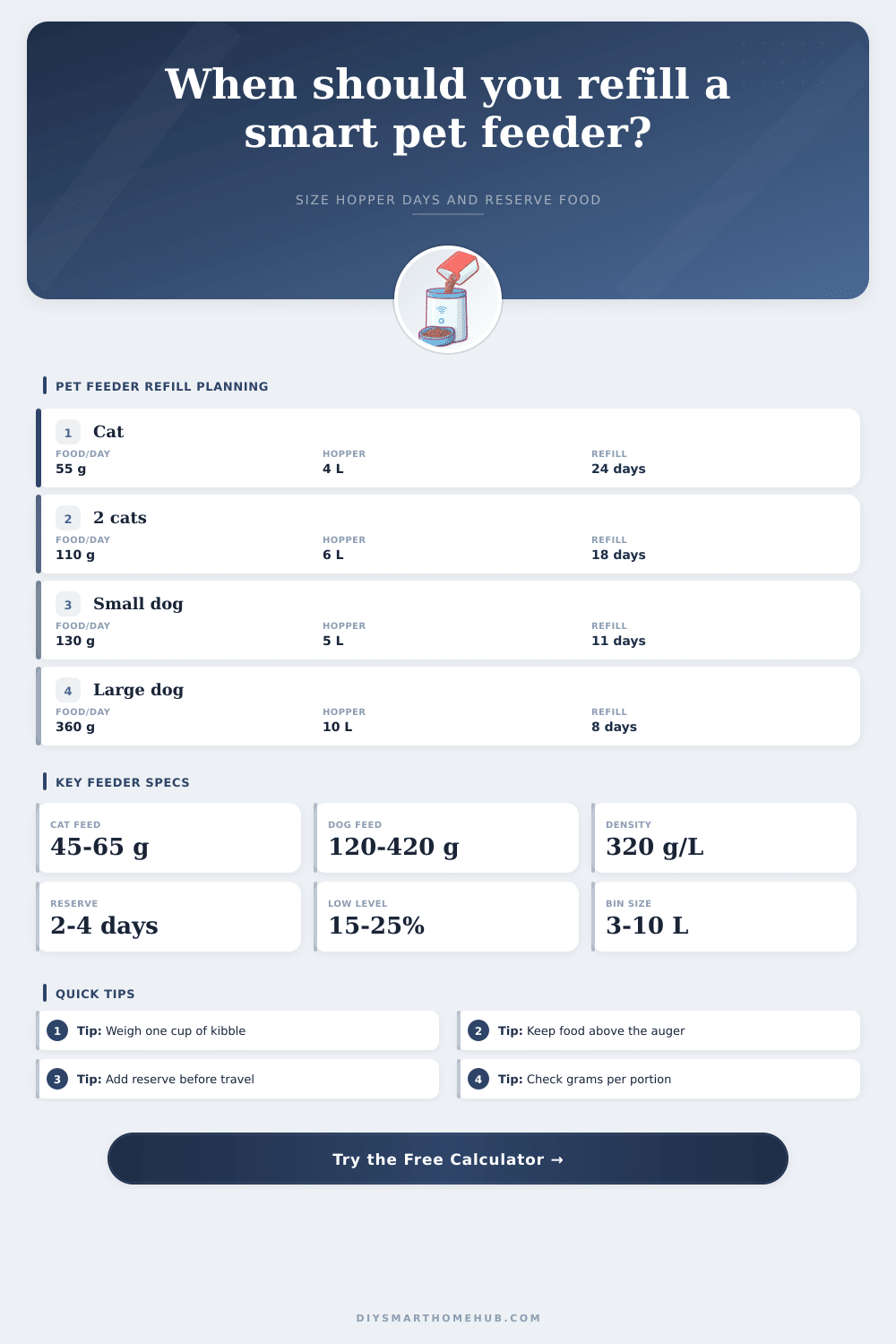
Preset values use common dry-kibble densities and measured daily gram targets. Replace them with your feeder label volume and the weight from your own kibble cup for the closest result.
⚙Feeder inputs
📊Refill results
📦Feeder/bin spec comparison grid
📋Kibble density reference
| Kibble style | Typical density | US cup weight | Calculator use |
|---|
📏Hopper threshold reference
| Threshold | Food left unused | Best fit | Refill behavior |
|---|
🔍Feeder size comparison table
| Bin class | Nominal volume | Practical grams | Typical use |
|---|
🐾Common refill scenarios
| Scenario | Daily draw | Low threshold | Safe refill estimate |
|---|
The refill calculator is a tool that help calculate the number of days that a pet feeder will provide food for the pet. The calculator provides a safe window of time during which to feed the pet. These values can be used to determine if a fourteen-day trip will be safe for the pet with food provided by the feeder, or to determine if more food is needed to last the pet for a given period of time.
The inputs for the calculator describe the physical limits of the feeder. These limit are required to provide an accurate calculation of the length of time that the food will last. The volume of the hopper describe the size of the feeding area for the pet, but the effective volume is less due to the need for space for the auger or paddle wheel to move.
How the Refill Calculator Works
The density of the kibble can vary based off the shape of the food, as the amount of air that exists between the kibble pieces may differ. The daily grams of kibble that each pet eats is an input that is required to calculate the number of days that the food will last in the feeder. However, the daily grams can change if the pet experiences a growth spurt, or if the pet changes diets.
The number of days of food that is to be reserved in the feeder (when the automated dispenser is off) and the threshold of food that is detected in the feeder are two different ways to calculate the amount of food that is to remain in the feeder at all times. The calculator incorporates mathematical processes to calculate the number of days of food that the feeder will provide for the pet. First, the calculator mathematically multiplies the volume of the hopper by the density of the kibble to calculate the total grams of food that is contained within the feeder.
Second, the calculator multiplies the total grams of food that is contained within the feeder by the threshold of food in the feeder to calculate how many gram of food is dispensed by the feeder; the remainder of the total grams is the usable food. Third, the calculator mathematically subtracts the amount of food that the pet owner reserves from the amount of usable food; the remainder of the total grams is the amount of food that the pet will eat before the feeder must be refilled. Finally, the calculator divides the amount of food that can be eaten by the pet before the feeder must be refilled by the number of grams of food that the pet is provided each day; the result is the number of days that the food will last within the feeder.
A number of factors in the real world can impact the accuracy of the refill calculator. For instance, the humidity in the environment in which the feeder is located can cause the kibble to swell or to clump together. Such clumping can impact the amount of food that is dispensed by the feeder.
Additionally, some cats may paw at the feeder to remove the food from the dispenser. Such pawing can cause the pet owner to waste food. Finally, moving the feeder within a car can cause the kibble to settle within the dispenser.
Such settling can again impact the amount of food that may be available to the pet. While each of these factors is an individual issue, they can combine to impact the amount of food that may remain in the feeder after the dispensing cycle. Reference tables are provided for each of the factors that influence the number of days that the feeder will provide food for the pet.
For instance, tables of the density of the kibble can allow the pet owner to more accurately calculate the total amount of food that may remain in the feeder. Tables that illustrate the low-level threshold can help the pet owner to understand the trade-off between providing longer periods of food for the pet, and ensuring that the level of food in the feeder does not drop too low. The comparison of the sizes of bins that can be used for the feeder can help the owner to determine if purchasing a feeder with a larger hopper size will solve the owners problems with feeding their pet.
A pet owner can make a number of mistakes when feeding the pet with the feeder. For instance, one of the most common is to think that when the feeder alerts the pet owner that the level of food in the dispenser is low, that the feeder is empty. However, the feeder will continue to dispense food even after it has alerted the pet owner.
Additionally, the owner can set the threshold for the dispenser to a higher percentage (such as 20%) rather than a lower percentage (such as 10%) so that the owner has additional days before having to refill the feeder. However, if a second pet is added to the household, the amount of food that is consumed daily by the feeder may change. The reserve days that is required for the feeder can be used to provide food for the pets during travel, or during times when the owner is away from the pet to care for other duties.
For instance, if the owner desires to provide food for four days after the dispenser alerts the owner that the food level is low, then the owner can reserve that many days of food in the feeder. Thus, the number of days that the food will last within the feeder can be calculated. This result can allow the owner to determine whether their travel schedule will be compatible with the amount of food that can be provided by the feeder, or to make a decision about whether they need to purchase a feeder with a larger hopper size.
The same calculations can be made if the diet of the pet changes. For instance, if the diet changes to a higher-calorie food for the pet, the number of grams of food that is required to be dispensed daily will change. Similarly, if the food is lower in calories, the amount of food that is dispensed daily will change.
The refill calculator does not account for factors related to the age of the feeder. For instance, the auger that dispenses the food may wear down over time. The sensors that measure the level of food in the feeder may accumulate dust over time.
Additionally, the plastic that makes up the feeder may accumulate micro-scratches with use over time, which may cause the food to stick to the feeder. As a result of these changes in the feeder, the calculation that was performed when the feeder was new may no longer be accurate. Thus, it is recommended that the owner checks the weight of the food in the feeder against the amount that is calculated by the refill calculator to ensure that the calculations are accurate.
The refill calculator is accurate in providing a number of days that the food will last in the feeder, but does not provide a guarantee that the food will last for that period of time. Thus, the refill calculator can be used to establish a routine for feeding the pet, but the inputs into the calculator may need to be altered according to the changes in the pet, the food, or the routines of the household. For instance, measuring the density of the food that is to be dispensed each day, and entering the number into the refill calculator will help to ensure that the feeder will provide the correct portions of food for the pet each day.
It is alot of work but its worth it. Youll see the results.