Smart Blind Motor Torque Calculator
Estimate the motor torque needed for roller shades, cellular blinds, Roman shades, dual rollers, and exterior screens from shade weight, tube radius, gear efficiency, and safety factor.
01Real blind presets
02Torque inputs
03Motor torque results
04Blind motor/spec comparison grid
Small light rollers, narrow windows, 25 to 28 mm tubes, low rail weight.
Common bedroom rollers and cellular blinds where calculated need stays below 1.2 N·m.
Wide interior solar shades, blackout fabric, and moderate cassette friction.
Large patio-facing rollers, Roman shades, long drops, and heavier hem bars.
Exterior screens, oversized fabric panels, wind bars, and higher safety-factor installs.
Commercial widths, guided side channels, very heavy textiles, or linked shade banks.
05Reference tables
| Fabric or shade material | Typical weight | Metric weight | Torque note |
|---|---|---|---|
| Light sheer roller fabric | 5 to 8 oz/yd2 | 170 to 270 g/m2 | Usually limited by tube fit more than torque. |
| Solar screen fabric | 8 to 14 oz/yd2 | 270 to 475 g/m2 | Open weave can still need rail weight for straight tracking. |
| Dimout or blackout fabric | 12 to 18 oz/yd2 | 405 to 610 g/m2 | Commonly pushes small windows into 1.5 N·m motors. |
| Roman shade fabric stack | 16 to 28 oz/yd2 | 540 to 950 g/m2 | Fold lift and rings add friction beyond fabric mass. |
| Exterior screen textile | 15 to 26 oz/yd2 | 510 to 880 g/m2 | Use stronger safety factor for side tracks and wind bars. |
| Tube radius | Metric radius | Torque multiplier | Where it appears |
|---|---|---|---|
| 0.50 in radius | 12.7 mm | 0.67x vs 0.75 in | Small battery shade tubes and light rollers. |
| 0.75 in radius | 19.1 mm | 1.00x baseline | Many 1.5 in outside-diameter roller tubes. |
| 1.00 in radius | 25.4 mm | 1.33x vs 0.75 in | Stiffer tubes for wider solar and blackout shades. |
| 1.25 in radius | 31.8 mm | 1.67x vs 0.75 in | Large tubes, exterior screens, and long spans. |
| 1.50 in radius | 38.1 mm | 2.00x vs 0.75 in | Heavy commercial tubes where deflection control matters. |
| Blind construction | Model factor | Efficiency range | Recommended safety factor |
|---|---|---|---|
| Free-hanging roller shade | 1.00x | 75% to 85% | 1.5x to 1.8x for interior use. |
| Cellular or honeycomb blind | 1.08x | 65% to 78% | 1.7x to 2.0x because cord paths add drag. |
| Roman shade with folds | 1.25x | 60% to 72% | 1.9x to 2.3x for ring and fold friction. |
| Dual roller or cassette pair | 1.32x | 60% to 75% | 1.9x to 2.2x when two fabrics share one drive. |
| Exterior screen with wind bar | 1.45x | 55% to 70% | 2.1x to 2.6x for guides, dirt, and weather. |
| Guided skylight or incline shade | 1.18x | 60% to 75% | 1.8x to 2.2x for rails and angled travel. |
| Preset scenario | Shade area | Moving weight | Typical motor class |
|---|---|---|---|
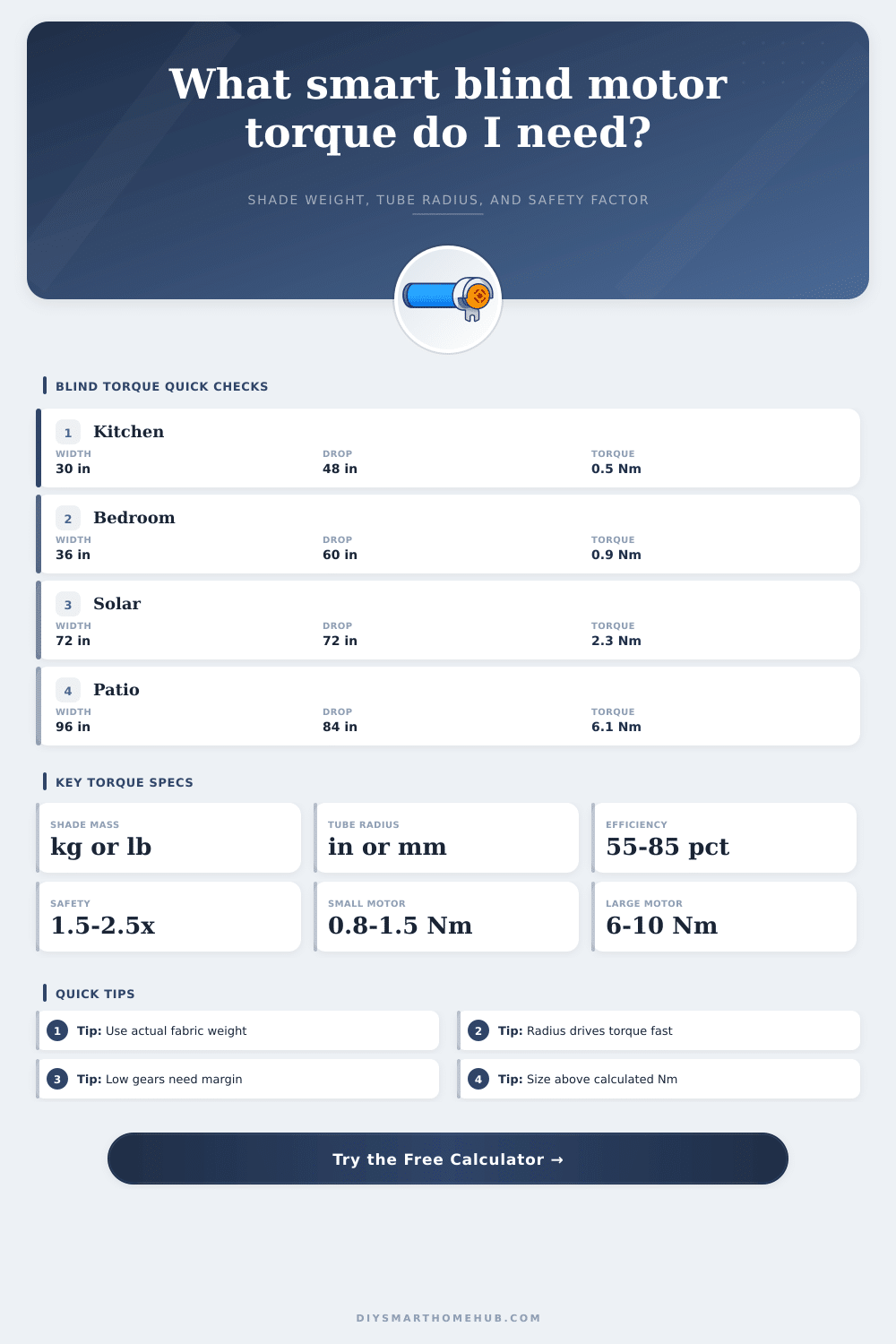
| Kitchen light screen | 10.0 ft2 / 0.93 m2 | 1.1 lb / 0.5 kg | 0.8 N·m micro motor. |
| Bedroom blackout roller | 15.0 ft2 / 1.39 m2 | 2.6 lb / 1.2 kg | 1.5 N·m compact motor. |
| Wide woven solar shade | 36.0 ft2 / 3.34 m2 | 7.0 lb / 3.2 kg | 3 N·m standard motor. |
| Roman living-room shade | 20.0 ft2 / 1.86 m2 | 6.2 lb / 2.8 kg | 3 to 6 N·m depending on folds. |
| Exterior patio screen | 56.0 ft2 / 5.20 m2 | 14.2 lb / 6.4 kg | 6 to 10 N·m heavy motor. |
06Torque sizing tips
When you are considering the purchase of motorized blinds, you must understand how weight, geometry, and friction plays crucial roles in creating the necessary torque to operate the motor. Most individuals will consider the brand of the blinds or the brand of the remote control as a starting point for their search for motors. However, this isnt the best way to select motors for blinds.
You must determine the amount of torque that the shade require and how much extra capacity the motor should have. Shade weight is one of the primary considerations in determining the motor requirement for blinds. Shade weight is not just the weight of the fabric.
How to Choose a Motor for Your Blinds
The weight of the solar screen does not include the weight of the bottom rail, the magnets, and the side channel of the shade. Additionally, the weight of the fabric will build up on the shade tube as the shade rolls up. The calculator allows you to enter these measurement to help you find the total weight of the shade.
The radius of the shade tube is another critical measurement in calculating the torque the motor must create. If you increase the radius of the tube from half an inch to one inch, the load that the motor have to lift changes, and it may require a different motor. If the radius of the shade tube is large, it is possible that a compact motor will not have the strength to operate the shade.
In such instances, a standard or heavy-duty motor will be required. The calculator will ask for the radius of the shade tube as one of the measurements. Another consideration is gear efficiency.
If there is a gearbox within the shade tube, it may only allow three-quarters of the motors power to reach the shade. In some instances, the power that reaches the shade may be even less. To account for this, the motor that the motor calculator calculates will not be underpowered.
You can also introduce a safety factor for the motor to provide it with the extra capacity to overcome additional variable like dust within the shade or cold temperatures. Finally, the construction of the shade will affect the amount of torque the motor must provide. If the shade is a free-hanging roller shade, it will require less torque than a cellular shade because cellular shades has cord friction and resistance within each cell.
Roman shades require more torque than a cellular shade because the motor must lift folds of fabric in sequence. Finally, if the shade is an exterior screen, it will require the most torque to operate because exterior screens have wind bar or side tracks. The calculator accounts for these different shade constructions so that you dont have to memorize the different charts for different shades.
While the reference tables provide general information about the weights and motor classes for shades, the reference tables should not replace the specific calculation that are required for your specific shade. The reference tables can help you to understand how the radius of a shade will impact the torque that is required to move the shade, but the calculator will provide you with the specific torque that is required for your shade. You should not assume that every blackout shade requires the same motor, nor should you assume that every shade that is described as “wide solar” shade will be able to fit onto a small diameter shade tube.
In order to improve the accuracy of the calculations that the calculator performs, you are encouraged to use the actual weight of the moving parts of the shade rather than the weight of the shade as published by the shade manufacturer. The weight of the hem bar, the tracking weight, and the thickness of the shade as it accumulates on the tube should all be accounted for in the calculation. Most importantly, entering the weight of the bottom rail of the shade separately will prevent the shade from being underweighted in the calculation.
The figure that the calculator provides represent the minimum amount of torque that is required to move the shade. Motors that are operating near their limit will tend to slow down, lose calibration, or even fail at an earlier point in their expected lifespan than the motor that is calculated to be required for the shade. Therefore, it is recommended that you increase the size of the motor by one size in relation to the calculations, especially for battery-powered shades.
Battery-powered motors will not provide the same amount of torque when the batteries is low. In addition to the factors that are described in the calculation of the torque requirement for the shade, other factors that may increase the torque that is required for the shade may also occur. For instance, cold weather, dust, and other environmental factors may increase the required torque to move the shade.
You may use the safety factor that is provided in the calculator to account for these environmental factors. For instance, exterior screen shades may require a higher safety factor due to the impact of the wind load and temperature difference between indoors and outdoors. However, interior shades, such as those for bedrooms may require a lower safety factor.
Even at a lower safety factor, the extra torque will prevent the motor from laboring if the shade fabric has stretched over time. The purpose of the calculator is to provide you with information regarding the motor that is required for your shade based off the actual condition of the shade. Once you know the requirement for torque, it becomes easier for you to determine the diameter of the tube for the shade and the power source that will be used for the shade.
The calculator will provide you with a figure that is used to purchase the motor or to provide information to an installer of the shade.