Smart Plug Appliance Runtime Calculator
Estimate appliance runtime and kWh from smart plug readings using active watts, runtime windows, duty cycle, appliance standby load, and smart plug idle draw.
Refrigerator compressor appliance
Smart Plug Runtime Results
Preset Runtime Examples
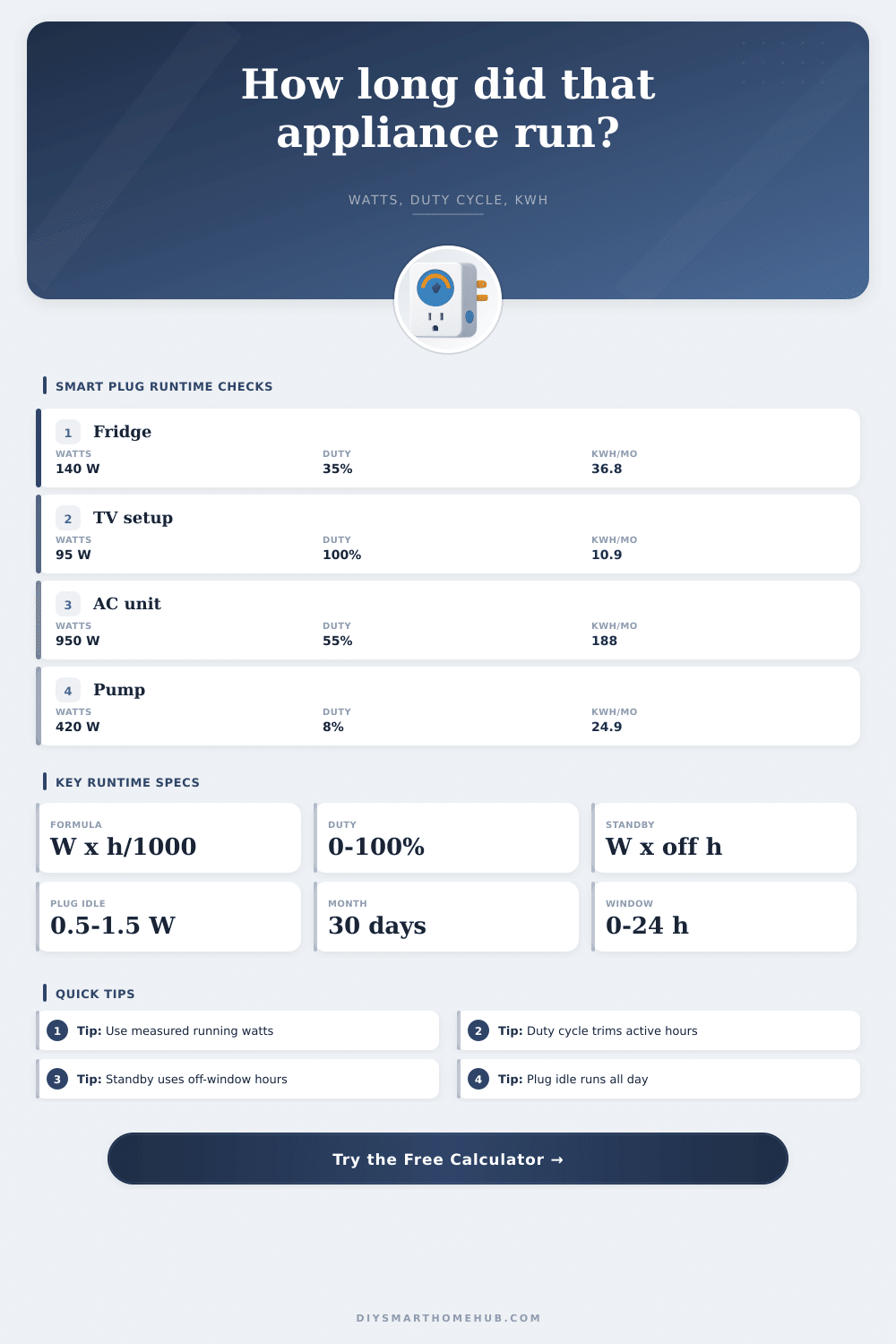
Each row uses active kWh plus appliance standby kWh plus smart plug idle kWh. The active runtime is window hours multiplied by duty cycle.
| Preset | Runtime basis | Standby basis | Estimated kWh/month |
|---|
Appliance Profile Assumptions
These are planning values for smart plug runtime math. Replace active watts and standby watts with your measured plug readings when available.
| Appliance profile | Active watts | Duty cycle | Runtime pattern |
|---|
Duty Cycle Guide
Duty cycle is the percent of the runtime window when the appliance is pulling its active watts instead of sitting in standby.
| Duty cycle | Active time in 8 h window | Best fit | Formula factor |
|---|---|---|---|
| 5% | 0.4 h active | Sump pump, short bursts | 0.05x |
| 20% | 1.6 h active | Intermittent motor or charger | 0.20x |
| 40% | 3.2 h active | Fridge, dehumidifier, aquarium heat | 0.40x |
| 60% | 4.8 h active | AC, heater thermostat cycling | 0.60x |
| 100% | 8 h active | TV, pump, fixed electronics load | 1.00x |
Formula Reference
The calculator uses only watt, hour, duty cycle, standby, and kWh formulas so the result stays tied to smart plug measurements.
| Component | Formula | What it captures | Input source |
|---|---|---|---|
| Active runtime | Window h x duty | Hours at active watts | Schedule and cycle behavior |
| Active kWh | W x active h / 1000 | Work done by the appliance | Smart plug active reading |
| Standby kWh | Standby W x off h / 1000 | Idle appliance draw | Smart plug idle reading |
| Plug idle kWh | Plug W x 24 h / 1000 | Meter and radio draw | Plug spec or measurement |
| Total kWh | Active + standby + plug | Combined daily energy | Calculated total |
Smart plugs allow for a measurement of the power that an appliance use. There is three specific measurements that can be obtained with a smart plug: the active power that the appliance uses while it is working, the standby power that the appliance uses while it is idle, and the power that the smart plug itself use. These three measurements is important in understanding the power that an appliance uses, as the power that appliances use is not constant throughout the day.
For instance, appliances like refrigerators has compressor motors that cycle on and off throughout the day, dehumidifiers may sit in standby mode for a period of time before the humidity sensor detect that the humidity in the measured area is increasing, and sump pumps only work when there is water that reaches the sump pumps float switch. Thus, if such appliances were measured without using a smart plug to separate active from standby power, the power consumption of the appliances could be incorrectly measure for each hour during which they were plugged in. Within the three measurements of a smart plug, the active watts and the standby watts are two different measurements of the power of an appliance.
How Smart Plugs Measure Power Use
Active watts measure the power of an appliance when its motor, heater, or compressor is actively performing its function. The appliance performs some essential function of itself when it measures standby watts, such as maintaining a display of the measurements of the appliances power. Each of these smart plugs makes these measurements visible for the appliance owner.
Furthermore, once the owner makes these power measurements visible to the appliance owner, the owner can decide how many hour per day that the appliance is allowed to run. Appliances like refrigerators may be allowed to run 24 hours per day, while appliances like space heaters may only be allowed to run for a few hours per day. These hours and the percentage of the allowed hours during which the appliance is active can be entered into a calculator associated with these smart plugs.
A third of the measurements of smart plugs is the concept of duty cycle. Many people dont consider the importance of the duty cycle of an appliance, yet it is a crucial concept to understand the energy use of the appliance. For instance, refrigerators that use 140 watts of power only 35% of the hours in a 24-hour day will use less energy than refrigerators that run continuous.
Furthermore, if the duty cycle increase over time, it may indicate that an appliance’s door seal is failing, or that the appliance’s coils need to be cleaned. Thus, by measuring the appliance’s duty cycle over time, it is possible to use the appliance to diagnose issues with that appliance. Beyond the concept of duty cycle, appliances also use some power while they are in a standby mode or while the appliance itself is idling.
The standby load of an appliance and the idle power of the smart plug itself will eventually add up over the course of a month to contribute to an appliance’s electricity bill. For instance, an appliance like a television console that draws 8 watts of standby power will contribute to the electricity bill after 30 days of standing by the television. Furthermore, the smart plug itself also draws some power, though less than the appliance; it draws between 0.5 watts to 1.5 watts of power around the clock.
These measurements of standby load and smart plug idle draw can only be made if they are measured separately from the active load of the appliances. Thus, the calculator maintains a category for each of these types of power use. Outside of the specifications described by the appliance manufacturer, the actual appliances in an individual’s home may behave different.
For instance, a washing machine may only run for a few hours every few days, while a laptop charging station may use 85 watts of power when it is actively charging a device, but almost no power at all when the batteries of the device are fully charge. The appliance owner can adjust these variables of each appliances runtime in the calculator, so that the calculator can accurately calculate the power use of the appliances in the home. Reference tables for each appliance allow the appliance owner to ensure that their entered values for the variables of each appliance are within the normal range for that type of appliance.
It is also important to enter the length of the observed sample of each appliances power use. Using the appliance for a single day may provide inaccurate measurements to the appliance owner due to the variability of each appliances power demands within a single day, or due to the open door in appliances like refrigerators. Using the appliance for a period of a week will smooth out any inaccurate measurements for most appliances in the home.
The length of the observed sample can be entered into the calculator, which will allow the appliance owner to project the power use of that appliance over the course of a month. This projection will allow the appliance owner to determine if the appliance is worth replacing, or if its energy use is simply the cost of using that appliance. Beyond determining the power use of each appliance in the home compared with others in the same category, it is also helpful to compare the appliances within the same category.
For instance, two different dehumidifiers may have similar ratings for power use, but one dehumidifier may be more efficient than the other due to the quality of the compressor within the dehumidifier. By entering each dehumidifier’s variables into the same calculator, the difference in their wattage can be seen. This same concept can be applied to appliances like space heaters and aquarium equipment.
The calculator allows for each appliance to be compared with one another based on its actual measurements. Beyond calculating the energy use of the appliances in the home, it is also important to take some action based upon that calculation. Some appliances will have energy use that can easily be reduced by changing some behavior in the home, while other appliances may use some of that energy that is inevitable to the operation of that appliance.
Furthermore, the separation of active power from standby power will allow the appliance owner to determine whether the cost of using that appliance is related to the active power that it uses, or if the appliances is costing the owner money due to the standby load. Thus, the numbers provided by the calculator will provide an owner with an opinion on the power use of that appliance in their home. Within the home, there may be additional appliances beyond the ones with which the appliance owner is most familiar.
By adding these appliances to the home with smart plugs and calculating their energy use, appliance owners may be surprised at the number of appliances with which they may have forgotten to account for their electricity bill. Furthermore, over time, an appliance owner can recognize some appliances as using more power than others. For instance, if the refrigerator begins to display a higher duty cycle in the summer than during the winter, it may be that the refrigerator is working harder to dissipate the heat from the summer air.
Furthermore, if the television console displays an increase in its standby power, it may indicate that one of the devices that it powers has a fault. Thus, the calculator allows for each appliance’s actual measurements to be compared with the others in the home. Similar to the reason that the measurements of each appliance must be calculated over the course of a week, rather than a single day, the measurements also compound over the course of a year.
For instance, any difference in standby power use will compound over time and contribute to the electricity bill, as will any difference in the duty cycle for the appliances. These measurements will have an impact upon the appliance owner’s electric bill, as well as the lifespan of the appliances themselves. By ensuring that each appliance owner enters each variable for each appliance in their home, their projections of the power use of those appliances will remain useful.
Furthermore, by removing the need for manual calculations for the appliances, the appliance owner can focus upon the appliances and their measurements.