CO2 PPM Calculator
Estimate indoor CO2 from room volume, occupant generation rates, outdoor baseline, ventilation by ACH or CFM, sensor accuracy, and time toward steady state.
⚙Real room presets
📏Room, people, and airflow inputs
CO2 calculation results
📊Live room specs
📘Occupancy generation reference
| Activity profile | CO2 generation used | Best fit | Calculation note |
|---|
🌬Ventilation and CO2 bands
| Reference item | Typical value | What it means | Use in calculator |
|---|---|---|---|
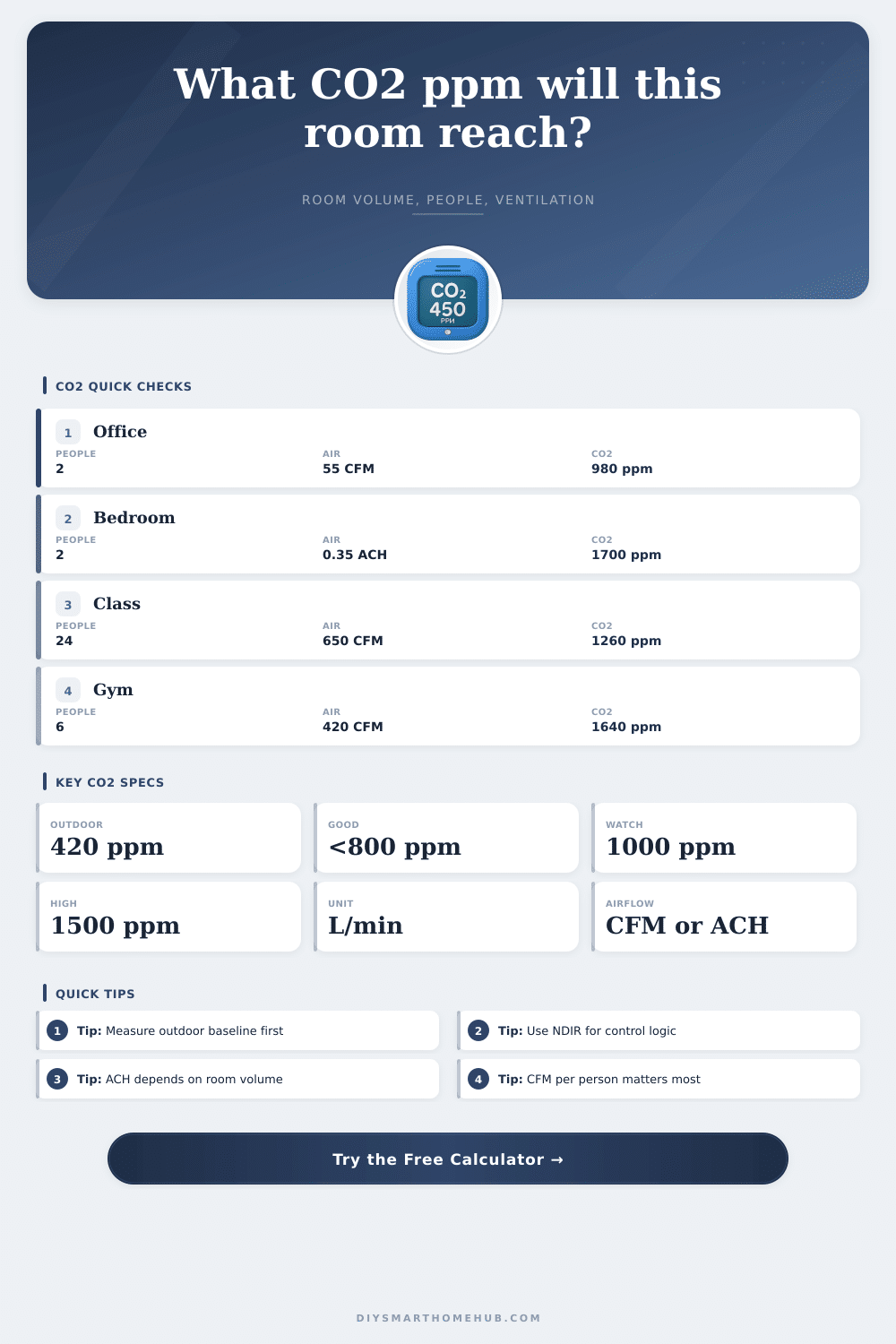
| Outdoor baseline | 400 to 450 ppm | Starting point for indoor CO2 rise | Enter your measured outdoor value when possible |
| Comfort watch line | 800 to 1000 ppm | Often used for practical room automation alerts | Set target line to match your policy |
| High occupied room | 1500 ppm and up | Signals low outdoor air per occupant | Compare against sensor high-side result |
| ACH conversion | CFM x 60 / volume | Outdoor air changes depend on room size | Useful when a fan is specified in CFM |
| CFM conversion | ACH x volume / 60 | Turns air changes into actual flow | Useful when blower door or ERV data is in ACH |
🔍Sensor and spec comparison grid
| Sensor / spec profile | Accuracy allowance | Best use | Automation caution |
|---|
🏠Common room examples
| Scenario | Room volume | Outdoor air | Likely CO2 behavior |
|---|---|---|---|
| Closed bedroom, 2 adults | 1200 to 1800 ft3 | 0.25 to 0.45 ACH | Often climbs well above 1200 ppm overnight |
| Home office, 1 to 2 people | 1000 to 2000 ft3 | 30 to 80 CFM | Usually controlled if outdoor air is continuous |
| Conference room | 2500 to 6000 ft3 | 15 to 25 CFM per person | Can rise quickly during dense meetings |
| Classroom | 8000 to 16000 ft3 | 400 to 900 CFM | Needs both volume and per-person ventilation |
| Home gym | 1500 to 4000 ft3 | 100 to 500 CFM | Exercise generation dominates the result |
Indoor air quality is the measurement of the air within a space, and the air quality within that space can affect the way that an individual feels within that space. CO2 levels increase within a space if the amount of fresh air within that space is too low for the number of individual within that space. While CO2 is not considered to be a toxic gas at most concentration, high level of CO2 within a space indicate that the room is not well-ventilated for the number of individuals within it.
A CO2 ppm calculator is a tool that an individual can use to determine the level of CO2 that are present within a space or that will be within a space, based off a few mathematical input. To determine CO2 levels within a space, the CO2 ppm calculator requires that the individual enter several different value into the calculator. These values can include, for instance, the dimension of the space, the number of individuals that are within the space, the activity level of those individuals within the space, and the amount of air that is being introduced into the space from outside source.
How to Use a CO2 Calculator
Each of these values is used in the calculation of the CO2 levels that will be present within that space. Furthermore, because each of these factor can impact the CO2 levels within a space, any changes to any of those values will impact the calculated CO2 level within the space. One of the factor that is especially critical to the CO2 ppm calculator is the activity levels of the individuals within the space.
Activity levels must be carefully choose for a few different reasons. For instance, an individual who is sleeping will produce less CO2 than an individual who is performing vigorous physical exercise. Thus, if the user is to use the CO2 ppm calculator for determining the CO2 levels within a bedroom, the activity level should be set to a low value.
In contrast, if the space that is to be calculated for is to be used as a gym, higher activity level should be selected. In addition to activity levels, another important factor that the user must enter into the CO2 ppm calculator is the outdoor baseline concentration. This value is the amount of CO2 that is present within the outside air.
While many people often assume the baseline is 400 ppm, the actual baseline in most area is between 410 and 450 ppm. This value can be adjusted in the calculator to reflect the outdoor baseline for your specific location. This value is important in creating a more accurate estimation of the CO2 levels within the space.
In addition to the outdoor baseline CO2 levels, another factor that can be entered into the calculator are the ventilation factor. Ventilation can be entered into the calculator in a variety of different way. For instance, ventilation levels can be entered in terms of the number of air change per hour that occurs within the space, or the amount of cubic feet of air per minute that is introduced into the space.
These two factor are related, and the CO2 ppm calculator can convert between these two form. Additionally, while many space often recirculate indoor air, that recirculated air does not contribute to ventilation of CO2 levels in the space. Another factor that should be considered in the CO2 ppm calculator is the accuracy of sensor that are used to determine CO2 levels.
Not all sensor are created equal in terms of accuracy of the measurements that they output. For example, low-cost sensor often read CO2 levels with a higher degree of tolerance than sensor that are manufactured as laboratory-grade sensor. Thus, the CO2 ppm calculator allows for the user to select a tolerance of sensor, which helps to provide an indication of the potential high-side reading of the sensor.
High-side reading are important to determine and understand, as the sensor may indicate higher levels of CO2 than exist in the space. Another feature that the CO2 ppm calculator can provide is the difference between steady-state calculation of CO2 levels within a space and calculation of how the CO2 levels change over time within a space. While the steady-state calculation will tell the user of the CO2 levels that will be reached within the space if the condition do not change over time, the calculation of CO2 levels over time will help an individual to understand how long it will take for a space to reach those steady-state CO2 level.
For instance, it is likely that after an hour-long meeting in a room, the CO2 levels will not have reached the steady-state CO2 level, yet after spending an overnight period within that same space, it is likely that the CO2 levels have reached its steady-state levels. Finally, while a CO2 ppm calculator is a helpful tool to estimate the levels of CO2 that may exist within a space, there are mistake that may be made in utilizing that tool. Two of the most common mistake include incorrectly entering the ventilation level within the space, and the number of occupant within the space.
For instance, it is easy to forget to account for the fact that if doors and window are closed within a space, that will reduce the amount of ventilation of CO2 from that space. Additionally, individuals may incorrectly use average occupancy level for that space rather than the peak number of individual that may occupy the space at one time. Furthermore, another mistake that often occur is using the total amount of airflow within an HVAC system rather than the amount of outdoor air that is vented into the space.
Because of these difference, it is important for user to enter accurate information into the calculator to ensure that the CO2 ppm calculator provides accurate result. Due to the fact that many of the factor in a room are more complex than can often be accounted for in the CO2 ppm calculator, the measurement provided by the calculator should only be used as a general guide as to the CO2 level within a space. Factor like furniture, the movement of individual within the space, and air leak through windows or electrical outlet may impact the actual CO2 levels within the space.
Thus, if precise measurement of CO2 levels are required, it is recommended that measurement are also taken with a sensor within the space. The information provided by a CO2 ppm calculator can be used to make various decision about the ventilation of a space. For instance, the information provided by the CO2 ppm calculator can help individual to determine the size of an energy-recovery ventilator that may be required within a space.
Additionally, the information from the calculator may allow an individual to decide whether or not the window within a space should be opened to allow for ventilation, or whether change should be made to the ventilation system that is already installed within a space. The reference table that are included with the CO2 ppm calculator provide additional information about the data that is collected within the calculator. For instance, the reference table may show the generation rate of CO2 from different type of activities, or it may provide information about how various sensor compare to one another in relation to the CO2 measurement that they provide.
In addition to this information, the reference table may also provide information about the CO2 level that are considered to be acceptable within different space. Thus, these reference table help to provide context for the data that the calculator collects and provides to the user. Overall, the goal of using a CO2 ppm calculator is to gain an understanding of the relationship between the number of individual in a space, that space’s ventilation system, and the resulting concentration of CO2 within that space.
By gaining an understanding of this relationship between these three variable, an individual can make adjustment to the space’s ventilation system to improve the air quality within that space. For instance, the number of unit of outdoor air that is introduced into a space can be increased during period when an increased number of individual are within that space. Additionally, the ventilation system can be scheduled to run during period when ventilation of CO2 is required, adjustment can be made to the placement of CO2 sensor within the space, and each of these adjustment can help to ensure that CO2 level within any space are regulated to an acceptable range.