Mold Risk Calculator
Estimate mold-risk pressure from room temperature, relative humidity, dew point, surface temperature, exposure duration, material sensitivity, airflow, and smart sensor uncertainty.
🎯Smart Home Mold Risk Presets
⚙Mold Risk Inputs
📊Current Mold Risk Snapshot
📟Sensor/Spec Comparison Grid
📘Mold Risk Reference Tables
| Surface RH band | Risk meaning | Duration cue | Common surfaces | Calculator treatment |
|---|---|---|---|---|
| Below 70% | Dry margin | Long exposure usually remains low | Warm room drywall, tile, trim | Score mostly from sensor margin |
| 70% to 75% | Comfort watch | Track if repeated daily | Basement walls, closets | Small risk pressure |
| 75% to 80% | Damp watch | Porous materials start counting hours | Carpet, insulation, paper edges | Duration multiplier starts |
| 80% to 85% | Mold-capable zone | 12 to 72 hours matters by material | Drywall, wood, crawlspace surfaces | Strong time-load score |
| 85% to 90% | High risk | Risk rises quickly if sustained | Cold sheathing, carpet, gypsum | High RH and dew penalties |
| 90% to 100%+ | Wet or near saturation | Short exposure can matter | Duct sweat, leaks, glass, grout | Critical cap and condensation flag |
| Material profile | Safe line | Mold line | Critical line | Reference exposure |
|---|---|---|---|---|
| Painted drywall or ceiling | 75% surface RH | 82% surface RH | 90% surface RH | 24 hours |
| Paper-faced drywall edge | 72% surface RH | 80% surface RH | 88% surface RH | 16 hours |
| Wood trim, joist, or sheathing | 75% surface RH | 85% surface RH | 92% surface RH | 48 hours |
| Concrete, masonry, or tile grout | 80% surface RH | 88% surface RH | 95% surface RH | 72 hours |
| Carpet, pad, or fabric | 70% surface RH | 78% surface RH | 86% surface RH | 12 hours |
| Fiberglass or cellulose surface | 72% surface RH | 80% surface RH | 88% surface RH | 12 hours |
| HVAC metal, register, or duct boot | 85% surface RH | 92% surface RH | 100% surface RH | 24 hours |
| Clean glazed tile or glass | 88% surface RH | 95% surface RH | 100% surface RH | 72 hours |
| Preset scenario | Air condition | Surface | Duration | Why it is useful |
|---|---|---|---|---|
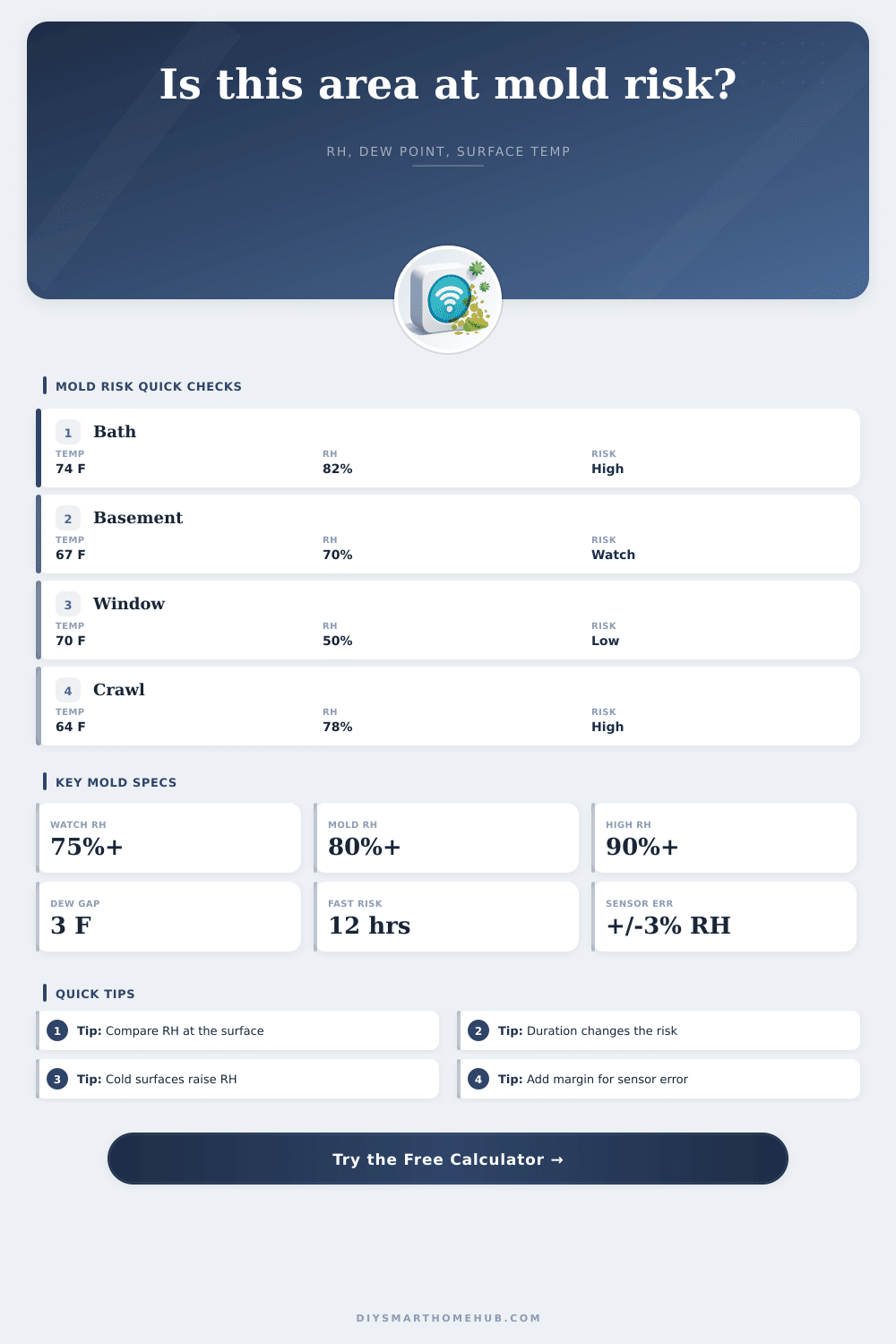
| Bathroom ceiling | 74 F, 82% RH | 67 F painted drywall | 36 hours | Shows repeated shower moisture load |
| Basement corner | 67 F, 70% RH | 58 F drywall | 168 hours | Cold wall surface raises local RH |
| Crawlspace rim joist | 64 F, 78% RH | 59 F wood | 240 hours | Long exposure dominates the score |
| Cold closet wall | 70 F, 62% RH | 55 F paper drywall | 96 hours | Still air increases uncertainty |
| Winter window trim | 70 F, 50% RH | 42 F wood | 12 hours | Dew point margin becomes tight |
| Carpet leak watch | 72 F, 75% RH | 66 F carpet | 18 hours | Fast-response porous material case |
| Sensor/spec profile | RH accuracy | Temp accuracy | Response behavior | Best mold-risk placement |
|---|---|---|---|---|
| Basic smart sensor | +/-3% RH | +/-0.5 C | Medium | Room average away from vents |
| Calibrated room sensor | +/-2% RH | +/-0.3 C | Medium | Representative wall or shelf |
| Remote surface probe | +/-1.5% RH | +/-0.2 C | Fast | Cold surface or hidden bay |
| Battery corner puck | +/-4% RH | +/-0.7 C | Slow | Closet, cabinet, crawlspace corner |
| Duct rated probe | +/-2.5% RH | +/-0.4 C | Medium | Plenum, duct boot, register edge |
| Industrial transmitter | +/-1% RH | +/-0.15 C | Fast | Critical monitoring point |
💡Mold Risk Calculation Tips
Mold does not always presents itself with a leak or a smell. Mold can often find a quiet place to grow on surfaces in basements or bathrooms. Mold will grow on any surface that are damp for long enough period.
The conditions for mold to grow include differences in both the temperatures of the surfaces and the length of those differences. It is possible for a room to have normal humidity but for a specific damp surface to be in a range that allow mold to grow. Without taking the correct measurement, a person might miss these differences.
How to Check and Prevent Mold Growth
One of the factor to consider is the temperature of the surface. Materials that is cold will take moisture out of the air. Therefore, even if the humidity in the room is within an acceptable range, the humidity on a cold surface might be much higher.
The mold growth calculator will provide a relative humidity to the surface that will allow for a determination of whether the surface has reach the threshold for mold growth. Another important factor is the length of time that the surface remains damp. The more longer a surface remains damp, the higher the risk of mold growth on that surface.
For example, a level of humidity might cause mold to grow on drywall after sustained periods, but it might cause problems on a carpet if the humidity is maintained at that level for many day. The mold growth calculator will provide a risk score for the level of humidity, the length of time that the area has been damp, and the type of material that are present on that surface. The accuracy of the sensor that measure the humidity of the area is one of the factors to consider.
Basic sensor might not provide accurate readings. The humidity near a cold piece of material might be recorded different than the humidity elsewhere in the room. The mold growth calculator will provide a risk score that include a penalty for the limitation of basic humidity sensors.
The movement of air near the surface that is potentially at risk for mold growth is another important factor. Air movement cause by fans or vents will keep moisture from lingering on the surface for long periods of time. The calculator will incorporate the airflow factor into the risk score provided.
The material that is present on the surface is another important factor for mold growth. Some materials can tolerate higher level of humidity than others. For instance, drywall with paint on it can tolerate higher humidity level than carpeting.
Wood sheathing can also take higher humidity but will degrade if there are repeated cycle of drying and wetting. The reference tables will provide information about the humidity limits for each of these materials. The calculator will provide information about the gap between the dew point and the temperature of the surface.
If the temperature of the surface is within one or two degrees of the dew point, moisture will condense on that surface. This information can be helpful in areas with large differences between indoor and outdoor temperatures. Many people only focus on the humidity reading for the room.
To determine if there is a risk of mold growth on a specific material, you must consider the measurement of the humidity, the temperature of the material, the length of time the area is damp, and the type of material. The mold growth calculator will provide a score for each of these factors that can help to provide an overall assessment of the risk of mold growth in the area. If the result of the calculator is in the elevated or high range, the area must be attended to.
When using the mold growth calculator, perform the calculations at the location where the mold growth risk is actualy occurring. Place the humidity sensors on the coldest surface in the room instead of a thermostat sensor. Run the calculations for the specific material that is present at the site of the potential mold growth and perform the measurement over time.
Perform these calculations periodically throughout the year as the humidity levels and temperature will vary throughout the seasons. By calculating the potential for mold growth at the locations where mold growth is likely, you can prepare and prevent the growth of mold altogether.