Heat Index Calculator
Estimate NOAA shade heat index from air temperature and relative humidity, then layer practical sun, airflow, activity, sensor accuracy, and alert-margin checks for smart-home heat monitoring.
🎯Heat Index Presets
⚙Temperature, Humidity, And Sensor Inputs
📊Current Heat Snapshot
📘Heat Index Reference Tables
| Air temperature | Relative humidity | NOAA shade heat index | Risk band | Smart home use |
|---|---|---|---|---|
| 80 F / 26.7 C | 40% | 79.6 F / 26.4 C | Below caution | Lower edge of heat-index table behavior |
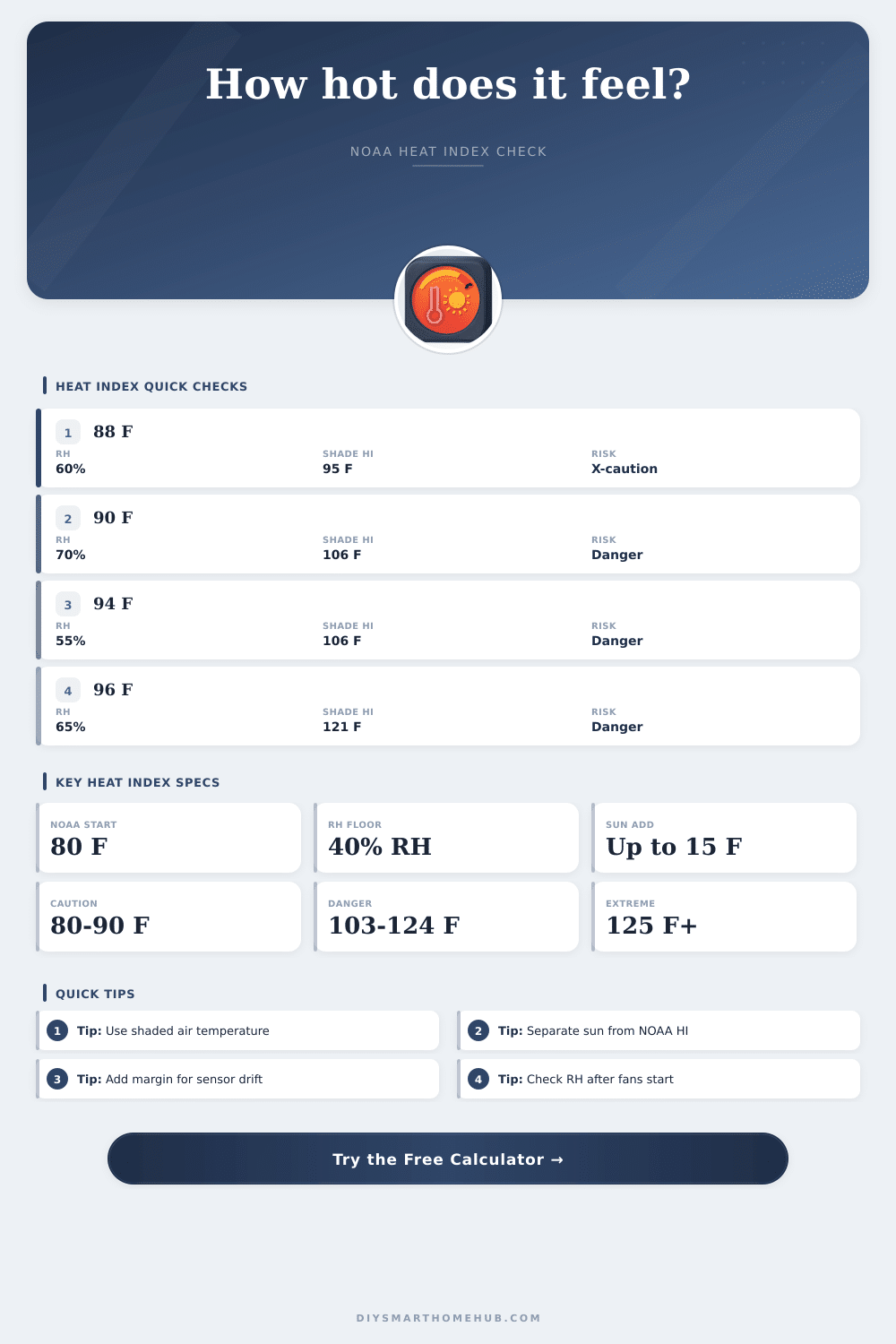
| 88 F / 31.1 C | 60% | 95.1 F / 35.1 C | Extreme caution | Porch, garage, or nursery watch point |
| 90 F / 32.2 C | 70% | 106 F / 41.1 C | Danger | Alert on patio, shed, or workshop sensors |
| 94 F / 34.4 C | 55% | 106.3 F / 41.3 C | Danger | Common hot-humid afternoon scenario |
| 96 F / 35.6 C | 65% | 121 F / 49.4 C | Danger | Outdoor automation should escalate quickly |
| 100 F / 37.8 C | 40% | 109 F / 42.8 C | Danger | Hot-dry sensor still needs heat caution |
| NOAA-style category | Heat index range | Celsius range | Automation interpretation | Where it appears |
|---|---|---|---|---|
| Below caution | Below 80 F | Below 26.7 C | Comfort or warm-room trend only | Bedrooms, server closets, mild garages |
| Caution | 80 to 90 F | 26.7 to 32.2 C | Notify when sustained or rising | Porch shade, warm nursery, closed room |
| Extreme caution | 90 to 103 F | 32.2 to 39.4 C | Increase cooling, fan, or occupancy alert | Garage, sunroom, humid patio |
| Danger | 103 to 124 F | 39.4 to 51.1 C | High-priority alert for occupied areas | Shed, greenhouse, outdoor work zone |
| Extreme danger | 125 F and above | 51.7 C and above | Critical apparent heat condition | Sun-loaded patio or enclosed hot space |
| Exposure or airflow input | Calculator allowance | Formula role | Practical meaning | Best sensor placement |
|---|---|---|---|---|
| Shaded or indoor air | 0 F sun add | NOAA baseline | Use this for official heat index | Shielded, ventilated location |
| Filtered sun near window | +4 F | Scenario add | Warm glass or sunroom load | Away from direct glass contact |
| Partial direct sun | +8 F | Scenario add | Mixed sun and shade exposure | Compare with shaded reference sensor |
| Full direct sun | +15 F | Scenario add | NOAA notes sun can raise apparent heat | Use only when exposure is truly direct |
| Ceiling or box fan | -5 F comfort offset | Practical offset | Improves evaporation but not air temperature | Measure both before and after fan starts |
📟Sensor / Spec Comparison Grid
| Sensor / spec profile | Temperature accuracy used | RH accuracy used | Typical lag | Best heat-index role |
|---|---|---|---|---|
| Basic indoor sensor | +/-0.9 F / +/-0.5 C | +/-3% RH | Medium | Bedroom, nursery, or living area trend |
| Outdoor shaded smart sensor | +/-0.7 F / +/-0.4 C | +/-2.5% RH | Medium | Porch and patio shade baseline |
| Radiation shield sensor | +/-0.5 F / +/-0.3 C | +/-2% RH | Fast | Best outdoor apparent-heat reference |
| Garage battery puck | +/-1.3 F / +/-0.7 C | +/-4% RH | Slow | Closed garage or shed warning |
| Attic high-temp probe | +/-1.8 F / +/-1.0 C | +/-5% RH | Medium | High-temperature envelope checks |
| Aspirated weather station | +/-0.3 F / +/-0.2 C | +/-1.5% RH | Fast | Reference sensor for automations |
📌Activity And Room Scenario Reference
| Scenario | Typical temp/RH | Activity allowance | Airflow assumption | Good alert use |
|---|---|---|---|---|
| Sleeping room | 78 F / 62% RH | 0 F | Light air | Comfort and sustained warm-night alerts |
| Nursery afternoon | 82 F / 58% RH | 0 F | Still or light | Early notification before room overheats |
| Garage workshop | 92 F / 58% RH | +5 F | Fan preferred | Occupied work-zone escalation |
| Greenhouse grow room | 91 F / 72% RH | +2 F | Fan | Human access window and plant-room entry |
| Shed workbench | 96 F / 48% RH | +5 F | Still | Closed-space alert before entering |
💡Heat Index Planning Tips
The heat index is a measurement of how hot it feels to teh human body. The heat index is important because it take into account both air temperature and relative humidity in its calculations. Air temperature is the actual temperature of the air around the human body.
Relative humidity is amount of moisture in the air. If both of these variable are high, the heat index will register a higher temperature then the actual air temperature around the human. This is due to the fact that high humidity levels prevents the human body from being able to cool itself through the evaporation of sweat.
What is the heat index
To determine the heat index, a calculator is used that require the air temperature and relative humidity of the environment to be entered. The calculator automatically calculates the heat index using mathematical regression instead of requiring the person to perform the calculations themself. The heat index is calculated as if the human is in the shade.
Factors that may affect the human body more different than the heat index include exposure to the sun. Direct exposure to the sun can increase the heat index by as much as fifteen degrees. Exposure to a fan will make the human feel more cooler due to the ability of the body to cool itself through the evaporation of sweat.
The level of activity that a person perform may also affect the human body in relation to heat index measurements. If a person is performing strenuous activity, their body will produce more metabolic heat. These conditions increases the risk of heat stress.
However, heat index does not account for the length of time that a person is exposed to hot temperatures. Factors like age, hydration, clothing, and the level of acclimatization of the human to hot climates do impact how the human body respond to heat but these variables is not included in the equation for the heat index. The heat index uses bands of temperatures to determine the risk of heat for a given region.
If the temperature index is below eighty degrees, the heat level is considered comfortable. If the temperature index range between the low eighties and the high nineties, there is a caution band for humans. In this temperature range, humans should pay attention to their bodys response to heat.
Between ninety and one hundred three degrees, there is an extreme caution band for humans. During this temperature range, individuals should increase their efforts to cool the body. Between one hundred three and one hundred twenty four degrees, there is a danger band for humans.
If the heat index reaches one hundred twenty four degrees or more, there is an extreme danger band for humans. The accuracy of sensors that measure the heat index is another factor to consider when calculating the heat index. Errors in measurements of the air temperature and humidity will lead to error in the heat index.
If the sensor is placed in areas that are exposed to the sun, the sensor will register higher air temperatures then the actual air temperature in the environment. The heat index should be calculated in areas that represent the air that humans breathes. Another measurement of humidity is the dew point.
The dew point is a measurement of the amount of moisture in the air. If the dew point is high, the humidity is high. If the dew point is in the mid-sixties or higher, the humidity is considered high.
The dew point can be used to determine if the high heat index is due to humidity or temperature levels. Along with measuring the air temperature, relative humidity, and dew point in a location, it is also possible to understand the variables that contribute to the heat index in that area.