Vertical Wind Turbine Calculator
Estimate vertical-axis wind turbine output from rotor height, diameter, average wind, site exposure, turbine type, and realistic electrical losses.
VAWT estimates are highly sensitive to real wind data. Because wind power rises with the cube of speed, a small wind-speed error can create a large energy error.
Calculation Breakdown
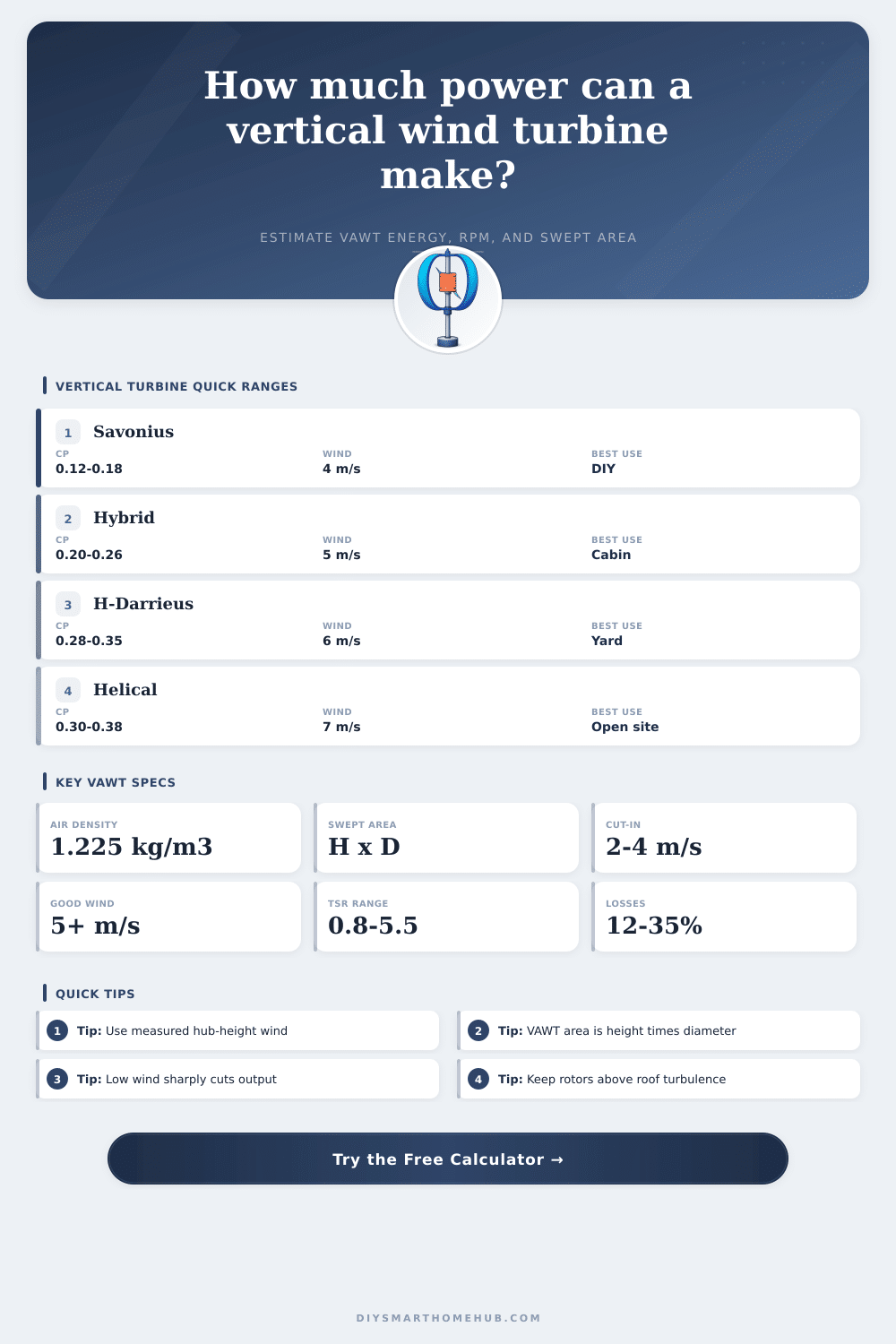
| VAWT profile | Typical Cp used | Cut-in speed | Design note |
|---|---|---|---|
| Savonius drum | 0.14 to 0.18 | 2.0 to 3.0 m/s | Strong starting torque, lower peak efficiency. |
| Helical Savonius | 0.16 to 0.22 | 2.2 to 3.2 m/s | Smoother torque ripple than a simple barrel rotor. |
| Savonius-Darrieus hybrid | 0.20 to 0.27 | 2.5 to 3.5 m/s | Better self-starting than a pure lift rotor. |
| H-Darrieus | 0.28 to 0.35 | 3.5 to 5.0 m/s | More efficient, but needs cleaner wind and sound structure. |
| Helical Darrieus | 0.30 to 0.38 | 3.5 to 5.0 m/s | High lift-rotor potential with reduced cyclic loading. |
| Rooftop micro VAWT | 0.12 to 0.20 | 3.0 to 4.5 m/s | Roof turbulence often matters more than brochure rating. |
| Average hub wind | Relative energy | Small VAWT expectation | Planning interpretation |
|---|---|---|---|
| 3 m/s | 0.22x of 5 m/s | Trickle charging only | Useful for sensors if loads are tiny. |
| 4 m/s | 0.51x of 5 m/s | Low but measurable | Battery charging needs careful load control. |
| 5 m/s | 1.00x reference | Practical small-wind threshold | Good minimum for a serious DIY estimate. |
| 6 m/s | 1.73x of 5 m/s | Strong small turbine site | Energy rises quickly if the wind is clean. |
| 7 m/s | 2.74x of 5 m/s | Excellent exposed site | Structural loads and braking become important. |
| Example build | Rotor size | Swept area | Likely role |
|---|---|---|---|
| Remote sensor charger | 0.6 m x 0.35 m | 0.21 m2 | Low-power IoT battery maintenance. |
| Balcony micro rotor | 1.0 m x 0.45 m | 0.45 m2 | Demonstration or small USB-class loads. |
| Shed battery turbine | 1.8 m x 0.9 m | 1.62 m2 | LED lighting and intermittent DC loads. |
| Cabin auxiliary VAWT | 3.0 m x 1.6 m | 4.80 m2 | Battery support beside solar power. |
| Open-site small turbine | 4.0 m x 2.2 m | 8.80 m2 | Meaningful energy where wind is measured. |
| Calculator step | Formula | Real factor used | Why it matters |
|---|---|---|---|
| Swept area | height x diameter | VAWT projected area | Vertical rotors do not use circular disk area. |
| Hub wind adjustment | Vhub = Vref x (Hhub / Href)^alpha | 0.10 to 0.34 alpha | Height and terrain shift the real wind at the rotor. |
| Wind power | 0.5 x rho x A x V3 | rho = 1.225 kg/m3 | Power changes with the cube of wind speed. |
| Rotor capture | wind power x Cp | Cp from turbine type | Cp estimates aerodynamic conversion before electrical losses. |
| Net output | rotor watts x (1 - losses) | User loss percentage | Controllers, batteries, inverters, and downtime reduce delivered power. |
Due to the difference in the design of vertical-axis wind turbines compared to horizontal-axis wind turbines, vertical-axis wind turbines have a different swept area than do horizontal-axis wind turbine designs. Horizontal-axis wind turbines have a circular swept area, but vertical-axis wind turbines have a rectangular swept area. Multiplying the height of the turbine by the diameter of the turbine calculates the swept area of a vertical-axis wind turbine.
These two values is used in calculating the energy production of the vertical-axis wind turbine. Each of these two parameters are important in determining the size of the wind turbine. For example, each vertical-axis wind turbine that is taller will be able to capture more of the available clean air, since the clean air is located higher above the ground and any ground-based clutter.
How to calculate energy from a vertical-axis wind turbine
On the other hand, increasing the diameter of the turbine will increase the area that the turbine can capture, but without increasing it’s height. Wind speed is another of the critical factors that must be entered into the calculator. The energy that the wind turbine produces is related to the wind speed cubed.
Thus, if the wind speed increase from 4 meters per second to 5 meters per second, the energy does not merely increase by 25%, but instead increases by nearly 100%. The user will need to provide the average wind speed to the calculator, as will the height of the anemometer that measured that average wind speed. The majority of weather station measure wind speeds at 10 meters above the ground.
Small wind turbines, however, are often located at heights lower than 10 meters. Small turbines can also be exposed to different terrains that will affect the wind speed. If these factors is not accounted for in the calculator, then the wind speed input will lead to inaccurate estimates of the amount of energy that the vertical-axis wind turbine will produce.
The third factor to consider is the design of the vertical-axis wind turbine. For example, Savonius vertical-axis turbines will begin to turn at rates in areas with light wind, and will be useful for locations that wish to provide battery charging. Other types of vertical-axis turbines, however, may require that the wind be relatively “clean” (i.e., without many obstacles that will create turbulence in the area) in order to achieve the high rates of efficiency that is possible.
Each type of vertical-axis wind turbine will have different coefficients of performance, cut-in speeds, and tip-speed ratios that can be entered into the calculator. For instance, if each of these variables is changed, then the amount of energy that will be produced will change. Additionally, if any of these variables are changed, then the rotor speed and the torque that the turbine will create will also change.
It is important to know the rate of the rotor speed and the amount of torque created by the turbine if it is to be matched with a specific generator, for instance. Another of the factors that will impact the amount of energy that is produced by the vertical-axis wind turbine is the losses that will occur in the system. For instance, losses will occur in the rectifiers, controllers, wiring, and batteries that is used to utilize the energy from the turbine.
Additionally, losses will occur when the turbine is turned off for maintenance of the turbine. Thus, an entry of the total amount of energy losses will be made into the calculator. If there are no losses entered, the energy estimates will be incorrect.
Small wind turbines, for instance, may lose between one-fifth and one-third of the energy that they capture from the turning of their rotor. Another of the factors that will reduce the amount of energy that is produced by a vertical-axis wind turbine is the presence of turbulence. Any buildings, trees, or overhangs in the area of the turbine will create turbulence in the moving air.
If the vertical-axis wind turbine is placed too close to these types of structures, the amount of energy that is produced will be less than that which the calculator calculates. The “exposure” setting within the calculator accounts for some of the impact of terrain on the wind speed at the turbine, but cannot account for the specific effects of turbulence created by nearby overhangs, buildings, or other structures. The energy that is produced by the vertical-axis wind turbine will need to be matched to the energy demands of the electrical load that the wind turbine is to supply.
For instance, a small turbine may be sufficient for a small sensor that requires only a few watt-hours of energy per day, but will not be able to meet the demands of a cabin that requires lighting levels and an inverter box to supply battery backup power. The calculator will provide estimates of the average watts that will be produced by the vertical-axis wind turbine, the monthly kilowatt-hours that will be produced, the RPM of the rotor, and the torque of the rotating blades. Each of these variables can be used to determine if the energy produced by the vertical-axis wind turbine will meet the demands of the electrical load.
The tables that are provided on the calculator can be used to verify the information that is being entered into the calculator. One table shows how the energy that is produced by a vertical-axis wind turbine increases with the average wind speed. Additionally, another table indicates common sizes for the rotors of vertical-axis wind turbines.
These tables are not a replacement for the data that is gathered with anemometers and other measuring devices, but they may help to determine whether the energy estimates that is provided by the calculator are likely to be correct. For instance, if the calculator indicates that a vast amount of energy will be produced by a small vertical-axis wind turbine, the tables will help to indicate whether the amount of energy that is estimated will actualy be produced. Vertical-axis wind turbines tend to be quieter and easier to mount onto the structures where they will be used, but they have different efficiencies than do horizontal-axis turbines.
Thus, the calculator allows individuals to understand these trade-offs between the types of vertical-axis wind turbines so as to allow them to make a determination of the conditions under which a vertical-axis wind turbine will be effective in meeting the demands of those plans for use.