TV Antenna Height Calculator
Estimate the antenna tip height needed for over-the-air TV using broadcast distance, transmitter height, local obstructions, Earth curvature, and Fresnel clearance.
📌Real TV reception presets
⚙Antenna height inputs
Formula Breakdown
📊Spec grid
📺TV band height reference
| Broadcast band | Planning frequency | Height sensitivity | Practical note |
|---|---|---|---|
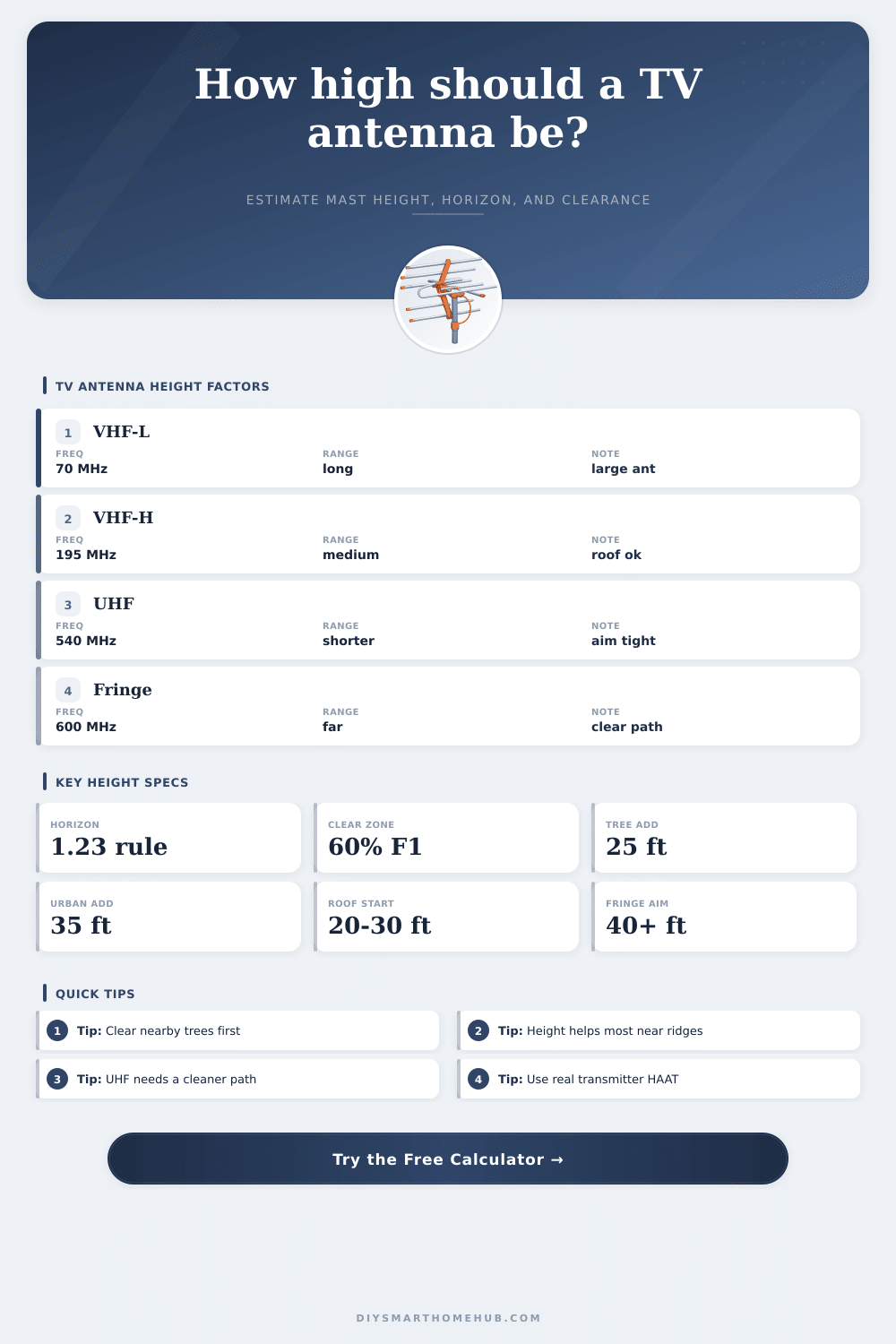
| VHF-low channels 2-6 | 70 MHz | Large Fresnel zone | Height helps clear terrain, but antenna size and electrical noise also matter. |
| VHF-high channels 7-13 | 195 MHz | Moderate Fresnel zone | Often benefits from roof height and a clean path above nearby trees. |
| UHF channels 14-36 | 540 MHz | Smaller Fresnel zone | More line-of-sight sensitive; aiming and obstruction clearance matter. |
| Upper UHF / fringe planning | 600 MHz | Smallest zone here | Use for conservative planning on distant UHF stations near the band edge. |
🏠Mounting height comparison
| Mounting point | Typical base height | Typical use | Calculator meaning |
|---|---|---|---|
| Indoor shelf | 4-8 ft / 1.2-2.4 m | Strong local stations | Enter the shelf height as the mounting point and use attic clutter if indoors. |
| Attic rafter | 12-22 ft / 3.7-6.7 m | Local to moderate signals | Enter the rafter height and select attic or indoor antenna trial. |
| Roof eave | 16-24 ft / 4.9-7.3 m | Suburban roof mount | Result mast height is the extra rise above this point. |
| Roof ridge | 22-35 ft / 6.7-10.7 m | Common whole-home OTA | Use when the mast starts near the highest roof line. |
| Yard tower | 35-70 ft / 10.7-21.3 m | Fringe or wooded lots | Enter the tower platform height before the final antenna mast. |
🌲Terrain and clutter buffers
| Condition | Buffer added | Signal penalty shown | Best use in calculator |
|---|---|---|---|
| Open or water path | 5 ft / 1.5 m | 0 dB | Flat open terrain, shoreline paths, or fields with few trees. |
| Typical suburban roofs and trees | 12 ft / 3.7 m | 4 dB | Normal neighborhoods with roof lines and scattered trees. |
| Wooded lot or tall tree line | 25 ft / 7.6 m | 9 dB | Use when leaves or trunks sit directly in the station direction. |
| Urban buildings and multipath | 35 ft / 10.7 m | 12 dB | Nearby apartment blocks, commercial roofs, or dense masonry. |
| Ridge, hill, or uneven terrain | 45 ft / 13.7 m | 15 dB | Use for ridge paths where a terrain high point is the main obstruction. |
| Attic or indoor antenna trial | 18 ft / 5.5 m | 10 dB | Accounts for roof materials and indoor placement uncertainty. |
📋Common OTA project sizes
| Scenario | Typical distance | Starting height | What usually controls height |
|---|---|---|---|
| Strong city UHF | 5-15 mi / 8-24 km | Indoor to attic | Building reflections and nearby walls usually matter more than horizon. |
| Suburban network stations | 20-35 mi / 32-56 km | Roof ridge | Tree lines and roof lines often set the practical mast rise. |
| Wooded outer suburb | 35-50 mi / 56-80 km | Roof plus mast | Local trees and the first Fresnel zone become important. |
| Rural fringe UHF | 50-70 mi / 80-113 km | Tall mast or tower | Radio horizon and terrain high points usually dominate. |
| Translator or hilltop relay | 8-25 mi / 13-40 km | Garage or roof | Lower transmitter height can make local obstructions decisive. |
✅Calculation tips
Getting over-the-air television signals depends on whether or not an antenna can catch a signal from a TV transmitter. There are several factor that play into this concept of whether or not an antenna can successfully capture a signal from a TV transmitter. Factors such as the distance between the antenna and the transmitter, the terrain between the antenna and the transmitter, and the obstacle that may lie in the way of the antenna and the transmitter will all play a role in whether or not those signals can be successfully received.
One of the factors that can be manipulated to even out these other variables is the height of the antenna itself. By elevating the antenna above trees, rooflines, and the curve of the Earth, an antenna can increase its visibility of the transmitter. By understanding how the height of an antenna can impact the visibility of its signal, decisions can be made regarding the length of the mast upon which the antenna will be mounted.
How Antenna Height Affects TV Signal
The primary limit to an antenna’s range is its radio horizon. The radio horizon is the distance at which the curvature of the Earth begins to interfere with the antenna’s line-of-site to the transmitter. By increasing the height of the antenna, the line-of-site can be increased.
Many antenna are mounted on masts or towers rather than in the attic of the television station because the increased height of those masts and towers allows for increased line-of-site. The math that is used to calculate the height of the antenna takes into account various factor, such as the distance between the antenna and the transmitter, the heights of the broadcast tower, the mounting point of the antenna, and any potential obstructions to the signal. Each of these factor will have an influence upon the height of the antenna that is required to establish a signal.
The antenna height calculator can assist in determining the height of the antenna that is required by a television antenna installation. The antenna height calculator takes as its inputs the distance between the antenna and the TV transmitter, the height of the broadcast tower, the height of the mounting point for the antenna, and the height of any tallest obstructions between the antenna and the transmitter. The antenna height calculator also calculates the size of the Fresnel zone that must remain clear of any obstructions.
The Fresnel zone is the area around the line-of-site between the antenna and the transmitter that must remain free of obstructions in order to allow for the signal to reach the antenna. The antenna height calculator will not guarantee the height of the antenna that is required for the installation site to receive the signal, but the antenna height calculator will provide a target height for the antenna prior to the purchase of any antenna hardware. Broadcast signals come in different band, and those different bands have different requirements for the amount of clearance that must be provided between the signal path of the antenna and the transmitter and any potential obstructions.
These requirements change with the frequency of the signal. For instance, lower VHF channels have larger Fresnel zones than UHF signals. As a result, lower VHF channels require extra clearance over the terrain in comparison to UHF signals.
The antenna height calculator will adjust for the different bands of television signals that are available, ensuring that the height that is calculated for the antenna accounts for the potential differences in the range requirements of those signals. Obstructions can be created by a variety of element. For instance, a tree line located fifty feet from the antenna might obstruct the signal, but a ridge located two miles from the antenna may be obstructed by a ridge.
In these instances, the height of the obstruction and the distance between the antenna and the obstruction must be entered into the antenna height calculator. This distinction between the types of obstructions is crucial in creating an accurate calculation of the height of the antenna required to reach the TV transmitter; nearby trees can be pruned, but ridges cannot be removed. It is possible that an individual may underestimate the height of the antenna mounting point.
Any measurements of the mounting point must be accurate. The antenna height calculator will use the height of the mounting point as a starting point, and will calculate the amount of additional mast that will be required to mount the antenna to the height that is calculated by the antenna height calculator. Furthermore, the antenna height calculator will model the horizon that will be visible to the antenna once it is mounted on the mast of the calculated height.
This model will display whether or not the additional mast will provide any additional range for the antenna itself, or if the additional mast will only ensure that the antenna can clear one of the local tree line obstructions. In addition to the factor that relate to the placement of the antenna itself, there are additional factor related to the terrain over which the signal is to travel. Terrains as diverse as suburban neighborhoods, wooded lots, and urban cores include a variety of different type of clutter that can impact the signal of the TV antenna.
To account for these different types of clutter, buffers are established within the antenna height calculator. These buffers are established within the antenna height calculator because trees will move, buildings will reflect the signal, and the actual signal path of the antenna is more complicated than the model that the antenna height calculator presents. Furthermore, the different types of clutter require different margins to be established between the signal path that is modeled by the antenna height calculator, therefore each type of clutter must be accounted for within the calculations performed by the antenna height calculator.
It might be better for an individual to choose a different TV station than the one that is desired. For instance, one station might be located behind a ridge, while another is located on open ground. The antenna height for the station located on open ground may be less than the range of the antenna height required for the station behind the ridge.
Numbers can be entered into the antenna height calculator for each potential TV station, allowing individuals to compare each antenna height calculation to the others. By using the antenna height calculator, the individuals can more easily compare each of these antenna heights. The concept of diminishing returns apply to antenna height.
Beyond a certain height for an antenna, each additional ten feet of antenna mast will provide less additional range in the signal path than the previous increment of ten feet of mast. At some point, the additional range that is provided by additional mast will no longer justify the additional cost of purchasing that additional mast. While the antenna height calculator will not provide any indications of where the limit of diminishing returns is for a signal path, the antenna height calculator will provide indications of how much range is provided by each increment in antenna height above the calculated height.
Weather can impact the signal path of an antenna. Weather element such as leaves on trees or snowfall and ice on antennae structures can impact the signal path. While the antenna height calculator does not accept any weather-related variable as its inputs, the additional purchase of a few extra feet of mast may be the more cost-effective solution to purchasing an antenna that might be damaged by the weather.
The goal of establishing a stable signal path between the antenna and the TV transmitter can be achieved through the antenna height calculator. Once an individual has determined the height at which the antenna should be mounted based on the antenna height calculator, the individual can make a decision as to which type of mast and hardware will be used to mount the antenna to the structure. These physics of the signal path will remain the same, but the individual will have a better understanding of the hardware that may be required for that signal path with the assistance of the antenna height calculator.