Refrigerator Power Consumption Calculator
Estimate refrigerator energy use from an EnergyGuide label, measured running watts and duty cycle, or nameplate amps with power factor.
⚙Real Refrigerator Presets
📊Calculator Inputs
⚡Power Consumption Results
🧊Spec Grid
📘Reference Tables
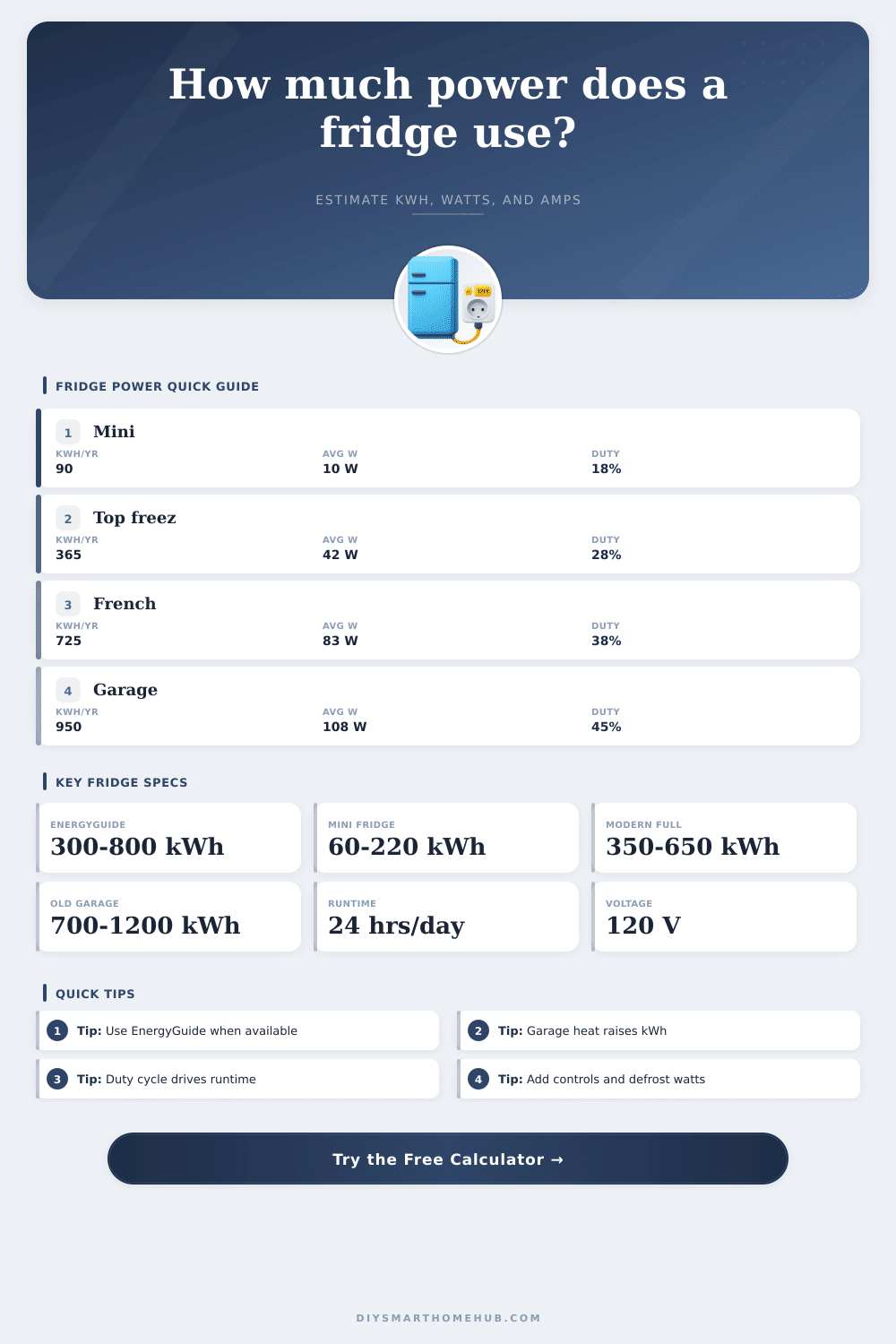
| Refrigerator type | Typical size | Typical kWh/year | Average watts |
|---|---|---|---|
| Mini refrigerator | 1.7-3.2 cu ft | 60-160 kWh | 7-18 W |
| Compact refrigerator | 3.3-5.5 cu ft | 140-260 kWh | 16-30 W |
| Top-freezer refrigerator | 16-21 cu ft | 350-550 kWh | 40-63 W |
| Bottom-freezer refrigerator | 18-24 cu ft | 500-700 kWh | 57-80 W |
| Side-by-side refrigerator | 22-28 cu ft | 600-850 kWh | 68-97 W |
| French-door refrigerator | 22-30 cu ft | 600-900 kWh | 68-103 W |
| Older garage refrigerator | 18-25 cu ft | 700-1200 kWh | 80-137 W |
| Input method | Formula | Best source | Use when |
|---|---|---|---|
| EnergyGuide label | kWh/day = kWh/yr / 365 | Yellow label | Rating label is readable |
| Plug-in meter | kWh/day = meter kWh / days | Measured use | Meter logged full days |
| Running watts | (W x duty x 24) / 1000 | Watt meter | Compressor watts known |
| Nameplate amps | V x A x PF x duty | Data plate | No watt meter available |
| Location condition | Adjustment | Why it changes | Calculator setting |
|---|---|---|---|
| Cool conditioned room | -8% | Lower cabinet heat gain | Cool room |
| Normal kitchen | 0% | Baseline indoor use | Normal room |
| Warm kitchen | +8% | More door and compressor cycles | Warm kitchen |
| Unconditioned utility space | +18% | Higher ambient temperature | Pantry or laundry |
| Hot garage | +30% | High cabinet heat gain | Garage or porch |
| Scenario | Example inputs | Daily kWh | Monthly kWh |
|---|---|---|---|
| Dorm mini fridge | 90 kWh/year | 0.25 kWh | 7.4 kWh |
| Efficient top freezer | 365 kWh/year | 1.00 kWh | 30.0 kWh |
| French door model | 725 kWh/year | 1.99 kWh | 59.6 kWh |
| Hot garage fridge | 950 kWh/year +30% | 3.38 kWh | 101.5 kWh |
💡Calculation Notes
A refrigerator is an appliance that will run continuous. Unlike a toaster or an microwave, a refrigerator wont take a break throughout the day. Appliances like toasters and microwaves will be dormant for the bulk of there lives.
However, refrigerators will cycle from periods of operation to periods of rest. The cost of operate a refrigerator wont be based off the price of the refrigerator indicated on the sticker on the appliance. Instead, the environment in which the refrigerator is placed will play a critical role in determining the amount of electricity that the refrigerator will use.
How a Refrigerator Uses Electricity
The EnergyGuide label can be used to provide a baseline measurement of how much electricity the refrigerator will use. However, this label bundles together the various component of a refrigerator into a figure that represents the number of kilowatt hours that the refrigerator will use in a year. This estimate assume that the refrigerator is placed in an environment that is controlled in relation to temperature.
When the kitchen in which the refrigerator is placed becomes warm, or if the refrigerator door is left open for a period of time, the refrigerator will need to work harder to maintain the temperature within the refrigerator. In these cases, you will need to account for the variables of refrigerator use and temperature in calculating the actual cost of operating the refrigerator. Another critical element of determining the amount of electricity that a refrigerator will use is understanding the concept of the duty cycle.
The compressor that circulates the refrigerant fluid within the refrigerator dont run continuously. Thus, the running wattage of a refrigerator is not the same as the electrical load that the refrigerator will use. The duty cycle of a refrigerator is the percentage of the time during which the refrigerators compressor is working.
Refrigerators that are placed in cool environment, such as a basement, will have a low duty cycle. In contrast, refrigerators that are placed in warm environment, such as a garage, will have a more higher duty cycle. The higher the duty cycle, the more electricity the refrigerator will use.
Placing an old refrigerator into an unconditioned part of a structure, such as a garage, may seem like a good idea. However, it is an inefficient practice. Because the refrigerator model is old, the seals on the refrigerator will degrade, and the insulation will not be efficient at maintaining the cold temperature within the refrigerator.
If a refrigerator must work harder to maintain its internal temperature due to external heat, the compressor will work longer period of time to remove the heat from within the refrigerator. Thus, placing an old refrigerator into a garage will increase the amount of energy that the refrigerator use by thirty percent if the refrigerator is of that model. If the refrigerator does not have an EnergyGuide label, another way of calculating the electrical load of the refrigerator is to use the nameplate method.
The nameplate will have information regarding the number of amps and the voltage of the refrigerator. Because the refrigerator includes motors, the load on the refrigerator is inductive; thus, the power factor is 0.70. Given this information, it is possible to calculate the load that the refrigerator uses.
This calculation is more accurate then estimate the electrical load of the refrigerator by its size. The electric refrigerator includes several component that use electricity. These components include the compressor, the fans that aid in the movement of the refrigerant, the digital display that allow the refrigerator to be programmed, and the automatic defrost heater.
The compressor is the most significant user of electricity within the refrigerator. However, other components also use some of the standby watts that are required for the refrigerator to remain in operation. Although each component use a small amount of electricity, the total amount that these components use annually is significant.
One method of determining if a refrigerator should be replaced is by looking at the yearly kilowatt hours that are used by the refrigerator. Moddern ENERGY STAR refrigerators are more energy efficient than older refrigerator models. This increased efficiency in newer refrigerators is due to the fact that they use better insulation and feature sensors that allow them to automaticly adjust to the amount of food in the refrigerator.
Thus, a new refrigerator will use less electricity than an old refrigerator of the same size. Reducing the amount of electricity that a refrigerator uses can be accomplished by reducing the difficulty that the refrigerator must work through in order to cool the refrigerator. This can be accomplished by cleaning the refrigerators coils and ensuring that the refrigerators door seals is tight to avoid the loss of cold air from the refrigerator.
Understanding the difference between the peak watts of a refrigerator and the amount of energy that it uses on average is essential for determining the electrical load of a refrigerator. When the concept of duty cycle and refrigerator ambient temperature are understood, the electrical demand of a refrigerator will also become understood.