AC Power Consumption Calculator
Estimate air conditioner input watts, daily energy, monthly kWh, running current, and cooling load from BTU capacity, efficiency rating, duty cycle, and real use hours.
AC Power Consumption Results
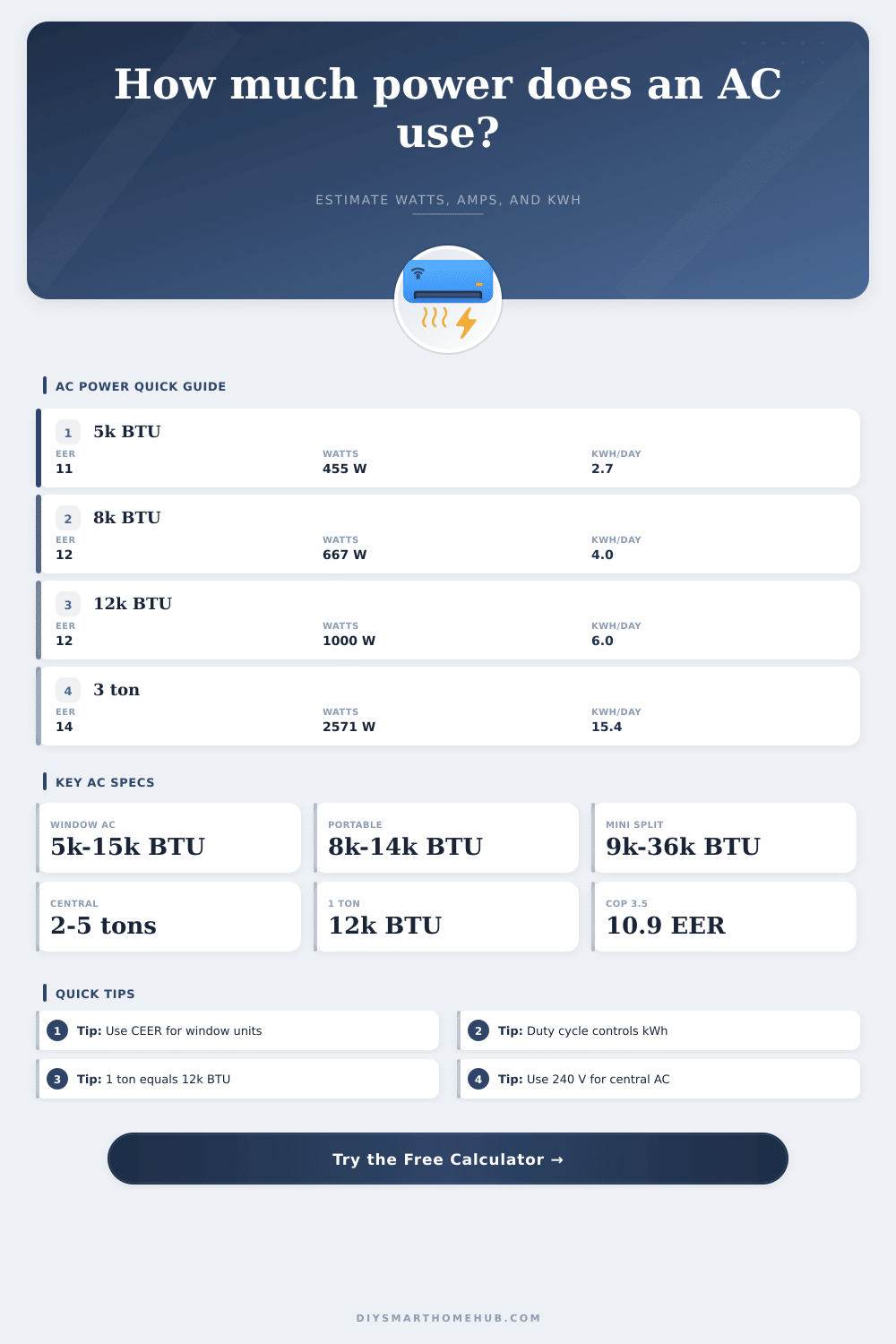
| Rated cooling size | Common AC format | Watts at EER 10 | Watts at EER 12 |
|---|---|---|---|
| 5,000 BTU/h | Small bedroom window AC | 500 W | 417 W |
| 8,000 BTU/h | Office or medium room window AC | 800 W | 667 W |
| 10,000 BTU/h | Portable or large bedroom AC | 1,000 W | 833 W |
| 12,000 BTU/h | Large room or 1 ton mini split | 1,200 W | 1,000 W |
| 18,000 BTU/h | 1.5 ton mini split zone | 1,800 W | 1,500 W |
| 24,000 BTU/h | 2 ton central or multi-zone unit | 2,400 W | 2,000 W |
| 36,000 BTU/h | 3 ton central AC system | 3,600 W | 3,000 W |
| Cooling condition | Typical duty cycle | How it affects kWh | Input to adjust |
|---|---|---|---|
| Mild evening cooling | 20% to 35% | Low compressor runtime | Lower duty cycle |
| Normal occupied room | 40% to 60% | Typical thermostat cycling | Use 50% as a start |
| Hot afternoon load | 65% to 85% | Longer compressor runtime | Raise duty cycle |
| Undersized or heat wave | 85% to 100% | Near continuous operation | Use 90% to 100% |
| Variable-speed inverter | 30% to 70% | Lower watts for longer periods | Use measured watts if known |
| Rating type | Meaning in this calculator | Power formula | Best use case |
|---|---|---|---|
| EER | BTU per watt-hour at a fixed test point | Watts = BTU/h / EER | Window, portable, older labels |
| CEER | EER with standby energy included in the rating method | Watts = BTU/h / CEER | Modern room AC labels |
| SEER | Seasonal cooling output per watt-hour | Watts = BTU/h / SEER | Central and mini split estimates |
| COP | Heat moved per watt of electric input | Watts = BTU/h / (COP x 3.412) | Heat pump spec sheets |
| Measured watts | Direct electric input while running | Watts = entered meter watts | Smart plug or clamp meter |
| Scenario | Inputs used | Estimated monthly kWh | Best input to refine |
|---|---|---|---|
| Bedroom window AC | 5,000 BTU, EER 11, 6 h, 50% | 45 kWh | Compressor duty cycle |
| Office window AC | 8,000 BTU, CEER 12, 8 h, 55% | 88 kWh | Daily cooling hours |
| Living room AC | 12,000 BTU, EER 12, 8 h, 60% | 144 kWh | Actual EER or CEER |
| Mini split zone | 9,000 BTU, SEER 20, 10 h, 45% | 61 kWh | Measured inverter watts |
| 3 ton central AC | 36,000 BTU, SEER 14, 8 h, 55% | 339 kWh | Outdoor unit runtime |
Air conditioners has the potential to increase the electricity bills of a household due to the amount of electricity that is required for air conditioners to function. Many peoples may experience increased electricity bills during the summer month due to the use of their air conditioner. Air conditioners do not draw a constant and flat amount of electricity from the electrical outlet to which they are plugged into (as other appliances do), and air conditioners do not continuously run at the same rate throughout the period in which they are on.
To understand why electricity bills increases when air conditioners are in use, it is first necessary to understand how air conditioners work. Air conditioners have a cooling capacity that is measured in BTUs (British Thermal Units). BTUs are a measurement of the amount of heat that the air conditioner can remove from a room in one hour.
Why Air Conditioners Raise Your Electricity Bill
The BTU measurement does not, however, indicate the amount of electricity that the air conditioner will use to perform its cooling function of that space. To understand the electricity use of an air conditioner, you will need to review the efficiency ratings for that appliance. Efficiency ratings (such as EER and SEER) indicate the amount of heat that the air conditioner will move for each watt of electricity that is drawn from the electrical outlet to which the air conditioner is plug.
Air conditioners with higher efficiency ratings will use less electricity in relation to the amount of cooling output that they will provide. Air conditioners do not consume the same amount of electricity at all times that it is turned on. The component of the air conditioner that consume the most electricity is the compressor.
The compressor does not run continuously; instead, it cycle on and off to maintain the temperature of the room in which the air conditioner is installed. The length of the duty cycle of an air conditioner (the period during which the air conditioner’s compressor runs) can change based off the insulation of the room in which the air conditioner is installed and the outside air temperature of the installation location of the air conditioner. If the room in which the air conditioner is located has good insulation, or if the outside air temperature are mild, the air conditioner will have a low duty cycle.
If the room in which the air conditioner is installed is poorly insulated, or if the outside air temperatures are high, the duty cycle will be high. Air conditioner also consume some electricity even when the compressor is off. Air conditioners use electricity to run fans (both indoor and outdoor fans), digital displays to display temperature settings and timers, and the internal electronics of the air conditioner.
Though each of these components may individually use a small amount of electricity, the amount of electricity that these components use does add up over the course of a thirty day electrical bill period. Therefore, the electricity that the air conditioner uses can be determined not only by calculating the amount of time that the compressor is running during a given period (the duty cycle), but also by considering the electricity used by these components while they are running (standby power). Air conditioners can run on different voltage.
Standard air conditioner units typically run on 120 volts, but large air conditioning units, such as central air conditioning units or heavy duty mini-split units, can require 240 volts. While the total wattage of the air conditioner may be the same at each voltage, the amperage of the air conditioner will change. If the air conditioner draws too many amps from the circuit to which it is plugged, the circuit breaker will trip to prevent the wires from overheating.
Air conditioners feature various efficiency ratings. For instance, cooling efficiency ratings (as a means of comparing the efficiency of air conditioning units of different types) is expressed as the COP (Coefficient of Performance) rating. Additionally, manufacturers and models use SEER (Seasonal Energy Efficiency Ratio) ratings for air conditioning units.
Though both of these ratings measure the efficiency of an air conditioner, the SEER rating measures the average efficiency of an air conditioner over a season (as compared to the EER rating), and the COP rating is most often applied to heat pump. Using the EER instead of the SEER will result in an error in the estimate of the cost of the electricity that the air conditioner will use. By changing how the air conditioner is used, an individual can change the electricity cost of the air conditioner.
For instance, if the temperature that is set on the thermostat is lowered, the duty cycle of the air conditioner will increase. Similarly, if the temperature that is set on the thermostat is increased, the duty cycle will decrease. By changing the settings on the thermostat, an individual can manage the amount of electricity that the air conditioner uses.
Through understanding the relationship between the BTUs of an air conditioner, the efficiency of the air conditioner, and the duty cycle for that air conditioner, an individual can manage their electricity bill.