HVAC Energy Efficiency Calculator
Estimate heating and cooling kWh from SEER2, HSPF2, runtime, duct losses, and smart thermostat load reduction.
⚙Quick Presets
⌂Home and HVAC Inputs
HVAC Efficiency Results
Formula Breakdown
📊HVAC Spec Grid
📘Reference Tables
| Efficiency Metric | What It Means | Formula Use | Calculator Input |
|---|---|---|---|
| SEER2 | Seasonal cooling output per watt-hour | Cooling Btu / SEER2 / 1000 | Current and improved cooling rating |
| HSPF2 | Seasonal heat pump output per watt-hour | Heating Btu / HSPF2 / 1000 | Current and improved heating rating |
| EFLH | Equivalent full-load hours | Capacity x runtime x 12000 | Cooling and heating hours per year |
| Duct loss | Distribution energy penalty | Delivered load / (1 - loss) | Current and improved loss percent |
| System Condition | Cooling Rating | Heating Rating | Interpretation |
|---|---|---|---|
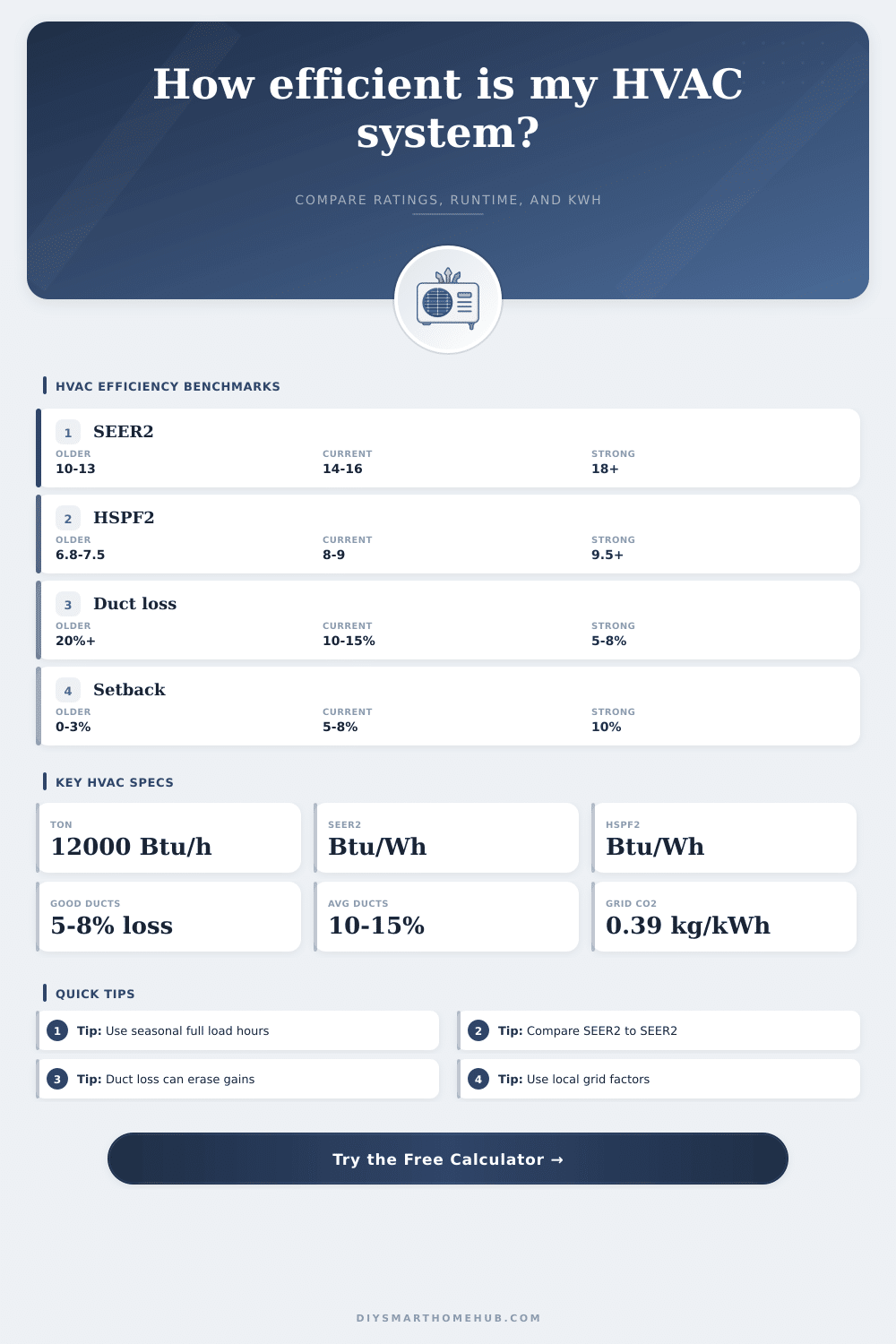
| Older working equipment | 10 to 13 SEER2 | 6.8 to 7.7 HSPF2 | Large savings can come from rating gains and controls |
| Current baseline equipment | 14 to 16 SEER2 | 8.0 to 9.0 HSPF2 | Good comparison point for typical replacements |
| High efficiency heat pump | 17 to 20 SEER2 | 9.5 to 10.5 HSPF2 | Strong seasonal reduction when runtime is high |
| Premium variable-speed system | 20+ SEER2 | 10.5+ HSPF2 | Best modeled with real runtime and duct data |
| Runtime Profile | Cooling EFLH | Heating EFLH | Use Case |
|---|---|---|---|
| Mild coastal | 300 to 550 | 250 to 600 | Small loads with control-driven savings |
| Mixed climate | 700 to 1100 | 500 to 1000 | Balanced heating and cooling comparison |
| Hot cooling-heavy | 1200 to 2000 | 100 to 450 | SEER2 dominates annual kWh |
| Cold heating-heavy | 300 to 700 | 1200 to 2200 | HSPF2 dominates annual kWh |
| Project Size | Area | Typical Capacity | Efficiency Focus |
|---|---|---|---|
| Single room mini split | 120 to 250 sq ft | 0.5 to 1.0 tons | High SEER2 and low cycling losses |
| Open plan zone | 500 to 800 sq ft | 1.0 to 1.5 tons | Runtime hours and thermostat control |
| Small ducted home | 1200 to 1800 sq ft | 2.0 to 3.0 tons | Duct sealing plus rating improvement |
| Larger whole house | 2200 to 3400 sq ft | 3.5 to 5.0 tons | Distribution loss and heating rating |
✓Calculation Tips
An HVAC system is a collection of component that work together to maintain the temperature of a home. HVAC systems include the machine that creates an air within the home, the ducts that move that air throughout the home, and the walls that hold that air. While many individual focus on the machine that creates the air within the home, that machine is only one part of the HVAC system.
For instance, if an HVAC system has a highly efficient machine to create the air for the home, but if those ducts are leaky or not insulated, the amount of air that exit those ducts will reduce the efficiency of that machine. Thus, individuals must also consider the ducts and walls of the HVAC system when considering it’s efficiency. There are efficiency rating for HVAC systems, such as the SEER2 and the HSPF2 ratings.
How to Save Energy with Your HVAC System
The SEER2 measure the efficiency of the cooling system, while the HSPF2 measures the efficiency of the heating system. Each of these ratings are measurements of the energy that the HVAC system use to perform its tasks of heating and cooling the home. However, these ratings are theoretical, and the actual amount of energy that will be saved is dependent upon the environment in which the individual live.
For instance, in hot climates, the SEER2 efficiency of the cooling system is more important to energy costs than in cold climates, where the HSPF2 efficiency of the heating system is more important. One of the most common forms of energy waste within HVAC system is duct loss, or the loss of air from HVAC ducts to areas such as crawlspace or walls. Because the energy used to heat and cool the air that exits the HVAC ducts is wasted, individuals can make HVAC systems more efficientally by improving the insulation of the ducts.
Additionally, smart thermostats can be utilized within an HVAC system to ensure that the HVAC system is not running unnecesarily (when the homes is empty, for instance). When individuals consider upgrading their HVAC system, they must balance the cost of the HVAC system against the potential savings on the electricity that the HVAC system uses. While an HVAC system with a high SEER2 and HSPF2 ratings will cost more money of purchase, it will reduce the amount of electricity that the individual’s home use throughout the year.
Thus, an individual must balance the initial cost of the HVAC system against the electricity cost savings. Additionally, if an individual utilizes an electric heat pump to heat the home, that choice will reduce the homes carbon footprint. However, since electric heat pumps uses electricity to perform their tasks, the environmental impact of the HVAC system is dependent upon the electricity grid for the homes area.
When upgrading HVAC system, the efficiency ratings will diminish in potential savings. For instance, converting from an old HVAC system to a moddern efficient system will result in a higher efficiency rating then converting from a very efficient HVAC system to an even more efficient HVAC system. Thus, each individual can upgrade their HVAC system by considering the climate for their area, as well as the condition of there ducts.
Each component of the HVAC system must be considered as a system as a whole.