⚡ Home Energy Calculator
Estimate your household energy consumption by appliance — get daily, monthly & annual kWh totals
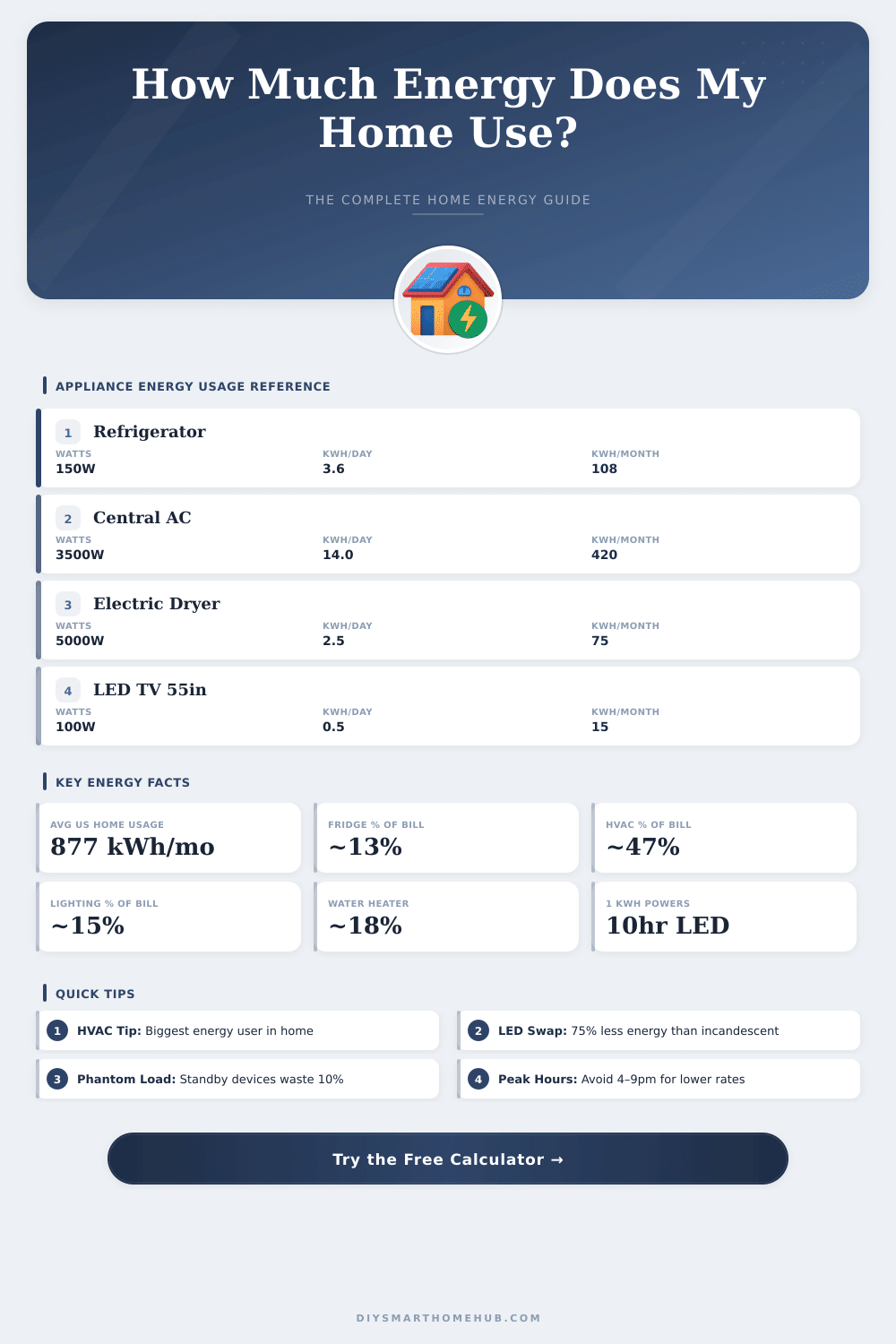
| Appliance | Typical Watts | Avg Hrs/Day | kWh/Month | Category |
|---|---|---|---|---|
| LED Bulb (10W) | 10W | 5 | 1.5 | Lighting |
| CFL Bulb (15W) | 15W | 5 | 2.3 | Lighting |
| Incandescent (60W) | 60W | 5 | 9.0 | Lighting |
| Central Air Conditioner | 3,500W | 8 | 840 | HVAC |
| Window AC Unit | 900W | 8 | 216 | HVAC |
| Electric Furnace | 10,000W | 8 | 2,400 | HVAC |
| Gas Furnace Fan | 600W | 8 | 144 | HVAC |
| Space Heater | 1,500W | 6 | 270 | HVAC |
| Ceiling Fan | 75W | 8 | 18 | HVAC |
| Refrigerator (top-freezer) | 150W | 24 | 108 | Kitchen |
| Refrigerator (side-by-side) | 200W | 24 | 144 | Kitchen |
| Dishwasher | 1,200W | 1 | 36 | Kitchen |
| Microwave | 1,200W | 0.5 | 18 | Kitchen |
| Electric Oven | 2,400W | 1 | 72 | Kitchen |
| Electric Cooktop (per burner) | 1,500W | 1 | 45 | Kitchen |
| Coffee Maker | 900W | 0.5 | 13.5 | Kitchen |
| 55" LED TV | 100W | 5 | 15 | Entertainment |
| Gaming Console | 150W | 3 | 13.5 | Entertainment |
| Desktop Computer | 300W | 8 | 72 | Entertainment |
| Laptop Computer | 50W | 8 | 12 | Entertainment |
| Wi-Fi Router | 10W | 24 | 7.2 | Entertainment |
| Electric Washer | 500W | 1 | 15 | Laundry |
| Electric Dryer | 5,000W | 1 | 150 | Laundry |
| Water Heater (electric) | 4,500W | 3 | 405 | Other |
| Pool Pump | 1,500W | 8 | 360 | Other |
| Hot Tub / Spa | 6,000W | 4 | 720 | Other |
| Home Size | Sq Ft | Sq Meters | Avg kWh/Month | Avg kWh/Year |
|---|---|---|---|---|
| Studio Apartment | 400–600 | 37–56 m² | 350–450 | 4,200–5,400 |
| 1-Bedroom Apartment | 600–900 | 56–84 m² | 450–600 | 5,400–7,200 |
| 2-Bedroom Apartment | 900–1,200 | 84–111 m² | 600–800 | 7,200–9,600 |
| Small House | 1,200–1,600 | 111–149 m² | 700–950 | 8,400–11,400 |
| Average US Home | 1,600–2,200 | 149–204 m² | 877 (avg) | 10,500 |
| Large Home | 2,200–3,000 | 204–279 m² | 1,100–1,500 | 13,200–18,000 |
| Very Large / Luxury | 3,000+ | 279+ m² | 1,500–2,500+ | 18,000–30,000+ |
| From | To | Multiply By | Example |
|---|---|---|---|
| Watts (W) | Kilowatts (kW) | ÷ 1,000 | 1,500W = 1.5 kW |
| kW × Hours | kWh | × hours used | 1.5 kW × 4h = 6 kWh |
| kWh | BTU | × 3,412 | 10 kWh = 34,120 BTU |
| kWh | MJ (Megajoules) | × 3.6 | 10 kWh = 36 MJ |
| kWh | Therms | ÷ 29.3 | 100 kWh = 3.41 therms |
| kWh | CO₂ lbs emitted | × 0.92 | 100 kWh = 92 lbs CO₂ |
| kWh | CO₂ kg emitted | × 0.42 | 100 kWh = 42 kg CO₂ |
An electricity bill can be high in a household even if individuals go to the effort of turning off the lights in the home and taking shorter showers in the house. One of the main reason that an electricity bill is often high for a household is due to a concept known as the invisible load of the household. The invisible load include all of the devices that may be draining energy from the home while an individual is sleeping or while they are not actively using the devices themselves.
Many individuals believe that a household only uses electricity when they make an active choice to use a device, such as using the oven or the vacuum. However, the house is still consuming electricity every second of every day. One of the components of invisible load is known as the baseline load of the home.
What is Invisible Load in Your Home
The baseline load is the electricity that the home uses to “exist”, such as the router for the internet, the microwave clock, and the smart home hub. The baseline load is a small amount of electricity that are continuously used by the home. If an individual has a high baseline load, then they are continuously paying a fee to the utility company for keep their home in a state of readiness to perform any tasks.
While many individuals may focus upon the individual major appliance in the home, the baseline load can still consume a significant percentage of the electricity that the home uses each day. The second major component of invisible load is the HVAC system in the home. The HVAC system is often the largest consumer of electricity in the home.
The HVAC system may be the heat pump for the home or it may be an electric furnace. The thermal envelope of the home determines how hard the HVAC system must work to keep the interior of the home at a comfortable temperature. Homes with single pane windows or leaks will require the air conditioning system to work harder to cool the interior of the home compared to a well sealed home.
In addition to the baseline load and the HVAC system, other factors that can contribute to the invisible load of a home can also be calculated. For instance, the calculator for invisible load considers the home as a collection of layers of energy use rather than as a single number. The conditioned area of the home is a factor that considers the total area of the home that must be kept at a comfortable temperature for the individuals that live there.
Additionally, the number of individuals that live in the home is a factor in the calculation, as each human in the home use a significant amount of energy for tasks like boiling water, running dishwashers, or simply charging phones. Other major appliances in the home, such as an electric water heater or a pool pump may add to the invisible load of the home. These major appliances often have high peak demand.
An understanding of the peak demands that each of these appliances can have is helpful for individuals that are thinking about adding an EV charger to their home or a hot tub. For these same reasons, it is also important for individuals to understand the limit of the electrical setup in their home prior to reach the limit of that electrical setup itself. Finally, the electricity use in the home is not a flat line throughout the year (the home has the seasons).
In some months, when the home is most efficient, such as in October, the home may use little electricity. However, in another time of the year, such as in July in a severe climate, the home may require significant amounts of electricity to maintain the comfort of the interior of the home. The reference table that is provided on the page includes different benchmarks for electricity use in each scenario.
While the high monthly kilowatt hour (kWh) count for a home does not necessarily mean that the residents of that home are wasteful, it may indicate that they live in a climate that is severe and that there entire home is electric-powered. In order to lower the electricity bill that a residential property owner runs up, it is first necessary to understand which layer of invisible load is the largest. For instance, it may be necessary to determine whether the baseline load of the home is high due to outdated power strips in the home, or whether the HVAC system of the home is continually running at high rates due to a leaky window or other thermal envelope issues.
Once the owner understands these issues, they can make a decision about which renovations will provide the best return on investment for the home. For instance, while it may be difficult and expensive to replace the insulation of the homes thermal envelope, it may be a relatively small project to swap an old refrigerator for a new refrigerator. Understanding the kWh (kilowatt hours) per square foot of a home is the best means of comparing the energy use of that home to other homes.
By understanding the kWh per square foot of each home, it is possible to strip away the size of the home to understand how efficient the home is. The efficiency of a large home with high kWh use may be more efficient than a small studio apartment whose efficiency isnt as high due to potential issues with air leaks. By measuring and accounting for the baseline load of the home, the peak demands of its appliances, and how many season the home experiences, an individual can gain a clear understanding of the invisible load that is present in their home.
Thus, by gaining such knowledge, individuals can begin to take control of the invisible load within their homes.