Battery C-Rate Calculator
Check battery charge C-rate, discharge C-rate, peak load stress, pack watts, energy, and estimated runtime from real pack specs.
🔋Real Battery Presets
⚙Battery And Load Inputs
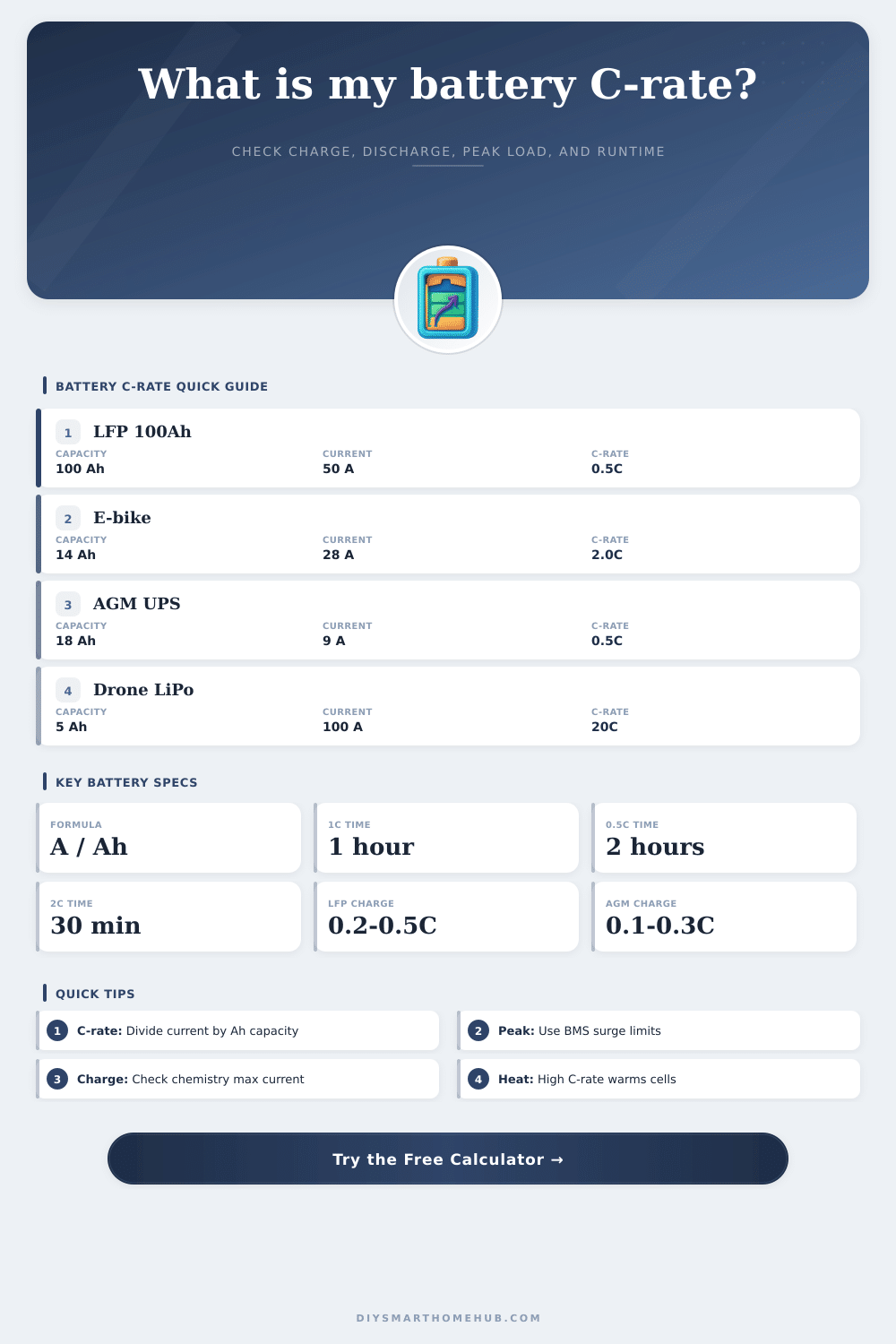
C-rate is current divided by amp-hour capacity. A 100 Ah battery discharging at 50 A is 0.5C; the same battery charging at 20 A is 0.2C.
📊Selected Chemistry Spec Grid
📐Battery Chemistry C-Rate Reference
| Chemistry | Typical charge C-rate | Continuous discharge | Short peak reference | Planning note |
|---|---|---|---|---|
| LiFePO4 / LFP | 0.2C to 0.5C common, up to 1C on some cells | 0.5C to 1C common | 2C to 3C short bursts | Popular for home storage and server rack batteries |
| NMC lithium-ion | 0.3C to 0.7C common | 1C to 3C depending on cell design | 3C to 5C short bursts | Used in e-bikes, scooters, and compact packs |
| High-rate LiPo | 1C common when approved by maker | 10C to 30C for RC-grade packs | 30C+ only if pack is rated for it | Printed C ratings vary; watch voltage sag and heat |
| NCA lithium-ion | 0.3C to 0.6C common | 1C to 2C common | 2C to 4C short bursts | Energy-dense packs often need conservative heat limits |
| AGM lead-acid | 0.1C to 0.3C typical | 0.05C to 0.5C practical | 1C+ for very short periods | Capacity falls at high current due to Peukert effect |
| Flooded lead-acid | 0.1C to 0.2C typical | 0.05C to 0.3C practical | About 1C short periods | Ventilation and electrolyte limits matter |
| LTO lithium titanate | 1C or higher on many cells | 2C to 5C common | 5C+ depending on cell | Excellent high-rate and low-temperature behavior |
⏱C-Rate To Runtime Reference
| C-rate | Ideal full-capacity runtime | 100 Ah current | 20 Ah current | What it usually means |
|---|---|---|---|---|
| 0.05C | 20 hours | 5 A | 1 A | Low standby or small electronics load |
| 0.1C | 10 hours | 10 A | 2 A | Gentle discharge for many battery types |
| 0.2C | 5 hours | 20 A | 4 A | Common charging and moderate discharge |
| 0.5C | 2 hours | 50 A | 10 A | Typical inverter load on lithium storage |
| 1C | 1 hour | 100 A | 20 A | High load or rated lithium discharge |
| 2C | 30 minutes | 200 A | 40 A | Shorter high-power operation |
| 10C | 6 minutes | 1000 A | 200 A | High-rate RC or specialty packs only |
🔌Common Battery Pack Examples
| Battery example | Nominal specs | Current example | C-rate | Approx power |
|---|---|---|---|---|
| Home LiFePO4 battery | 12.8 V, 100 Ah | 50 A inverter load | 0.5C | 640 W DC |
| Server rack LiFePO4 module | 51.2 V, 100 Ah | 100 A load | 1C | 5120 W DC |
| 48 V e-bike battery | 48 V, 14 Ah | 28 A controller draw | 2C | 1344 W DC |
| 6S drone LiPo | 22.2 V, 5 Ah | 100 A climb draw | 20C | 2220 W DC |
| 12 V AGM UPS battery | 12 V, 18 Ah | 9 A backup draw | 0.5C | 108 W DC |
| 18 V tool battery | 18 V, 5 Ah | 30 A tool draw | 6C | 540 W DC |
🌡Temperature And High-Rate Planning
| Condition | Battery temperature | Limit factor | C-rate effect |
|---|---|---|---|
| Normal | 15-35°C / 59-95°F | 1.00x | Use the normal datasheet or BMS current limit |
| Cool | 10-15°C / 50-59°F | 0.85x | Moderate charging derate is common |
| Cold | 0-10°C / 32-50°F | 0.55x | Lithium charging may be heavily limited by the BMS |
| Hot | 35-45°C / 95-113°F | 0.80x | High C-rate operation can trigger thermal derating |
✅C-Rate Calculation Tips
Lithium battery have two different measurement: capacity and C-rate. The capacity of a battery represents the total amount of energy that the battery contains. However, the C-rate indicate how quickly the battery can release energy.
It is possible to have a battery with a high capacity but not be able to release the energy quick from that battery. If too many current is drawn from a lithium battery, the voltage from the battery will drop quickly. Although many person feel that the capacity of a battery is the most important measurement of a battery, there are others out there as well.
Lithium Battery Capacity and Discharge Rate
The capacity of a lithium battery is the total amount of energy that exist within the battery, while the C-rate is the rate at which the energy can leave the battery. If too much current are drawn from the battery, the internal resistance of the battery will create heat, which will cause the voltage of the battery to drop. Thus, just because a battery has a high amp-hour rating does not mean that it can provide a high amount of current.
The C-rate is a calculation of the amount of current drawn by a battery as a ratio of the rated capacity of the battery. For example, if a battery is discharge at a 1C rate, the battery will take one hour to fully discharge the battery. If a battery is drawn at a 0.5C rate, it mean that the battery is drawing half of the current that would fully discharge the battery in one hour.
As a result, a battery drawn at a 0.5C rate will last twice as long than the battery drawn at a 1C rate. Because of this calculation, it is possible to compare the life of small lithium batteries to large lithium batteries. The different type of batteries have different capability for their C-rates.
For instance, designers designed a LiFePO4 battery with stability and safety in mind. Thus, the battery should be discharged at a 0.5C rate at most. If the battery are discharged at a rate of 2C or 3C, the battery will become hot and may even trigger its protection circuit.
On the other side of the spectrum, a LiPo battery is designed to allow high rates of discharge. Thus, it can handle a 20C rate or higher. However, the downside to this battery is that it may not have as long of a life as the LiFePO4 battery.
The chemistry of the battery must match the load to which it will be connected; otherwise, the battery will be damaged. Another factor to consider with lithium batteries is the usable capacity of the battery. Due to chemical reason, it is not recommended that people use the full capacity of the battery.
Instead, many people use only 80% of the batteries capacity. By using only 80% of the batterys capacity, the chemical component of the battery will not be damaged over time. If batteries are use at the full capacity, they will have a much shorter life.
By limiting the batteries to 80% of their capacity, people will extend the life of the batteries. Another factor to consider is the effect that temperature have on the C-rate of the battery. The rate at which the chemical component of the battery react to one another can change with the change in temperature of the battery.
At lower temperatures, the chemical reactions will take place at a much slower rate. If someone try to charge a lithium battery in very cold temperature, the internal resistance of the battery will increase. This affects the C-rate of the battery to where it can only provide a certain amount of current at which the battery can accept the input.
If too much current is provide to the battery at cold temperatures, there is a chance that the battery will plate its lithium. This will reduce the life of the battery and possibly cause it to catch fire. Finally, it is important to distinguish between the peak surge of a battery and its continuous discharge.
The peak surge of a battery is the amount of current that a battery can draw for a very short period of time. Essentially, the peak surge is a batterys burst capacity. Almost all battery can handle a peak surge of current for a very short period of time.
The continuous discharge rate of a battery is the amount of current that a battery can continuously deliver. It is not recommended to use the peak surge as the continuous rate of a battery. The continuous rate is what is used to power device.
When current increase, the heat of the battery increase as well. Therefore, a load that is safe for a short period of time may not be able to be used continuously over a long period of time. The peak surge of a load should be balanced with the continuous thermal limit of a battery to ensure that the battery remains stable.