Deep Cycle Battery Capacity Calculator
Size a deep-cycle battery bank for smart home backup, solar storage, network racks, cameras, pumps, refrigerators, and inverter loads using watts, runtime, voltage, chemistry, depth of discharge, and reserve.
📌Real Backup Presets
🔋Battery Capacity Inputs
Capacity Results
⚙Deep Cycle Spec Grid
📐Battery Type Comparison
Flooded Lead-Acid
Best modeled near 50% DoD for long life. Capacity falls with high current, cold locations, and older plates.
AGM Deep-Cycle
Useful for enclosed backup cabinets and UPS-style loads, but runtime should still stay conservative at higher discharge rates.
Gel Deep-Cycle
Similar capacity math to AGM, with tighter charge and current limits that should be checked against the battery datasheet.
Lead-Carbon
Often tolerates partial-state cycling better than standard lead-acid, so a 60% planning depth is a reasonable model.
LiFePO4
Higher usable depth and flatter voltage make LiFePO4 efficient for home backup capacity when BMS current limits are adequate.
Small SLA
Small sealed batteries lose usable capacity quickly under heavy loads, so this calculator gives them a shallower DoD model.
📊Reference Tables
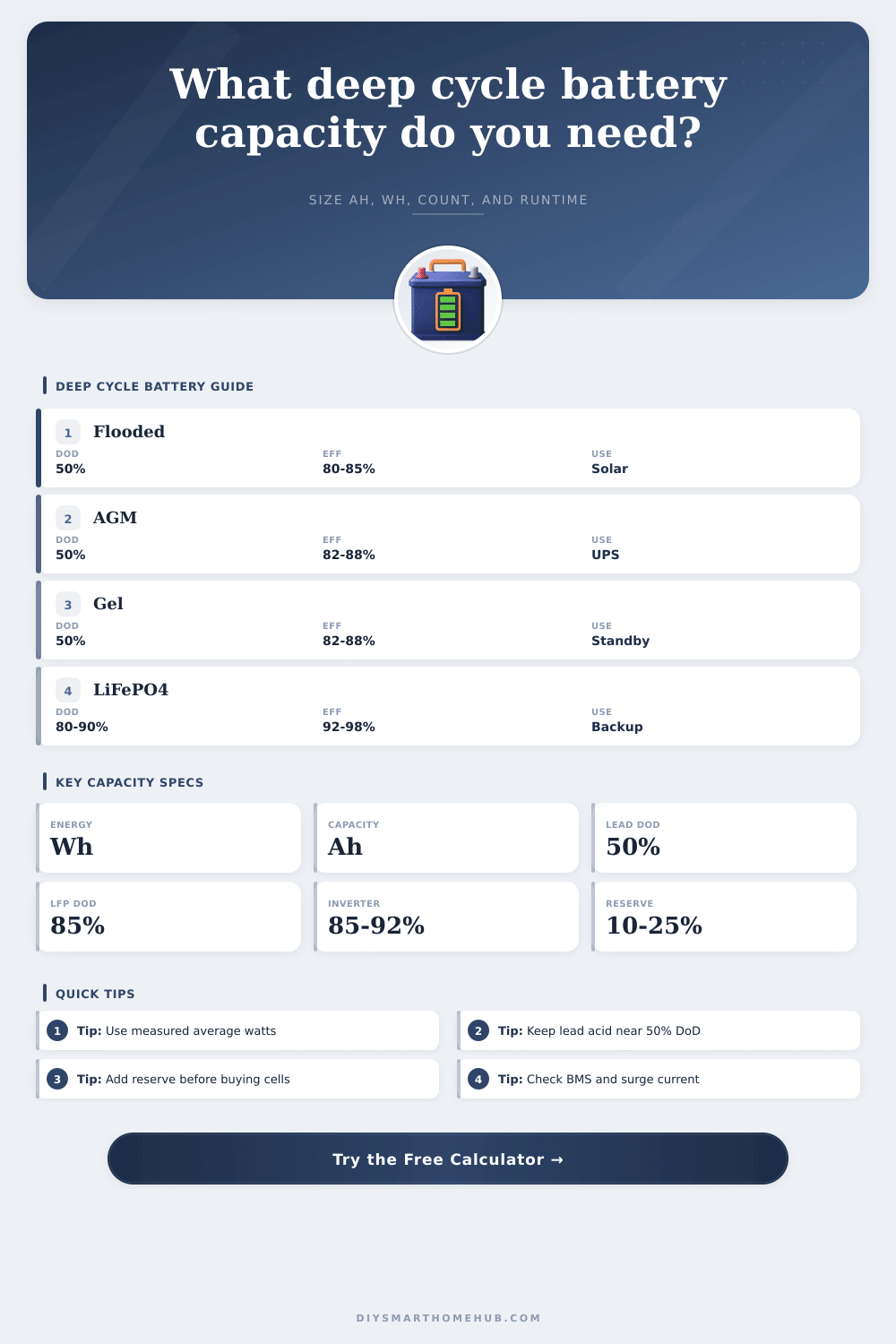
| Battery Type | Planning DoD | Typical Efficiency | Best Capacity Use |
|---|---|---|---|
| Flooded lead-acid deep-cycle | 40% to 50% | 75% to 85% | Solar shed storage and ventilated utility banks with careful maintenance. |
| AGM sealed deep-cycle | 40% to 50% | 80% to 88% | Indoor backup cabinets, router shelves, UPS-style smart home loads. |
| Gel sealed deep-cycle | 45% to 55% | 82% to 88% | Low-current standby systems where strict charging limits are followed. |
| Lead-carbon deep-cycle | 50% to 60% | 83% to 90% | Frequent partial cycling in small solar and automation banks. |
| LiFePO4 deep-cycle | 80% to 90% | 92% to 98% | High-use home backup, network racks, camera loads, and inverter banks. |
| Small sealed SLA | 30% to 40% | 75% to 85% | Short runtime electronics backup where high-rate discharge is modest. |
| Smart Home Load | Typical Average Watts | 12-Hour Energy | Capacity Note |
|---|---|---|---|
| Fiber ONT, modem, and WiFi router | 25 to 45 W | 300 to 540 Wh | Excellent fit for direct DC backup or a very small efficient inverter. |
| Security panel, LTE radio, and smart hub | 15 to 40 W | 180 to 480 Wh | Low steady load rewards accurate watt measurement and reserve planning. |
| PoE switch, cameras, and NVR | 120 to 300 W | 1.44 to 3.6 kWh | Night infrared LEDs can push camera loads above daytime averages. |
| Mini fridge or efficient refrigerator average | 60 to 150 W | 720 Wh to 1.8 kWh | Capacity uses average watts, while inverter sizing must handle startup surge. |
| CPAP with humidifier reduced or off | 25 to 60 W | 300 to 720 Wh | Check the actual nightly watt draw because humidifier heat changes runtime. |
| Sump pump on duty-cycle average | 200 to 700 W | 2.4 to 8.4 kWh | Use duty-cycle average for capacity and running surge for equipment limits. |
| Bank Voltage | Current At 100 W | Current At 500 W | Current At 1,000 W |
|---|---|---|---|
| 12 V nominal bank | 8.3 A before losses | 41.7 A before losses | 83.3 A before losses |
| 24 V nominal bank | 4.2 A before losses | 20.8 A before losses | 41.7 A before losses |
| 36 V nominal bank | 2.8 A before losses | 13.9 A before losses | 27.8 A before losses |
| 48 V nominal bank | 2.1 A before losses | 10.4 A before losses | 20.8 A before losses |
| Example Project | Average Load | Runtime Target | Practical Battery Starting Point |
|---|---|---|---|
| Internet-only outage backup | 35 W | 12 hours | 12 V 50 Ah LiFePO4 or 12 V 100 Ah AGM with reserve. |
| Security cabinet and smart hub | 30 W | 24 hours | 12 V 100 Ah LiFePO4 or two 12 V 100 Ah AGM batteries in parallel. |
| PoE camera corner with NVR | 160 W | 10 hours | 24 V 100 Ah LiFePO4 bank or larger lead-acid bank for 50% DoD. |
| Mini fridge average backup | 90 W | 18 hours | 24 V 100 Ah LiFePO4 with inverter surge headroom. |
| Home essentials inverter bank | 500 W | 8 hours | 48 V 100 Ah LiFePO4 bank or multiple AGM strings with heavy cabling. |
✅Capacity Tips
This calculator estimates steady-state deep-cycle battery capacity. Confirm manufacturer ratings, discharge curves, charge limits, protection devices, and local electrical requirements before building a battery system.
When the power goes out, many peoples internet, security cameras, and medical device cease to function. Many individuals attempt to use small power strip or uninterruptible power supply (UPS) to provide power to these devices during the outage. However, these small power strips and uninterruptible power supplies will only provide power for short period.
In order to provide power for many hour during the outage, you must use deep cycle batteries. Deep cycle batteries are different than the types of battery that is used in an automobile. The deep cycle battery is specifically design to be drained over a long period.
How to Build a Simple Battery Backup for Power Outages
The automotive battery is designed to provide short bursts of energy. Batteries contain a measurement called amp-hours (Ah). The amp-hour measurement describe the capacity of the battery.
However, the amp-hour measurement does not give the total amount of energy that the battery can contain if the voltage of the battery isnt also given. For instance, 100 Ah of a battery at 12 volts contains a different amount of energy then a 100 Ah battery at 24 volts. The 100 Ah battery at 24 volts contains twice the amount of energy as the 100 Ah battery at 12 volts.
Therefore, watt-hours (Wh) are a better measurement of the total amount of energy that a battery can contain. With watt-hours you can calculate how many hour the battery will provide power to the devices based off the wattage that those devices use. Many people make the mistake of using the total capacity of the battery.
However, using the total capacity will damage the battery. Lead acid batteries, such as AGM and Gel batteries, will be damaged if they is deeply discharged. Lead acid batteries are chemically stress if they are discharged to 50% of their total capacity.
For this reason, the total depth of discharge for lead acid batteries should of be 50%. If a person purchases a 200 Ah lead acid battery, they should only use 100 Ah of the batterys total capacity. However, lithium batteries dont suffer from this same limitation.
Specifically, LiFePO4 batteries allow for deep discharges and contain nearly double the amount of usable capacity in comparison than lead acid batteries. Another consideration in building a backup system is the efficiency of the devices that convert the batterys energy to the power that the devices use. For instance, if an inverter is used to convert the batterys energy to the amount that the devices require, the inverter will use some of the energy from the battery.
Energy is lost in the inverter because some of the energy is convert to heat. Therefore, if you do not consider the energy loss from the inverter in building the backup system, the battery may become deplete of its power sooner than calculated. Another consideration with building a backup system with batteries is the voltage of the batteries.
Commonly, batteries are of 12 volts. However, using 24 volts or 48 volts will be more efficient. Higher voltages allow for lower currents to move the same amount of power.
Using lower currents in the wires will prevent the wires from becoming warm with high level of current. For these reasons, using a 12 volt battery for a device that uses a large amount of power will result in high currents in the wires. Using a higher voltage will prevent the wires from becoming to warm.
One more consideration in building a backup system is to include a buffer in the system. The performance of the hardware will change over time. Batteries have a limited amount of capacity over time.
Additionally, batteries lose their capacity when the temperature around the battery becomes cold. Another reason to include a buffer in the backup system is to account for potential increase in the power needs of the devices in the system. If you include a buffer in the system, say of 10 or 20% of the total power of the system, it will allow the system to continue to function even if the battery chemistry slow due to cold weather.
Building a backup system require consideration of the costs of the batteries. For instance, individuals can purchase the expensive LiFePO4 batteries that contain more usable power than lead acid batteries. Additionally, individuals can also purchase the less expensive lead acid batteries such as AGM batteries.
However, the AGM batteries will need to be replaced more frequently. Another consideration of the batteries is the difference between the capacity that the battery can provide and the surge of power that the battery can provide. While the capacity will determine how many hour of power the batteries will run, the surge will determine whether or not the battery and inverter can supply enough power to devices that contain compressors, like refrigerators.
By calculating the capacity of the batteries, the voltage, the chemistry of the batteries, and the surge power requirements of the devices, individuals can create a calculated plan for the power outages.