Home Battery Storage Calculator
Estimate usable backup energy, nominal battery capacity, inverter size, and module count from real outage loads.
Battery Storage Results
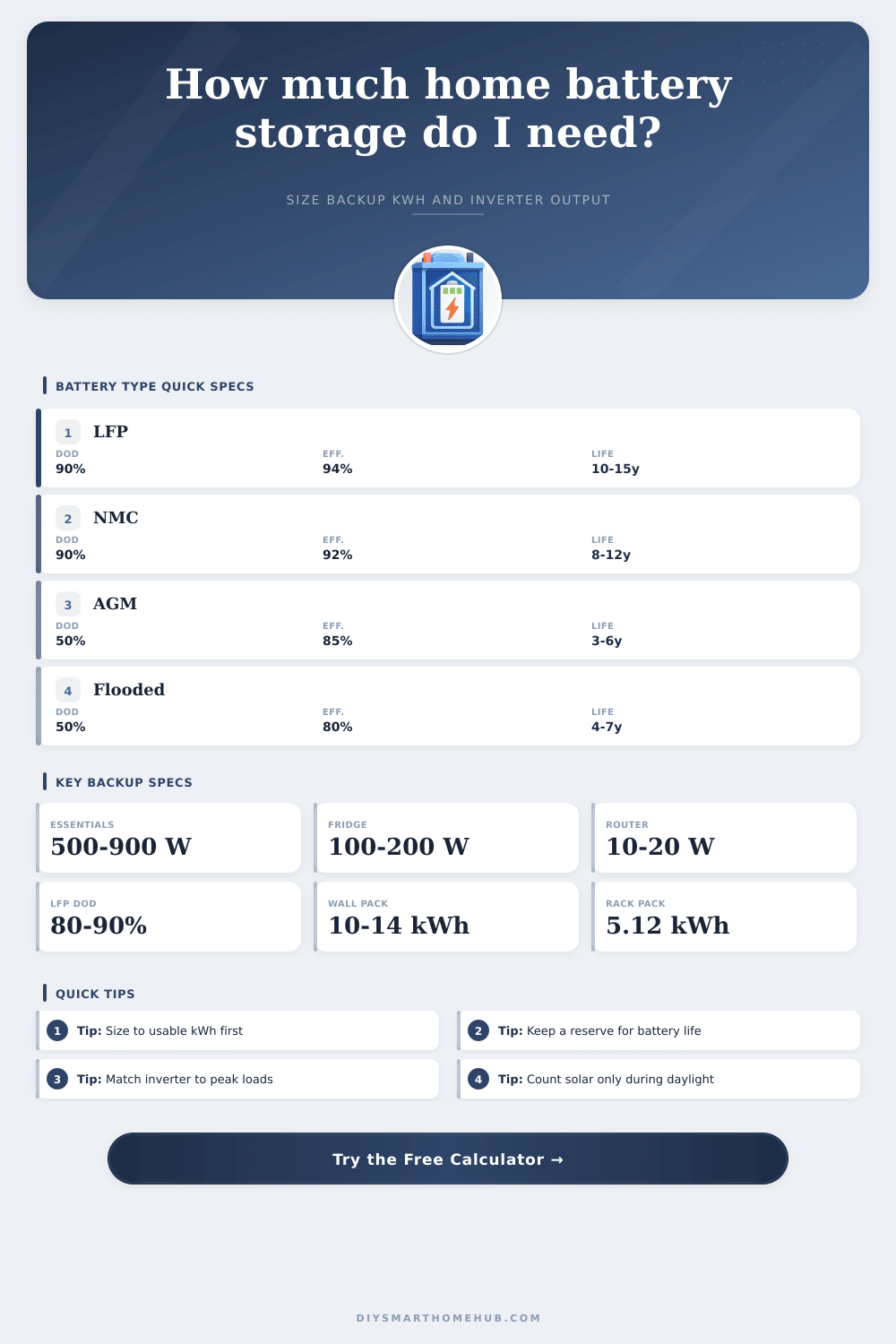
| Battery type | Planning DoD | Round-trip efficiency | Typical cycle range | Best fit |
|---|---|---|---|---|
| LiFePO4 home battery | 80-90% | 92-96% | 3000-6000+ | Daily backup and solar storage |
| NMC lithium wall battery | 80-90% | 90-94% | 2000-4000 | Compact wall-mounted systems |
| Portable LiFePO4 station | 80-90% | 88-92% | 2500-4000+ | Plug-in essential loads |
| AGM lead-acid bank | 50% | 80-85% | 500-1000 | Occasional backup with larger bank size |
| Flooded lead-acid bank | 50% | 75-85% | 500-1200 | Ventilated utility battery rooms |
| Server-rack LiFePO4 bank | 80-90% | 93-96% | 4000-7000+ | Modular equipment-room storage |
| Load group | Typical running watts | 8 hour energy | 24 hour energy | Planning note |
|---|---|---|---|---|
| Wi-Fi router and modem | 10-25 W | 0.08-0.20 kWh | 0.24-0.60 kWh | Small but often continuous |
| Refrigerator | 100-200 W average | 0.8-1.6 kWh | 2.4-4.8 kWh | Startup surge can be several times running load |
| LED essential lights | 40-120 W | 0.32-0.96 kWh | 0.96-2.88 kWh | Depends on number of fixtures |
| Sump pump | 600-1000 W running | 4.8-8.0 kWh if continuous | 14.4-24.0 kWh if continuous | Use actual duty cycle when known |
| CPAP device | 30-90 W | 0.24-0.72 kWh | 0.72-2.16 kWh | Humidifier heat raises draw |
| Well pump | 750-1500 W running | 6.0-12.0 kWh if continuous | 18.0-36.0 kWh if continuous | Motor surge drives inverter sizing |
| Critical load | 8 hours | 12 hours | 24 hours | 48 hours |
|---|---|---|---|---|
| 300 W essentials | 2.4 kWh | 3.6 kWh | 7.2 kWh | 14.4 kWh |
| 600 W essentials | 4.8 kWh | 7.2 kWh | 14.4 kWh | 28.8 kWh |
| 1000 W circuits | 8.0 kWh | 12.0 kWh | 24.0 kWh | 48.0 kWh |
| 1500 W circuits | 12.0 kWh | 18.0 kWh | 36.0 kWh | 72.0 kWh |
| Nominal module | Approx LFP usable at 90% DoD | Approx AC usable at 92% inverter | Typical format | Good for |
|---|---|---|---|---|
| 2.56 kWh | 2.30 kWh | about 2.12 kWh | Small rack module | Router, lights, compact backup |
| 5.12 kWh | 4.61 kWh | about 4.24 kWh | 48 V rack module | Fridge, network, lighting circuits |
| 10 kWh | 9.00 kWh | about 8.28 kWh | Wall or stack pack | Longer essential-load outages |
| 13.5 kWh | 12.15 kWh | about 11.18 kWh | Large wall module | Whole-home essential panels |
| 15 kWh | 13.50 kWh | about 12.42 kWh | Stacked floor module | Extended backup and solar shifting |
| Backup scenario | Typical load | Target time | Raw AC energy | Likely inverter class |
|---|---|---|---|---|
| Communications only | 50 W | 24 hours | 1.2 kWh | 0.5-1 kW |
| Fridge, lights, router | 500 W | 12 hours | 6.0 kWh | 1-2 kW |
| Apartment essentials | 650 W | 18 hours | 11.7 kWh | 2-3 kW |
| Essential-load panel | 1200 W | 24 hours | 28.8 kWh | 3-5 kW |
| Well pump household | 1800 W | 12 hours | 21.6 kWh | 5-8 kW |
Home battery storage systems can provides electrical energy for homes in the instance that the power grid should fail. A failure of the power grid is often referred to as a blackout, and blackouts can create various problem for individuals and there homes. For instance, blackouts can prevent hospitals from being able to supply power to life-critical medical devices, it can prevent those in home offices from being able to perform they jobs, and it can prevent basement flood prevention system from functioning.
Thus, home battery storage systems is not an unnecesary luxury for moddern homes, but are, instead, a critical infrastructure system that will provide energy to each home until the power grid is restored. In order to ensure that the battery system effectively fulfill its purpose, an individual must determine how much energy their home battery system need to store, and ensure that they purchase a system that has the correct amount of energy to allow it to last until the power grid is restored. Many individuals will attempt to use the method of guessing at the amount of energy that their home battery system will require.
How to Pick the Right Home Battery for Power Outages
For example, many individuals may believe that purchasing a system that can store ten kilowatt hour of energy will be sufficient for there home. However, this is an unreliable method of determining the amount of energy that their system should be sized to store. For instance, determining the power that each device in the home draws that is to be powered, and the length of time that those devices require the power, actualy calculates the amount of energy that a home requires.
Thus, instead of attempting to power all of the appliance in their home, individuals should determine which appliances are critical for operation during a power outage, and ensure that the battery system does not become depleted of its stored energy too quick. Calculators that are available online to determine the size of battery systems that are to be utilized in individual homes ask individuals to determine the wattage of the appliances that they wish to power during a blackout. Thus, the critical load for each home is actually the combination of the wattages of those essential appliances, such as refrigerators, internet routers, and LED lights.
Additionally, many battery systems must account for the startup surge that many appliances experience. For instance, refrigerators may use relatively small amount of energy while they are running, but their compressors requires large amounts of energy to start running. The chemistry of the battery system that manufacturers manufacture for each home is another of the main factors that must be considered.
For instance, manufacturers often manufacture lithium iron phosphate (LFP) batteries for home battery systems because LFP batteries tend to last longer than other types of batteries, and can better handle deeper discharges of the batteries. Depth of discharge is a measurement of the amount of energy that can be drawn from the batteries. For instance, lead acid batteries have relatively low depth of discharge, meaning that a substantial amount of energy must remain stored within the batteries to avoid experiencing failure in the function of those batteries.
Thus, the low depth of discharge indicates that energy is purchased for which is not going to be use. Another factor to consider is the efficiency of the system. For instance, energy is lost each time the energy changes form from batteries to the inverter that distributes the energy, and within the wiring system of the home itself.
Thus, the inverter is not a perfect system of transferring energy to each appliance, meaning that there will be less energy at each appliance than was originaly stored within the home battery system. This factor should of been considered in the calculations of how long the batteries will last. Solar panel systems may also factor into the energy calculation for the home battery system.
For instance, homes that incorporate solar panel systems will experience the power to recharge their battery system while they are providing energy for the home. However, the solar panels will not provide power in instances where the sunlight does not reach the panels, such as on cloudy days. Thus, solar power may be considered an added bonus to the energy that is provided by the battery system, but isnt a system that can be relied upon for power.
One more factor to consider is the aging of the batteries. After the batteries have been manufactured, they will age over time. For instance, the battery chemistry will degrade over time, leading to a reduction in the power that can be provided by the batteries after five year, for instance, of manufacturing.
Thus, individuals should purchase a battery system that includes a ten or twenty percent buffer for the energy calculations for the system to account for the natural degradation of the chemistry within the batteries. This reserve margin may be used to power additional appliances, such as a space heater to keep the water in the pipes from freezing in cold climate. The sizing of the battery system also indicates how much an individual will spend on the system.
While it may be appealing to purchase a very large battery system, the additional cost may not be worth the amount of energy that it will output. Thus, one of the goals for many individuals may be to purchase a system that provides enough energy to power the essential appliances in the home, and to provide power to the internet router. Thus, if an individual determine their critical loads, and purchases a battery system that uses the appropriate chemistry, they will have a reliable battery system.