MPPT Charge Controller Calculator
Estimate safe MPPT controller amps, cold-weather string voltage, supported PV watts, and expected daily harvest before you lock in battery voltage, panel count, and controller class.
☀Preset system layouts
Start from a realistic solar setup, then tune panel specs, series count, charge voltage, and harvest assumptions for your own battery bank.
🔋Array and battery inputs
Use the panel label values for watts, Vmp, Voc, and Imp. The calculator applies a cold-weather Voc rise, controller efficiency, and safety buffer before rounding up to a controller class.
📊Controller class snapshots
These quick cards show how much PV wattage common MPPT controller sizes can process at the current charging voltage you selected.
📋Controller watt guide
Approximate supported PV watts by controller current and battery bank charge voltage.
| Controller | 12V bank | 24V bank | 48V bank |
|---|
⚡String voltage planner
Cold-weather Voc is the number that most often decides whether a string plan fits a 75V, 100V, 150V, or 250V MPPT input.
| Series | String Vmp | Cold Voc | PV class fit |
|---|
📘Common MPPT layout references
Use these reference rows to compare your result against typical small off-grid and backup solar designs.
| Scenario | Array | Battery | Controller target |
|---|
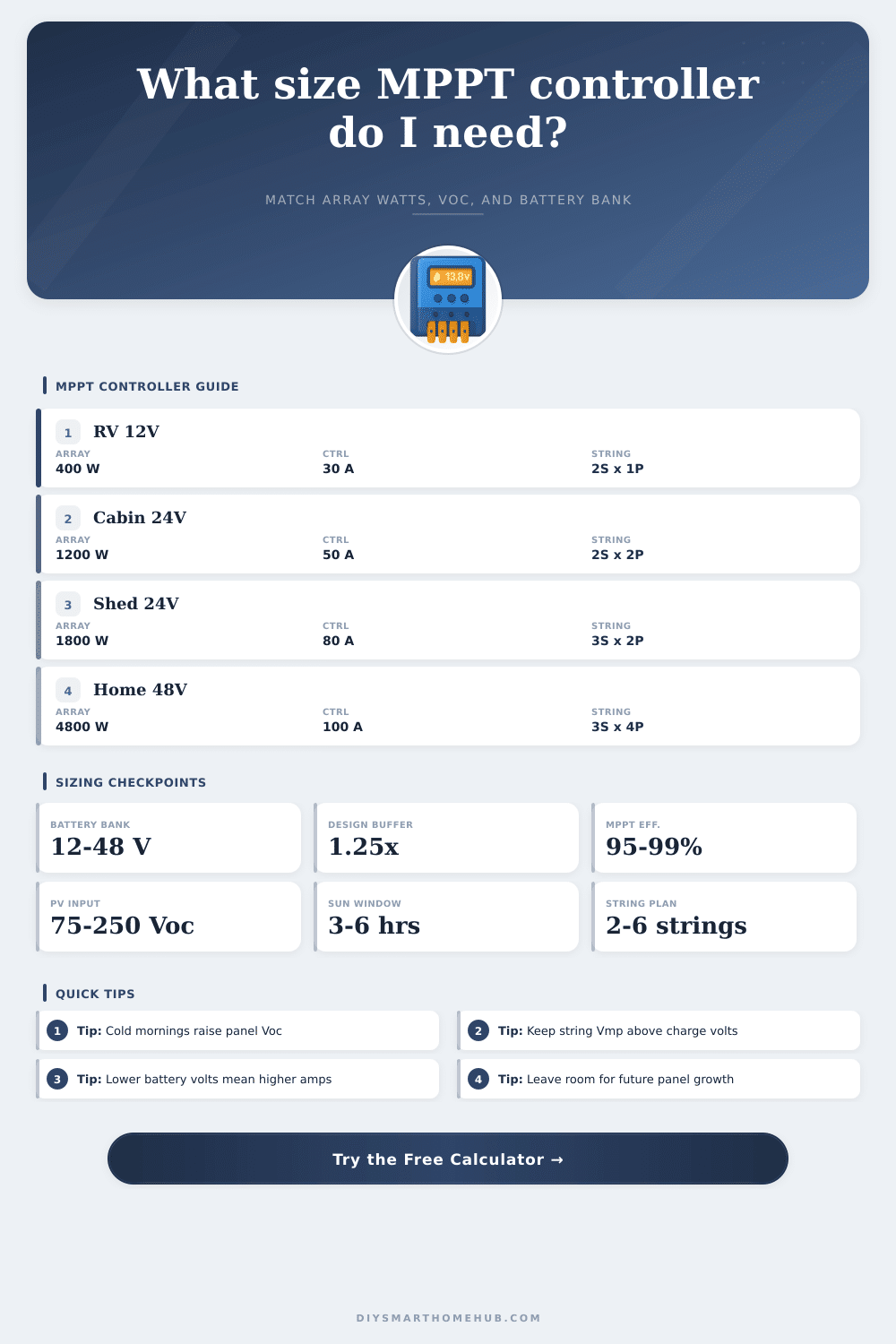
Controller current is array charging power divided by the battery charging voltage. A 12V bank may charge at 14.4V, while a 48V lithium bank may charge near 56.8V.
Voc rises as modules cool down, so the same series count that looks safe on a warm afternoon can exceed a 100V controller limit on a cold bright morning.
An MPPT charge controller is a device that can manage the flow of electricitys generated by solar panels and can deliver that electricity to a battery bank. An MPPT charge controller is more efficient than a PWM charge controller because an MPPT charge controller can track the optimal voltage of solar panels and can convert excess voltage into additional amperage for the battery bank. Because an MPPT charge controller can increase the efficiency of the solar panel and battery bank system by 20% to 30%, an MPPT charge controller is useful in areas where solar sun hour are low.
To select the appropriate MPPT charge controller for a solar panel and battery bank system, a person must calculate the total wattage of the solar array and the voltage of the battery bank and the MPPT charge controller. The voltage of solar panels can change based off the temperature of the panels. When solar panel temperatures decreases, the voltage of the solar panel increases.
How to Choose an MPPT Charge Controller
For example, a solar panel with an open-circuit voltage of 22 volts when exposed to warm weather may produce 25 volts when exposed to cold weather. If a person connects too many solar panels in series with each other, the total voltage output of the solar panel can approach or exceed the maximum input voltage of the MPPT charge controller. If the solar panels exceeds the maximum input voltage of the MPPT charge controller, the MPPT charge controller can be damage or fail to function altogether.
Therefore, a person must calculate the maximum voltage that the solar panels may produce when temperatures drop to ensure that the voltage output by the solar panel remains within the voltage limit of the MPPT charge controller. Another factor that a person must calculate when selecting an MPPT charge controller is the amperage of the system. A person can calculate the required amperage for the battery bank by dividing the total wattage of the solar array by the actual charging voltage of the battery bank.
The nominal voltage of the battery bank should not be use; the actual voltage at which the battery bank is being charged should be used. The wattage and voltage of the solar array will often not be at full efficiency when the solar panels are generating electricity for the battery bank. An MPPT charge controller is typicaly between 95% and 99% efficient in convert the solar panel wattage to battery bank wattage.
Additionally, there will be some loss in efficiency due to solar panels getting covered in dust and solar panel and battery wiring reaching too high of temperatures to safely allow electricity to pass through. Thus, a person should allow for some additional losses in efficiency by selecting an MPPT charge controller with a higher amperage rating to provide for these losses; 25% is a typical safety buffer to allow for these losses. The way in which a person connects solar panels together into series and parallel strings can dictate both the voltage and amperage of the electricity that is delivered to the MPPT charge controller.
If solar panels are connected in series with each other, the voltage of the series of solar panel strings increases, but the amperage remains the same as that of the individual solar panel strings. If solar panel strings are connected in parallel, the opposite occurs; the amperage of the strings increases but the voltage remain the same. By connecting solar panel strings in parallel to one another, a person can increase the amperage that is supplied to the MPPT charge controller without exceeding the voltage limits of the MPPT charge controller.
However, because connecting solar panels in parallel increases the amperage that passes through the wiring, the wiring must be of a thicker gauge to allow for the increased current without overheating the wiring. The chemistry of the batteries that will receive the electricity from the solar panels and MPPT charge controller will dictate the voltage settings that are used for the MPPT charge controller. For lead-acid AGM batteries, the voltage reaches 14.4 volts when the battery bank is 12 volts; however, lithium batteries typically have a charge voltage of 14.2 volts.
For those with a 48 volt battery bank, the voltage levels are higher and the amperage required to charge the battery bank is lower. Thus, a 48 volt battery bank allow for a single MPPT charge controller to manage a much larger solar array than a 12 volt battery bank. Finally, another consideration for a person when selecting an MPPT charge controller is the future expansion of the system.
If a person selects an MPPT charge controller to allow for the current wattage and voltage of a solar panel array, but the solar panels are replaced with higher wattage panels in the future, that MPPT charge controller will need to be replaced. A person can avoid this costly replacement by selecting an MPPT charge controller that has a higher wattage and voltage limit; this will allow for the addition of solar panels in the future without having to purchase a new MPPT charge controller or wiring for the battery bank. Thus, planning for the future expansion of a solar panel and battery bank system allows for the system to grow with the expanding need of the user.