Solar Battery Bank Size Calculator
Estimate battery bank kWh, amp-hours, module count, and one-day solar recharge for backup circuits, cabins, RV systems, and off-grid home loads.
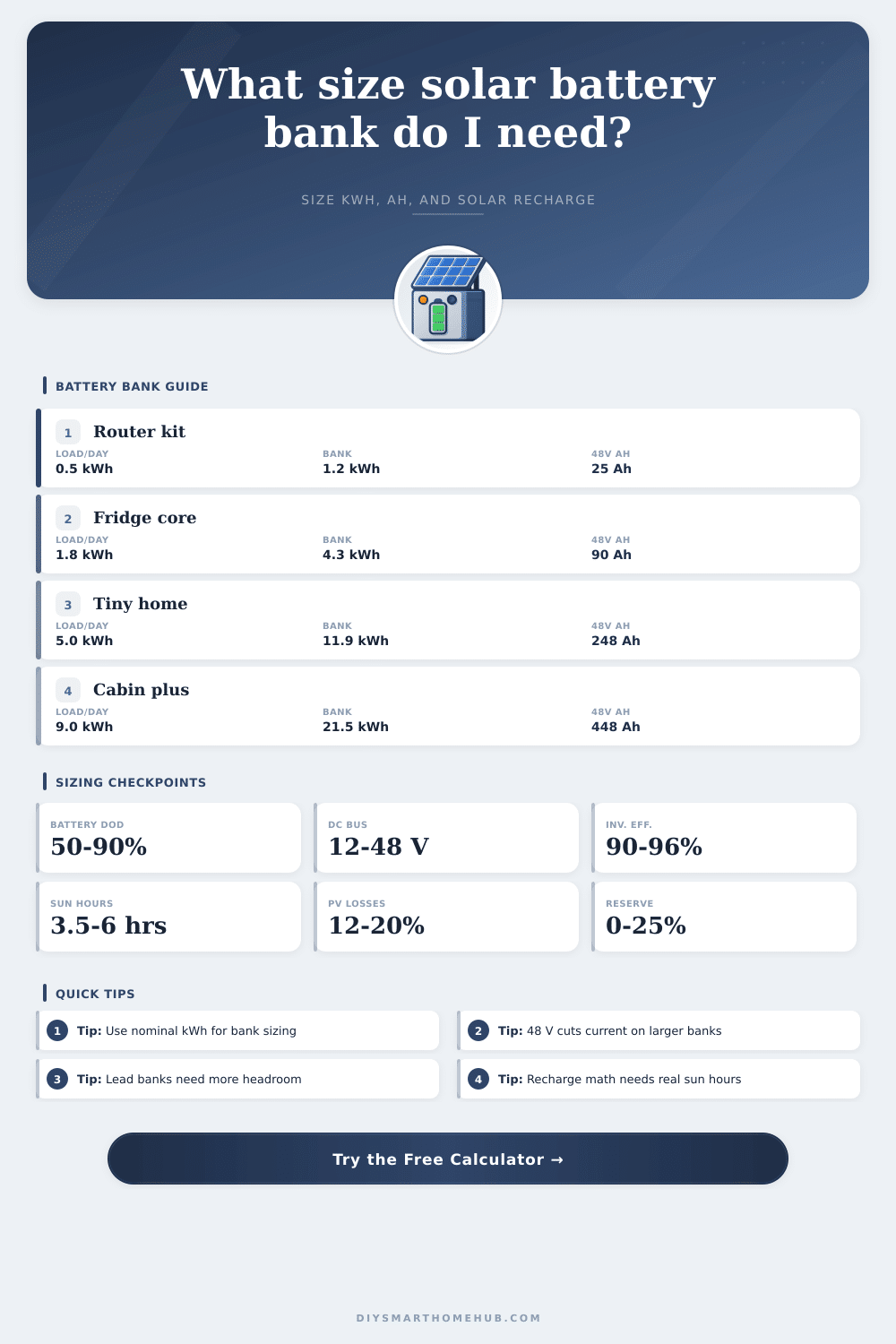
Start with AC kWh and outage days, then divide by inverter efficiency and the chemistry's allowed depth of discharge. That keeps lead-acid and lithium banks comparable on a fair basis.
The same 2,400 W load pulls about 217 A at 12 V, 109 A at 24 V, and 54 A at 48 V before wiring losses. Bigger systems usually work better on higher voltage.
To size a solar battery bank, you must calculate the energy need that your battery bank will have to provide during periods of outage. To determine your energy needs, you must first calculate the total amount of energy that you consume each day, which is measured in kilowatt-hour. To calculate your kilowatt-hours, you will have to calculate the energy usage of each of the appliance in your home, such as lights, refrigerators, and tools.
In most cases, people will underestimate there energy consumption if they do not account for appliances like chest freezers, which draw more energy when the surrounding temperature is highly. Once you have calculated your daily energy consumption in kilowatt-hours, you must multiply that number by the number of day of autonomy that you would like your battery bank to provide power without recharging from your solar panels. In addition to your battery bank size, you must also account for energy losses that occur with the conversion of electricity.
How to Size a Solar Battery Bank
For instance, inverters that convert the direct current from your battery to an alternating current that your appliances use can lose between 5 and 15 percent of the energy that it converts. Thus, your battery bank must be able to provide additional energy to account for these loss. Furthermore, batteries also has a depth of discharge that limits the amount of energy that can be drawn from the battery before it is considered “empty.” Lead acid battery only allow for approximately 50% depth of discharge, meaning that a lead acid battery bank will have to be twice as large as a lithium battery bank to provide the same amount of energy.
In contrast, lithium batteries, such as LiFePO4 batteries, can have a depth of discharge of approximately 90% of the battery bank, meaning they contain more usable energy in the same size battery bank. The voltage of your battery bank will also impact the current that flows through the wires of your installation. For instance, if your battery bank is 12 volts and your load is 2,000 watts, your load will require over 160 amps of current to power the devices.
High currents place high demand on the thickness of the wires that are used to deliver that current to the appliances. If, however, your battery bank is 48 volts, the current that is required to power your devices will be significantly less, which will allow for thinner wires to be used in your installation. Thus, higher voltages are preferred in reducing the risk of the wires overheating under high load from appliances.
Another factor that will impact your battery bank is the chemistry of the batteries that you will use within the battery bank. Flooded lead acid battery banks are relatively inexpensive, but their capacity to be drained to only 50% of there total capacity. AGM and gel batteries is sealed and do not leak, but similarly have limited depths of discharge.
Finally, lithium batteries offer high efficiency and many charge cycles before the battery declines in performance, which is why those who use their solar battery bank daily often prefer them. Additionally, another factor to consider is the round-trip efficiency of the batteries, or the energy loss during the charging and discharging cycle. In addition to battery bank considerations, the sizing of your solar panels must also be coordinated with the sizing of your battery bank.
You will use the solar panels to recharge your battery bank, so their output must be calculated to ensure that the battery bank will be recharged within one day of sunlight. The solar panel output that you calculate should be based on the number of peak sun hours that your area receives during its least sunny season of the year. Additionally, due to energy losses in the wiring, solar panels, and solar charge controllers, you may need to oversize your solar panel array by 12% to 20% to compensate for these losses.
Additionally, you may want to provide another percentage of energy between 10% and 25% to provide for aging battery bank cell or cloudy weather that may prevent the batteries from being fully charged. If the battery bank is too small for your installation, it will take several days to recharge the batteries. Thus, you must ensure that the solar panel array can fully recharge the battery bank within one day of sunlight.
Finally, there are some common mistakes that you should avoid in the process of sizing a battery bank. One common mistake is focusing on the nameplate capacity of the batteries, rather than the usable capacity of the battery bank. The usable capacity is the amount of energy that can be drawn from the batteries, rather than the total capacity of the batteries.
Furthermore, it is common to ignore the surge wattage of the appliances that will be powered by the battery bank. Appliances like well pumps requires high amounts of starting wattage to start up, which can create issues for a small inverter that cant supply that much starting power. Finally, the environment in which the battery bank will be installed should be considered.
Battery chemistry works best within an environmental range of 50 to 77 degrees Farenheit, and can experience a 20% reduction in capacity within extreme cold weather.