Airflow Pressure Drop Calculator
Estimate total pressure loss from airflow, duct shape, material, straight length, elbows, and terminal restrictions, then compare the result with the static budget your fan or blower can realistically spare.
📌Quick path presets
This calculator models pressure loss the way a real fan sees it: straight-run friction, local loss at elbows and grilles, and the reserve you still need for loading, dampers, or future airflow changes.
📏Path inputs
💡Live sizing notes
📊Pressure drop results
⚙Path planning specs
📋Duct velocity bands
| Profile | Quiet | Target | Fast side | Why it matters |
|---|---|---|---|---|
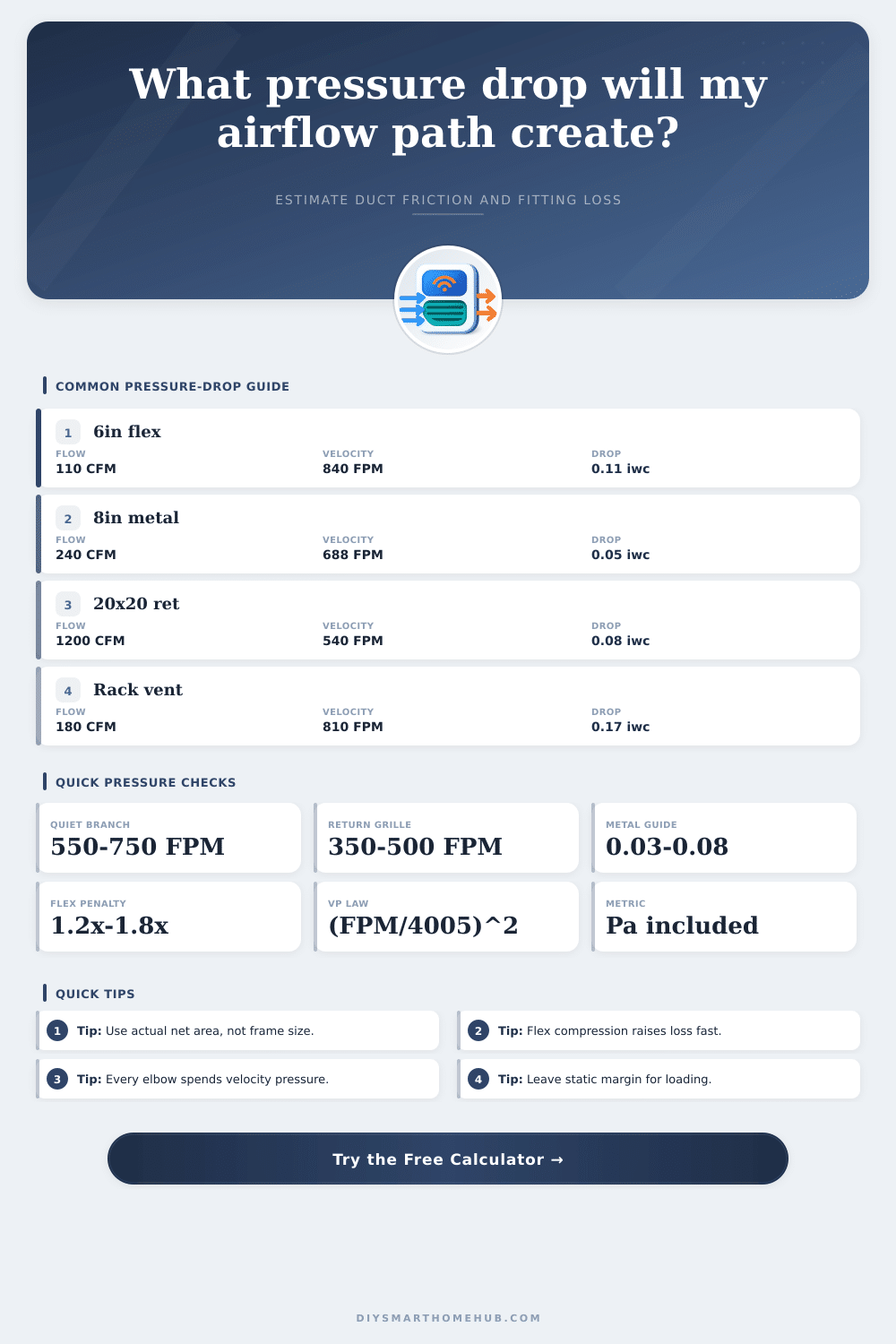
| Smart vent | 450 FPM | 500-750 | 900 FPM | Small branch vents can whistle quickly. |
| Supply branch | 500 FPM | 550-800 | 950 FPM | Comfort usually favors the mid band. |
| Return grille | 300 FPM | 350-500 | 650 FPM | Lower return speed cuts grille noise. |
| Server vent | 450 FPM | 500-800 | 950 FPM | Enough speed moves heat without hiss. |
| Purifier loop | 220 FPM | 250-450 | 600 FPM | Filters and media paths prefer slower flow. |
| Bath exhaust | 500 FPM | 650-900 | 1100 FPM | Small exhaust ducts often run faster. |
📑Material and fitting effects
| Path type | Roughness | Loss mult | Best use | Watch for |
|---|---|---|---|---|
| Material rows load with the calculator. | ||||
🗂Preset project snapshots
| Preset | Flow | Velocity | Reserved drop | Status |
|---|---|---|---|---|
| Preset examples load when the calculator starts. | ||||
A frame that measures large on the tape can still act like a much smaller opening once blades, mesh, or filter supports remove real free area.
Dust loading, closing dampers, and running a boost mode all spend static headroom, so a path that just fits on paper often ends up noisy or under-delivering.
Static pressure drop is a measurement of the resistances that a fan must overcome to move air through a ventilation system. Static pressure drop occur in ventilation systems because the air that moves through the system encounter resistance moving through the ducts of the system. If the static pressure drop in a ventilation system is too high, then the airflow will decrease in the system.
If the static pressure drop is so high that the fan cannot move enough air to the room that the ventilation system serve, the system will underperform. Many factors contribute to the static pressure drop in a ventilation system. The straight section of a duct system create friction between the air and the duct walls.
What Is Static Pressure Drop in a Ventilation System
The fittings in a duct system create turbulence in the airflow, contributing to a static pressure drop. Grilles contribute to a static pressure drop because the blades of the grille create restriction in the movement of air through the grille. Flexible ducting systems tend to have a higher static pressure drop than systems that use smooth metal ducting.
If the flexible ducting is compressed to fit into a tight space, the static pressure drop will increase. The static pressure that a fan can provide to a ventilation system is limited, and the manufacturer measure this limit in inches of water column. The velocity of the air that moves through a duct system should be balanced against the static pressure that the fan can provide.
Higher velocities means that air will move faster through the duct system. At high velocities, such as 900 feet per minute through the vent, a noise will result from the fittings in the system. At lower velocities, such as below 400 feet per minute, the air may not be able to reach the corners of the room.
The velocity of air that is required in different application is not the same. Air movement system in bedrooms require low velocities so that the fans dont create noise while people are sleeping. Bathroom exhaust fan can move at higher velocities because the noise is less of a problem in a smaller bathroom.
Server closet fan can move air at a medium velocity because it is fast enough to move heat away from hot servers, but slow enough to avoid creating too much noise in the closet. Ventilation system terminals, such as ceiling registers, create a static pressure drop because the registers often twist the air as it exit the register. Many people make mistake when they size a ventilation system.
One of the most common is to size the system based off the gross dimension of a grille rather than the net area of the grille. The gross dimensions of a grille include the louvers and the frame that hold the grill open. However, the net area of a grille is the area of the open space for air to move through the grille.
Using gross dimensions instead of net area mean that the velocity of air in the system will spike, and the static pressure drop will increase. Another mistake is to ignore the effect that elbows in the system can have on static pressure drop. A long-radius sweep elbow will have a less static pressure drop than a stamped elbow in the system; therefore, long-radius sweep elbows is preferred.
There should always be a safety reserve provided for a ventilation system. The safety reserve in a ventilation system is provided to allow for changes to the system that may occur in the future. A ten percent safety reserve in a system provides some allowance for future changes; a twenty percent safety reserve is better if the system will use dirty filter.
If there is no safety reserve in a system, the system may not provide enough air movement if the grilles or filters in the system become dirty over time. To create a well-planned ventilation system, people should pay special consideration to the net area of the component of the system and the smoothness of the paths that the air moves through the system. Smooth metal ducting should be favored over flexible ducting.
Turns in a ducting system should be wide rather than sharp. The net area of the grilles should be considered rather than the outer frame size of the grilles. By considering the static pressure drop of the system and planning for it with the use of smooth materials and a safety reserve, people can create an effective and efficient ventilation system.