Air Filter Pressure Drop Calculator
Estimate clean and dirty filter drag from airflow, real face geometry, media family, depth, rack quality, and loading stage before you tighten a return path or retrofit a deeper cabinet.
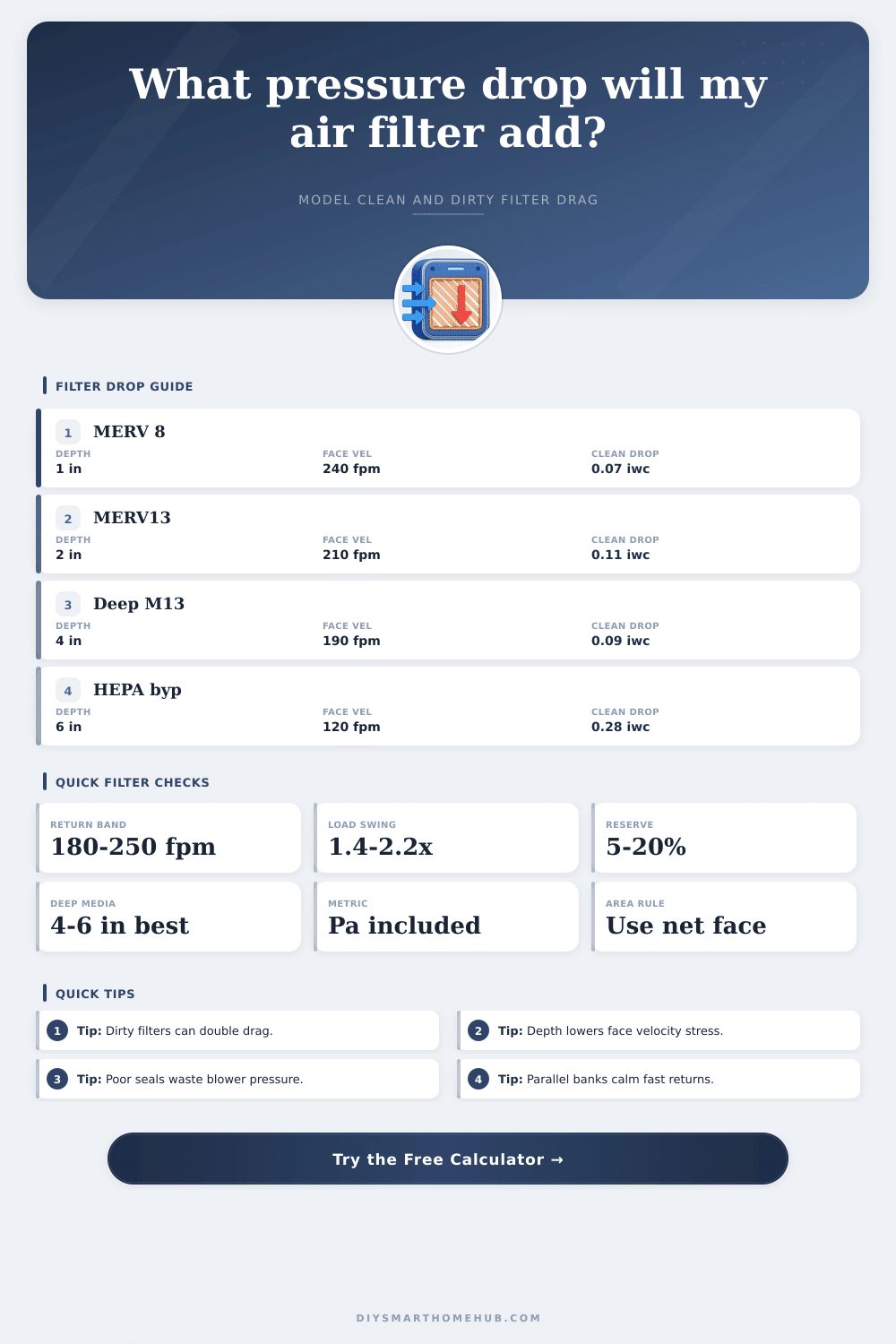
📌Quick filter scenarios
This calculator focuses on the pressure the filter stage itself consumes. It accounts for media response, depth, prefilter choices, housing losses, and the way loaded filters eat into the blower allowance you still need for the rest of the system.
📏Filter path inputs
🔍Live planning notes
📊Pressure planning anchors
📘Media response table
| Media | Ref velocity | Ref clean drop | Loaded swing | Open area | Best fit |
|---|
📏Common filter face checkpoints
| Nominal face | Gross area | MERV 8 1 in | MERV 13 2 in | Deep M13 4 in | Typical use |
|---|
📋Scenario snapshots
| Scenario | Airflow | Filter setup | Clean drop | Loaded drop | Status |
|---|
🛠Field notes
Most pressure complaints start with effective area, not media label. A slot rack, carbon wrap, or sloppy cabinet can spend the same static pressure a deeper media upgrade would have saved.
Use the loaded number when you want stable blower performance between filter changes. Clean-drop math alone can look comfortable while the late-cycle filter quietly pushes the fan off target.
Air pressure drops is the resistance that occurs for air moving through an air filter. The pressure drop within a HVAC system can reduce the efficiency of that system. Air filters loads with dust and debris.
When an air filter becomes loaded with dusts and debris, the air filter creates more pressure drop. If an air filter creates more pressure drop, the blower motor must work harder to move the air through the system. The blower motor working harder mean that the air filter is consuming more energy.
Why Air Filters Cause Pressure Drop and How to Reduce It
Additionally, high pressure drop will create a decrease in the total volumes of air that passes through the system. Decreased volume of air can result in uneven temperature throughout a building. Face velocity is the rate of air movement through the surface of the air filter.
The face velocity impact the pressure drop within the HVAC system. If the face velocity is increased, the air moves faster through the air filter, thus creating a higher pressure drop. People who uses higher MERV air filters will experience a higher pressure drop through the air filter.
By adjusting the face velocity of the air filter, you can permit the air to move through the air filter at a lower rate to reduce the formation of a high pressure drop. If the face velocity increases beyond 250 feet per minute, the air will create a significant amount of resistance through the air filter. The depth of the air filter will impact the pressure drop within the HVAC system.
A two-inch air filter will create more pressure drop than a four-inch or a six-inch air filter. This is due to the fact that the two-inch air filter have a smaller surface area. The shallower the air filter, the more quick it will load with dust and debris.
When using a deeper air filter, there will be more paths for the air to travel through the air filter. More paths for the air to travel will allow the air to move at a lower face velocity. A deeper air filter will also load with more dust and debris before creating too high a pressure drop within the HVAC system.
Using a prefilter will allow the prefilter to collect the larger particles, thus protecting the main air filter. Air pressure drop also has to be considered in the total available pressure budget for the HVAC system. The blower motor create the air pressure for the HVAC system.
This air pressure has to support the air filter, the ductwork, and the air conditioning coils. A buffer of ten or twenty percent of the total available pressure budget should be reserved for the air filter. If the air filter consume most of the available air pressure, there will not be enough air pressure left for the ductwork and air conditioning coils.
Thus, maintaining a low pressure drop for the air filter will ensure that the air conditioning coils receives enough air to properly function. Air pressure drop within the HVAC system is also impacted by the seals of the air filter. If the air filter does not have a tight seal within the filter cabinet, the air will leak around the edges of the air filter.
If the air moves around the air filter instead of through the media of the air filter, the air filter will not be able to remove particles from the air. Thus, air filtration efficiency will decrease with loose seal around the air filter. Additionally, the physical dimensions of the grille also impact air pressure drop.
The air filter has to be installed in a way that will maximize the effective area through which the air move. The larger the effective area, the lower the face velocity of the air through the air filter. Finally, there are methods to monitor the pressure drop of the air filter.
The blower motor will make more noise if the air filter presents an obstacle for the motor to push the air through the system. Furthermore, if the airflow from the vents in the building is weak, the air filter may be creating a significant amount of pressure drop. In environments with high levels of pet dander or workshop dust, the air filter will load with these particles more quick.
Thus, air filters in these environments will need to be change more often. By managing the face velocity, depth of the filter, and pressure drop of the air filter, HVAC system will operate in an efficient manner throughout the life of the air filter.