Air Filter CFM Calculator
Estimate how much airflow a filter face can carry before velocity climbs too high for the media, depth, return style, and service interval you want to maintain.
📌Quick filter CFM presets
Each preset changes the filter face geometry, media family, and reserve policy so you can compare CFM capacity instead of only staring at a nominal filter label.
📏Filter airflow inputs
🔍Live sizing notes
📊Filter airflow result
Use the results as a sizing checkpoint before you lock in return grilles or media cabinets.
💡Filter CFM planning anchors
📘Media airflow target table
| Media | Depth ref | Base target | Open area | Best fit | Service note |
|---|
📏Common nominal size capacity table
| Nominal size | Gross face | Quiet CFM | Balanced CFM | Headroom CFM | Typical fit |
|---|
📋Preset comparison table
| Preset | Target flow | Filter setup | CFM ceiling | Face velocity | Status |
|---|
Nominal filter labels can look generous, but airflow capacity tracks the real gross face, open media fraction, and grille losses. Two smaller returns often outperform one overloaded central slot.
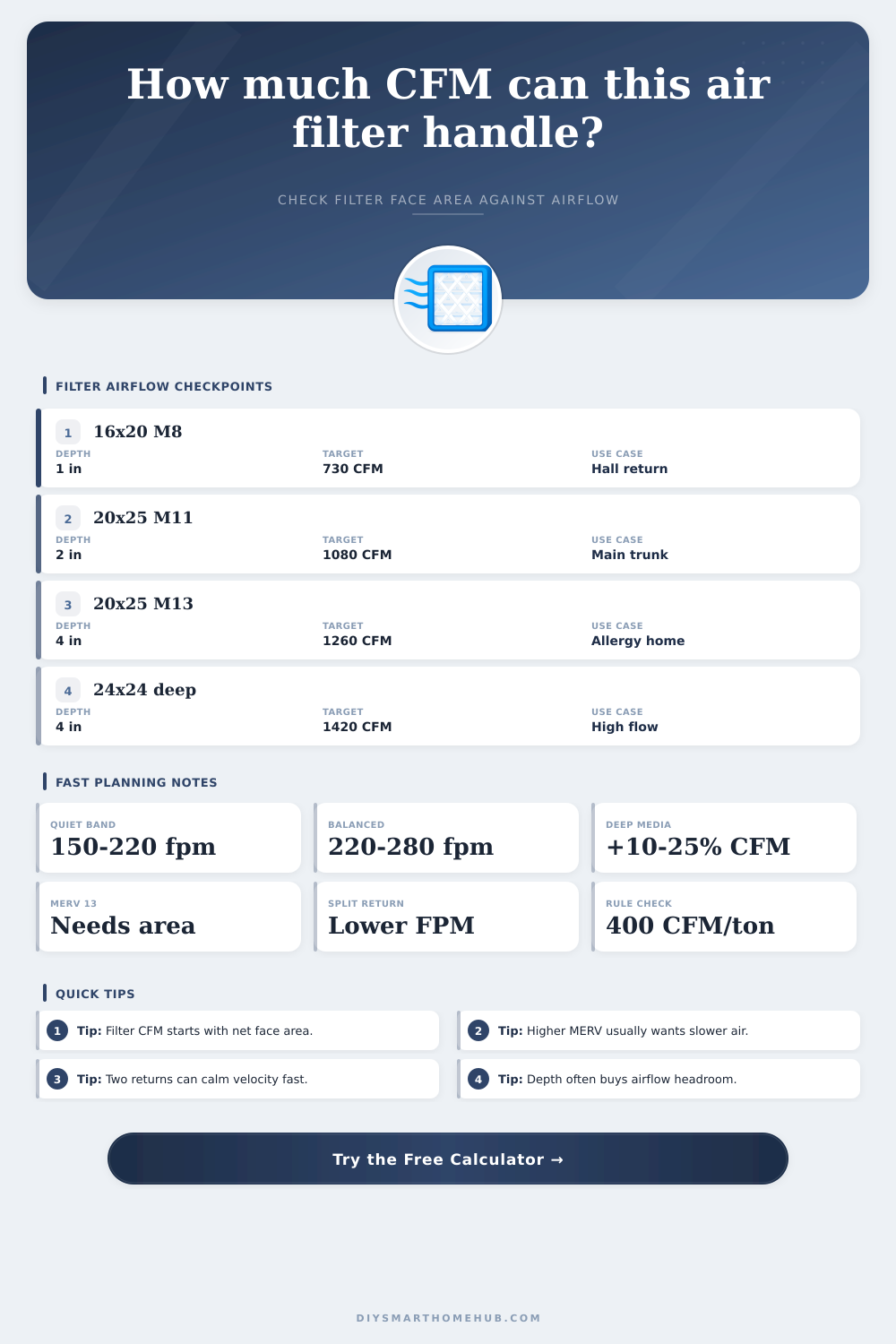
A deeper cabinet can support better capture at the same airflow because the pleat pack spreads the velocity load. That usually means lower hiss, slower loading, and more blower headroom.
When the HVAC system begins to make a whistling sound when the blower motor begins to turn on, the HVAC system experience a sign that the air filter is working too hard. This whistling sound often occur when the velocity of the moving air through the air filter’s pleat is too high for the systems design. High velocities of air can cause the dust in the air to hit the air filter media and accumulate on the filter at a faster rate then if the air were moving at a slower velocity through the pleats.
One of the factor that can affect the velocity of the air moving through the air filter is the size of the air filter. If you use an air filter of the wrong size for your HVAC system, you will have to experience issues with the louder operation of the air conditioner and with the shorter life of its air filter. You must select air filters to ensure that the velocity of the air moving through the pleats of the air filter are maintained at an appropriate level.
How to Choose the Right Air Filter Size and Air Speed
The capacity of an air filter is measured in CFM, or the number of cubic feet of air that the air filter must move each minute in order to efficient return the air to the blower motor of the HVAC system. For example, a three-ton HVAC system will require 1200 CFM of air movement at hot times of the year in order to efficiently cycle the air within a 2000-square-foot home. If you force 1200 CFM of air through a slot in the air handler that is the size of an undersized air filter, the velocity of the air will be forced to move at a velocity that is too high for most pleated air filters.
Air velocities that are too high will cause the fine particle of dust to hit the pleats of the air filter rather than simply settling onto the pleats. As a result, the air filter will become clogged in just a few weeks instead of the systems designed service life. If air can move at a slower velocity, the air filter media can perform its necessary function without placing undue stress upon the filter.
The depth of the air filter can also impact how well the air filter perform within the HVAC system. A one-inch air filter that use fiberglass media can allow for higher air velocities than a two-inch pleated air filter. However, the one-inch fiberglass air filter will not allow small particle of dust to be captured, while the two-inch pleated air filter will capture those particles.
Because of its increased depth, air can be allowed to move at lower velocities through the two-inch air filter while still maintaining its performance specification and high efficiency rating. Additionally, a four-inch pocket filter will provide more surface area for the air to pass through the air filter. Because there is more surface area available to the air within the four-inch pocket filter, it will be able to allow air to move at a higher velocity while still permitting the filter to effectively capture fine particles without allowing the air filter to become clogged.
The frequency with which you change the air filter will impact the type of air filter you must use in your HVAC system. For example, if your home contains many pet, or if the home has a garage in which heavy dusty work occur, then the air filter will become loaded with dust more rapidly. Thus, in these case, you can use an air filter with higher maximum face velocity to reduce the rate at which the filter becomes loaded.
If you change your air filters every quarter, you will need to use a larger air filter then if you change them every month. Additionally, the type of air filter rack can impact the face area of the air filter. For example, louvres on doors or stamped metal air filter frames may lose five to twenty percent of the gross face area of the air filter.
However, a media air filter that is installed within a tight cabinet will lose no face area due to obstructions. In larger HVAC systems, you can use banks of air filter in place of a single air filter to maximize the efficiency and reduce the noise of the HVAC system. For example, if you use one 20×25 air filter, the air filter may only be able to move 1000 CFM of air through the system.
However, if you use two of these filters, the air will split between each filter such that the velocity of the air will be halved through each of the two filters. Using two air filters instead of using just one will double the capacity of the HVAC system to move air, while also reducing the noise level of the system. This method of using two smaller air filters in place of one large air filter to handle the same amount of air movement is a common method of increasing the total number of CFM that an HVAC system can move through the use of multiple air filter banks.
The media that is used within the air filter will determine the velocity at which the air should move through that air filter. For example, fiberglass media allow for higher air velocities through its air filter than pleated filters. However, the fiberglass media will not capture fine particles of dust in the air.
Pleated air filters with a MERV 13 rating will allow air to move at a gentle velocity through the air filter to prevent fouling of the pleats. MERV 13 air filters may foul rapidly if the air velocity are too high. People use carbon blend air filters to remove odors from the air, and they may allow for less air movement through the HVAC system.
For quiet air conditioning system and high indoor air quality, aim for a low velocity of 150 to 220 feet per minute. For balanced operation with a moderate level of indoor air quality, aim for 220 to 280 feet per minute. There are some common mistake that individuals may commit that are attempting to select the proper air filter for their HVAC systems.
For example, an individual may select an air filter of the correct nominal size but without considering the actual face area of the air filter that will be installed within the HVAC system. The face area of the air filter may be twenty percent smaller than the nominal size of the air filter. Second, individuals may not consider the profile of the air that are supplied to the HVAC system.
Air drawn from a fresh-air intake will contain more pollen and humidity than fresh air within a home. Thus, more clearance will be needed for the air filter to handle the extra moisture in the air. Always include a reserve of ten to twenty percent in the face area calculations to ensure that the air filter will not become undersized due to the accumulation of dust within the air filter.
Finally, one of the best way to enhance the HVAC system is to measure the actual CFM of air that is created by the HVAC system using a flow hood. Do not rely upon air blower nameplate ratings alone. Additionally, listening to the HVAC system while it is operating will help to reveal if the velocity of the air through the air filter are too high.
High velocities will create a whistling sound. Additionally, measuring the static pressure created by the air filter slots each year will reveal any issue with the air filter or HVAC system. For example, if the static pressure reads a half-inch rise in pressure, the air filter or HVAC system is likely encountering trouble.
By ensuring that the air filter is properly sized relative to the requirements of the HVAC system, the HVAC system will experience quiet operation, the air filter will last its full service life, and the indoor air will remain fresh.