Greenhouse Dehumidifier Calculator
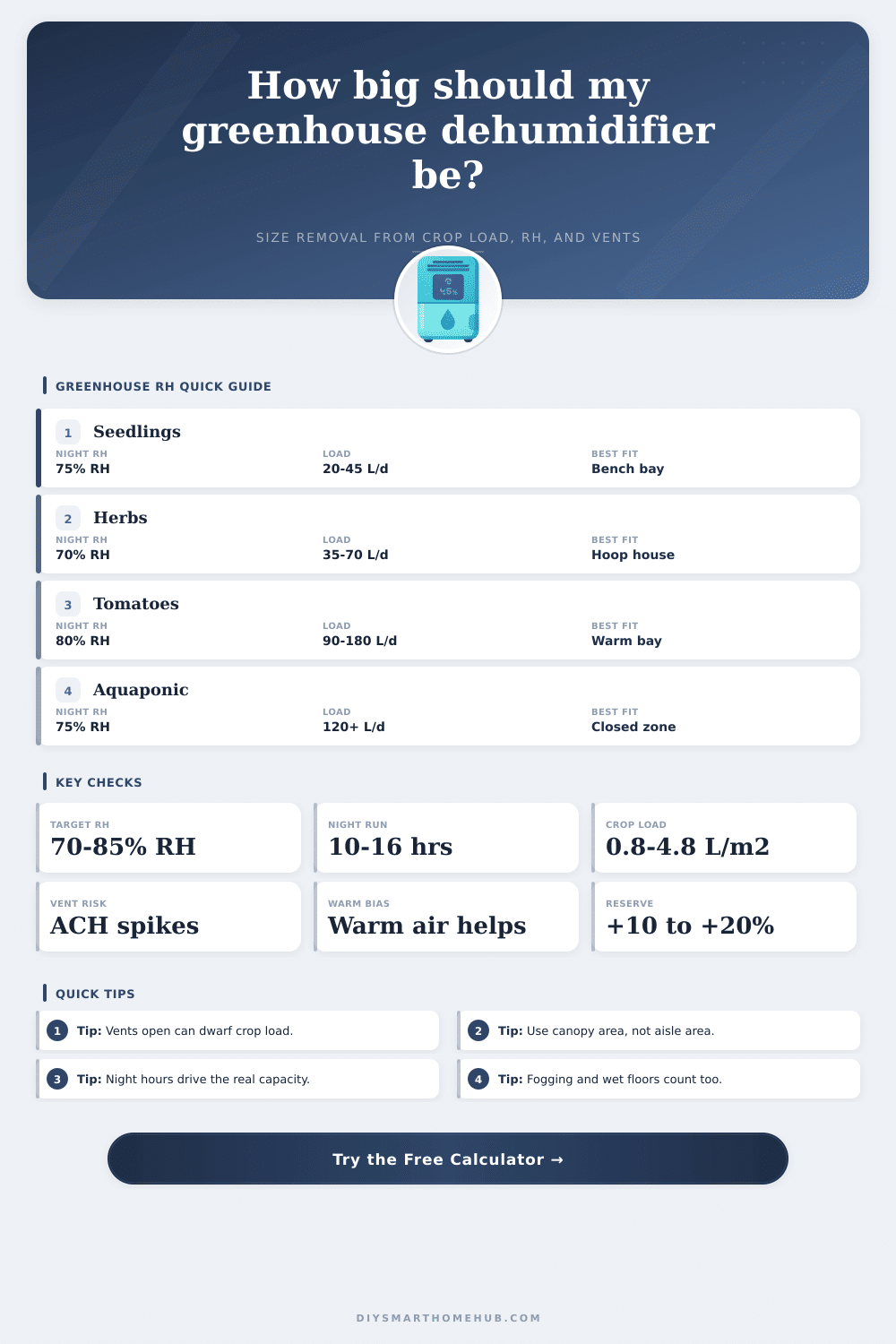
Estimate greenhouse moisture removal from crop transpiration, outside-air humidity, free-water evaporation, and the pull-down needed to move from current RH to a safer target during closed-house hours.
📌Quick greenhouse presets
Each preset combines greenhouse shell leakage, vent mode, crop transpiration, and run-hour limits so the recommendation reflects how dehumidification is actually used at night or in sealed periods.
🌿Greenhouse inputs
💡How this model sizes
The recommendation compares steady load and pull-down load, then selects the higher required nominal capacity after room-condition correction.
📊Greenhouse dehumidifier classes
🌱Crop transpiration reference
| Crop profile | Base rate | Target RH | Where it fits |
|---|
🏡Shell and vent reference
| Shell or vent | ACH basis | Moisture effect | Planning note |
|---|
📈Preset load benchmarks
| Scenario | Area | Daily load | Suggested size |
|---|
📑Greenhouse notes
If outside air is wetter than the greenhouse target, each extra air change per hour brings in more moisture to remove. Closed-house or lightly cycled vent periods are where dehumidifiers make the most sense.
Tomatoes, cucumbers, dense flowering crops, fogging lines, and wet concrete all add water even when the greenhouse is not large. The driest aisle square feet do not drive the load nearly as much as the wet canopy zone.
You must manage the humidity within the greenhouse as high levels of humidity can cause fungal spore to grow within the greenhouse which can lead to diseases within the crops, such as powdery mildew. If the humidity within the greenhouse is too high, you can experience a loss of the yield of your crops. It is important to calculate how much dehumidification capacity are required for your greenhouse to avoid purchasing equipment that is too large or small.
In order to understand the moisture that the plants within the greenhouse will release, it is important to know that the plants will release moisture through a process known as transpiration. If you grow a dense canopy of plant within your greenhouse, the plants will transpire more moisture than if you did not have such a dense growth of plants. Additionally, the more area that the plants leaves occupy within the greenhouse, the more moisture will be released into the greenhouse.
How to Choose the Right Dehumidifier for Your Greenhouse
The amount of moisture that the plants release increase with an increase in the number of sunlight hours that pass through the greenhouse. In addition to the transpiration of the plants, there are other sources of moisture within the greenhouse such as fogging systems, damp greenhouse floor due to irrigation systems, or aquaponic tanks that are open to the greenhouse environment. Greenhouses that have double-poly walls will leak less air than a hoop house greenhouse; therefore, these greenhouses will have less infiltration of the outside air.
However, if the grower manually vent the greenhouse, the influx of outside air can increase the humidity within the greenhouse. In order to calculate the amount of dehumidification that is required within the greenhouse, you can utilize psychrometrics. One of the measurements of humidity is absolute humidity which measures the number of gram of water within one cubic meter of air.
This is different than the relative humidity that is often measured within greenhouses. Warm air can hold more water than cool air even if the relative humidity within both types of air are the same. Another factor to consider within the greenhouse is the pull-down period which is the time between the high humidity levels within the greenhouse during the daytime hours to the lower humidity levels that exist within the greenhouse during nighttime hours.
During this time, there may be a need for more dehumidification than during the daytime hours. One strategy to avoid purchasing a large dehumidifier is to run the dehumidifier for longer periods, such as 12 hour per day. This allows the dehumidifier to handle the humidity load within the greenhouse and provides a margin of safety within the system in case of periods of high humidity within the greenhouse.
Another consideration is the percentage of the growing area that plants cover since the plants will transpire moisture from their wet leaves but not from areas such as concrete paths through the greenhouse. Within the nighttime hours, another strategy can be used to manage the humidity within the greenhouse. If the greenhouse is a closed greenhouse, the dehumidifier can work within the greenhouse to manage the humidity levels.
If the greenhouse contains a pad-and-fan system, the greenhouse will allow for more air change per hour which will increase the humidity within the greenhouse. Dehumidifiers tend to work better within warm greenhouses since the coils will be more efficient with warm air than cool air. Additionally, because warm air allows the dehumidifier to outperform the specifications of the dehumidifier in cooler greenhouses, fewer nighttime hours will be required to manage the humidity within the greenhouse.
Two factors that you should consider when determining the amount of dehumidification capacity that is required within the greenhouse are the establishment of a baseline of the amount of moisture that the plants release and other sources within the greenhouse; and preparing for the peak power that the greenhouses will require during the first night that the relative humidity within the greenhouse drops to a low level. Many growers of greenhouses make the mistake of underestimating the amount of plant canopy that will be growing within the greenhouse. In calculating the area of the greenhouse that will transpire moisture, the area that should be measured is the planted zone of the greenhouse; there will be less moisture released by those plants that cover only part of the area of the floor of the greenhouse.
The amount of light that enters the greenhouse each day will also impact the amount of moisture that is released by the plants; more light hours enter the greenhouse during the summer months than the winter months. The outdoor humidity has an impact on the greenhouse only if the outdoor air contains more absolute humidity than the target humidity that is to be maintained in the greenhouse. Additionally, other factors that you should measure and account for in the determination of the amount of dehumidification capacity that is required within the greenhouse are the free-water loads of the greenhouse that enter the greenhouse; water from fogging systems for example will add to the moisture load of the greenhouse.
There are different amounts of dehumidification that will be required in greenhouses that have different setups. Greenhouses that contain young seedlings that are covered with double-poly walls may require only a small dehumidifier that will be used for 16 hours per day. Greenhouses that contain crops such as cucumbers that have 90% of the greenhouse covered by plants will require more dehumidification because there are more wet aisle for the plants to transpire moisture.
Additionally, the flower zones within the greenhouse that contain plants such as cannabis require a high level of control of the humidity levels to avoid the development of bud rot. Finally, aquaponic greenhouses will require the dehumidifier to have an extra capacity for the evaporation of water from the water surfaces within the greenhouse that is exposed to the greenhouse air. Within the consideration of the amount of dehumidification capacity that is required within the greenhouse, there are some mistakes that should be avoided.
For instance, if the amount of dehumidification capacity is undersized for the greenhouse, the greenhouse will remain too humid, especially during the morning hours. Should the amount of dehumidification capacity for the greenhouse be oversized, the dehumidifier will waste money and energy as it works to remove the humidity from the greenhouse; large units are not as energy efficient as small unit. The use of ventilation to control the humidity within the greenhouse is another mistake to avoid as the amount of moisture that enters the greenhouse through the venting of air can lead to a greater amount of humidity within the greenhouse than the amount that can be removed by the dehumidifier.
A reserve margin can be established in the size of the dehumidifier for cases of high humidity within the greenhouse or for plants that experience a growth spurts. Additionally, the placement of the dehumidifier within the greenhouse can impact its performance. Placing the dehumidifier in such a way that it is suspended high within the greenhouse will allow for even control of the humidity within the greenhouse.
Additionally, if ducting is used to the dehumidifier, it will allow for zones of dehumidification to be provided to large blocks of plants. Circulation fans can be used within the greenhouse to ensure that the air circulates around the leaves of the plants because the humidity is the highest near the leaves of the plants. Additionally, a type of sensor that can be used to control and monitor the amount of humidity within the greenhouse is the use of absolute humidity sensors instead of relative humidity sensors for the greenhouse; these sensors will accurately reflect the amount of moisture within the greenhouse as the humidity levels change.
The best method to control the humidity within the greenhouse is to implement a hybrid system wherein the dehumidifier removes the humidity from the greenhouse during the nighttime hours and minimal venting is introduced during the daytime hours. In determining the amount of dehumidification that will be required within the greenhouse, there are adjustments that can be made according to the environment in which the greenhouse is established. Greenhouses that are established in windy areas may experience leaks in the greenhouse walls that allow outside air to enter the greenhouse; the amount of moisture that enters the greenhouse in such cases will increase.
Additionally, if greenhouse contains dense flowering plants, such as plants containing cannabis flowers, the relative humidity will need to be maintained within the range of 50 to 60%. Finally, if fogging systems are established within the greenhouse, there will be an extra requirement for the greenhouse to have a reserve in the dehumidifier for the moisture that will be released from the fogging systems. Additionally, if there is a concern with the humidity within the greenhouse, the dehumidifier can be tested by logging the relative humidity within the greenhouse curves over several nights.