Satellite Dish Size Calculator
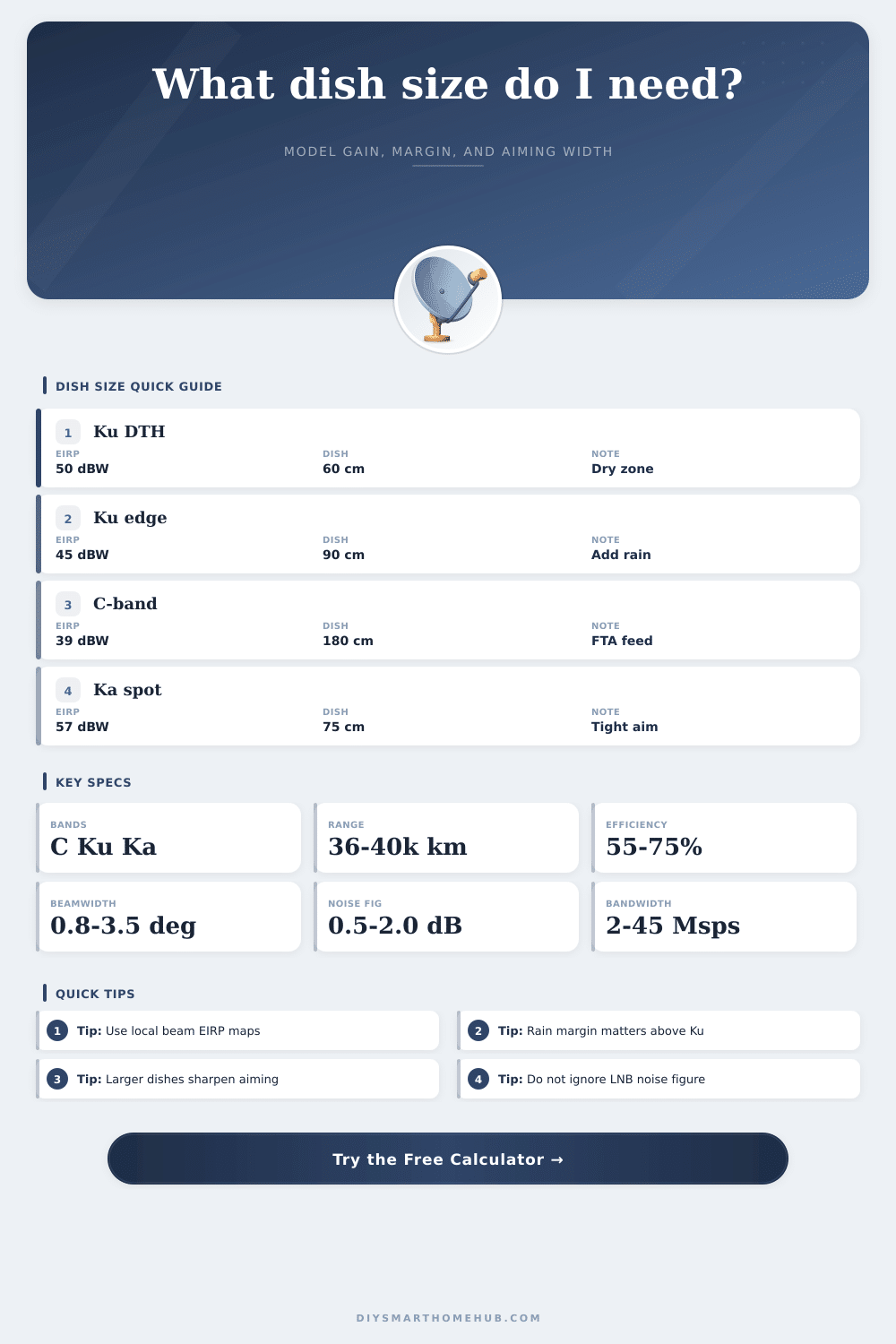
Estimate the minimum receive dish diameter for C, Ku, and Ka downlinks by balancing satellite EIRP, bandwidth, LNB noise figure, weather reserve, and modulation threshold before you buy or aim hardware.
Link Breakdown
| Dish Size | Gain | Predicted C/N | Margin | Beamwidth | Verdict |
|---|---|---|---|---|---|
| Run the calculator to compare common commercial dish sizes for this link profile. | |||||
| Band | Downlink Range | Typical Dish | Weather Sensitivity | Best Fit |
|---|---|---|---|---|
| C-band | 3.7 to 4.2 GHz | 1.8 to 3.0 m | Low rain loss | Wide-beam FTA and humid climates |
| Ku widebeam | 10.7 to 11.7 GHz | 75 to 120 cm | Medium | General TVRO and fringe DTH zones |
| Ku spot beam | 11.7 to 12.75 GHz | 45 to 90 cm | Medium-high | Consumer DTH and portable RV TV |
| Ka spot beam | 19.2 to 20.2 GHz | 55 to 98 cm | High rain loss | High-throughput internet terminals |
| Profile | Threshold C/N | Spectral Load | Dish Impact |
|---|---|---|---|
| QPSK 1/2 data | 3.5 dB | Light | Most forgiving on weak beams |
| DVB-S QPSK 3/4 | 5.5 dB | Moderate | Classic TV threshold for broad coverage |
| DVB-S2 8PSK 3/4 | 9.9 dB | High | Needs more dish or more EIRP |
| DVB-S2 16APSK 3/4 | 12.8 dB | Very high | Usually for strong data carriers |
| Scenario | Band | Typical EIRP | Normal Dish | Watch Item |
|---|---|---|---|---|
| Apartment balcony DTH | Ku | 49 to 52 dBW | 45 to 60 cm | Building shadow and mount flex |
| Whole-RV travel TV | Ku | 47 to 50 dBW | 55 to 75 cm | Frequent repointing in new cities |
| Remote fixed internet terminal | Ka | 55 to 60 dBW | 65 to 98 cm | Rain fade and precise skew |
| Backyard C-band hobby feed | C | 37 to 40 dBW | 1.8 to 3.0 m | Physical wind load and arc clearance |
A receiver can lock with little reserve, but real service quality depends on how much margin remains after rain, skew error, radome loss, and a slightly warped reflector eat into the budget.
Every size jump raises gain and shrinks beamwidth. That helps weak satellites, yet it also means mast plumb, azimuth resolution, and mount stiffness matter more than they do on smaller TV dishes.
Selecting a satellite dish size require an understanding of several technical factor. Therefore, the process of selecting a satellite dish size is not a matter of guesswork. A person must take into consideration the power of the satellite, the weather in the area, and the frequency band to which the satellite dish will be tuned to ensure in receive the signal.
If the satellite dish is too small, the noise in the signal will overwhelm the incoming satellite signal. If the satellite dish is too large, then the consumer will have spent money on equipment that they dont need. The link budget is a calculation that help to determine whether or not the signal from the satellite will reach the satellite dish without issues.
How to Choose the Right Satellite Dish Size
The satellite beam the power of its signal toward Earth, which is measured as the Effective Isotropic Radiated Power, or the EIRP. The EIRP diminish as the signal moves from the satellite toward the Earth. The satellite dish contain the Low Noise Block downconverter, or the LNB, that amplifies the signal from the dish to the satellite receiver.
The larger the diameter of the satellite dish, the higher the gain of the dish. Higher gain mean that the dish can focus more energy from the satellite into the feedhorn. The drawback to use a larger satellite dish is that the beamwidth of the signal becomes narrower.
A narrower beam of signal means that the dish must be aimed more precise at the satellite. Satellite signal frequency band play a role in the performance of the satellite dish in weather conditions. The C-band use a frequency of 4 GHz, which is low, and the C-band is very resistant to rain fade.
Because the C-band is not easily affected by rain, many choose to use a large diameter C-band dish, up to three meter in diameter. The Ku-band use a frequency of 12 GHz, which is higher than the C-band. Because the Ku-band use a higher frequency, it allow the dish to be smaller and mounted on balconies.
However, because the frequency is higher, the signal is more susceptible to rain fade. The Ka-band use a frequency of 20 GHz. The Ka-band is highly susceptible to weather conditions such as atmospheric vapor and heavy rain.
For these reasons, the Ka-band require the satellite dish to be aligned very precise with the satellite. Additionally, the Ka-band allow the satellite dish to have a higher signal margin to compensate for the weather-related signal loss. Satellite signals use a process call modulation to pack the data into the signal that is carried on the satellite signal.
DVB-S QPSK, one of the older forms of modulation, is more forgiving of weak signals. For these reasons, DVB-S2 is a newer modulation process for satellites that allow for more data to be transmitted. However, DVB-S2 require a higher Carrier-to-Noise ratio, or C/N, than DVB-S QPSK.
This means that a larger satellite dish is require to receive the signal using DVB-S2. The quality of the LNB can have an impact on the signal from the dish. If the LNB is of high quality, it will have a low noise figure.
Low noise figure is desirable because a low-quality LNB will introduce more noise into the signal. This additional noise may make a satellite dish that is small in diameter not function proper during periods of bad weather. When you install a satellite dish, there are many different variables that you must account for.
One of the variable to consider is the slant range. The slant range is the distance between the satellite and your location, which depend upon your latitude. Another variable to consider is the pointing loss.
A pointing loss can occur if the mast upon which you mount the satellite dish is not vertical or if the polarization of the signal is not correctly aim at the satellite. The availability target is the number of hour per day that you want the signal to be active. For instance, if you require 99.9 percent availability, you will have the signal offline for approximately three day per year.
This is important to consider if you are in an area that receives a great deal of tropical rain. In this instance, you will need to include a rain margin into the installation of the satellite dish. Some common error include installing small portable satellite dishes for RVs.
Small satellite dishes for RVs can lose the signal due to movement. Another common error is installing C-band dishes. A large C-band dish will create a heavy load of wind resistance.
Finally, if you are installing a Ku-band dish in a mountainous area, you will have to use a larger satellite dish than suggest for the area. This is because the signal weaken in mountains. Finally, you should always allow for signal loss caused by the coaxial satellite cables and the satellite signal switches.
These device will weaken the signal before it reach the satellite receiver.