Battery Backup Calculator
Estimate how much battery storage, inverter capacity, and recharge power your smart home needs by combining protected floor area, always-on electronics, surge loads, runtime goals, and real battery chemistry limits.
📍Preset Backup Profiles
Use presets to benchmark common outage cases, then adjust the geometry, direct appliance watts, runtime target, and battery platform for your exact backup plan.
📏Protected Load Inputs
Battery Backup Summary
Run the calculator to see usable energy, nominal battery size, inverter target, and recharge time for your outage plan.
🔋Battery Platform Snapshot
Runtime Planning Matrix
| Load | 4 Hours | 8 Hours | 12 Hours |
|---|---|---|---|
| 150 W network stack | 0.6 kWh | 1.2 kWh | 1.8 kWh |
| 300 W office core | 1.2 kWh | 2.4 kWh | 3.6 kWh |
| 600 W living essentials | 2.4 kWh | 4.8 kWh | 7.2 kWh |
| 1200 W hybrid outage plan | 4.8 kWh | 9.6 kWh | 14.4 kWh |
Battery Chemistry Comparison
| Platform | Usable DOD | Eff. | Best Fit |
|---|
Common Smart Home Backup Projects
| Project | Area | Running Load | Battery Bank | Inverter |
|---|
Recharge Recovery Table
| Recharge Source | Input Power | Restore Time | Best Use |
|---|
💡Calculation Tips
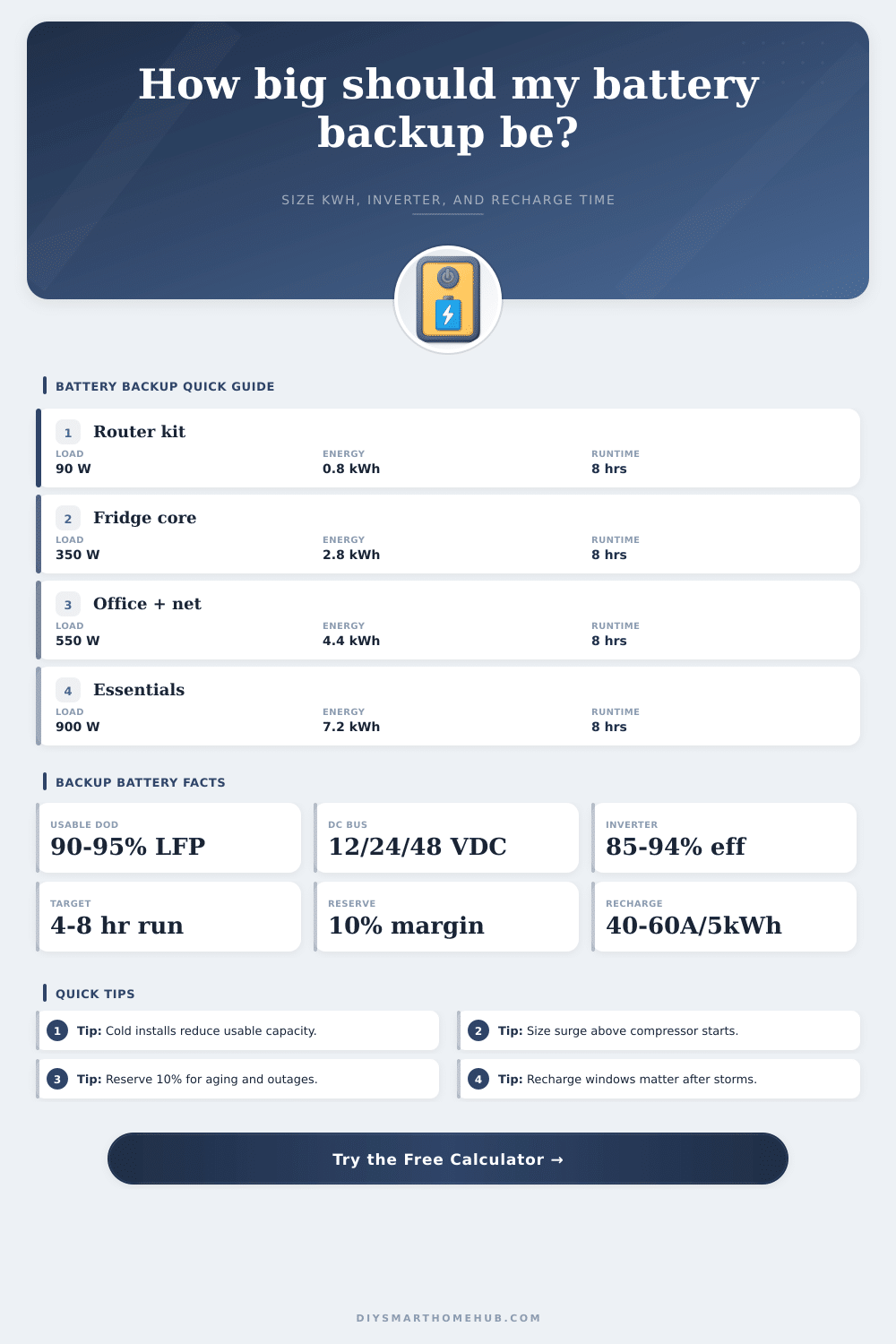
A 10% to 15% reserve is a good planning buffer because inverter heat, cold-soaked batteries, and a year or two of aging can shrink the energy you can actually pull during an outage.
Freezers, well pumps, and furnace blowers often fail on surge first. If the inverter or battery power rate is too small, more stored kWh alone will not keep those loads online.
When you experience a power outage, you may find yourself in need of a battery backup system to provide power to your device. Battery backup systems store energy that can be provided to your electronics, but the battery backup system must be of a correct size to supply the energy that your devices requires. To determine the size of the battery backup system that you should purchase, you must first understand your running load, your surge requirement, and your runtime requirement.
Your running load are the amount of electricity that your devices use while they are on. Small device, like routers and thermostats, can use a significant amount of electricity relative to the amount of load that they provide to your living space. It is critical that when calculating your running load, you account for all of the small devices in your home.
How to Size a Home Battery Backup
In addition to your running load, you will also need to account for any electrical surges that your appliance may require when they are first started up. Appliances like refrigerators and furnaces use a significant amount of power when they are starting up rather than while they are running, and any surge beyond what your inverter is programmed to handle will shut down the inverter. Another factor to consider when purchasing a battery backup system is the depth of discharge of the batteries that you will be using.
Depth of discharge is the amount of energy that you can extract from the battery before it become empty. Batteries like lithium iron phosphate batteries can allow you to use 90% of the battery, but lead-acid batteries may only allow you to use 50% of the batterys energy. You will need to purchase more lead acid batteries to ensure that you recieve the same energy as lithium iron phosphate batteries.
Furthermore, another factor that will reduce the energy that you can use is the efficiency of the inverter that convert the DC energy from the battery to the AC energy that your appliances use. Most inverters lose 6% to 15% of the energy that is stored in the battery during this process. Another consideration for battery backup systems is the impact of temperature on the batteries.
If you store the batteries in areas that are too cold for the body of the home, such as a garage, the cold temperature can reduce the battery capacity by 15%. To combat the reduction in battery capacity, you may need to purchase a larger battery backup system. Additionally, the runtime of the batteries is the length of time that your batteries will supply your devices with power.
To double the runtime of your batteries, you will need to double the size of your battery bank. It is also recommended that you provide a reserve margin for the battery bank, such as 10%, to account for batteries that may age and devices that may be started up that increase the electricity load more than what was calculated. Depending on the size of your living space, you may require different sizes for your battery backup systems.
For example, a router closet may only require a compact battery backup system made with lithium iron phosphate batteries due to the low running load of the devices in that closet. An apartment that is 800 square feet in size, however, may require more power than a router closet due to the number of device in the apartment and the refrigerator that may be in that apartment. In contrast, a large home that is 2000 square feet in size may require a large battery rack that provides 48 volt of power to account for the high running load of devices in the home.
Finally, another factor that you need to consider is how you will recharge your batteries. Since battery backup systems will eventually run out of energy, you will need a plan as to how you will refill the battery backup system. Using a small charger will take more longer to refill the battery bank than using a solar array or generator that is of a larger size.
To understand your running load, you can purchase a meter to measure the electricity that your devices use. By calculating your running load and understanding the chemistry of the batteries that you will use in the battery backup system, you can ensure that the system will function correctly in the event of a power outage in your home.