Refrigerant Capacity Calculator
Estimate delivered cooling capacity from airflow, humidity change, and saturation temperatures, then compare sensible split, moisture removal, airflow per ton, and refrigerant mass flow for common HVAC systems.
📌Service Presets
⚙Capacity Inputs
Capacity Snapshot
Run a calculation to review delivered tonnage, sensible split, latent removal, and refrigerant mass flow.
📊Selected Refrigerant Spec Grid
R-410A
Reference Refrigerating Effect
Blend Behavior
Capacity Bias
📘Refrigerating Effect Reference
| Evap Sat | Cond Sat | Effect | Effect | Flow per Ton |
|---|
🛠Application Airflow Targets
| Profile | Target Airflow | Expected SHR | Typical Lift | Use Case |
|---|
📋Refrigerant Comparison Table
| Refrigerant | Safety | Base Effect | Glide | Comfort Range | Best Fit |
|---|
📈Preset Benchmark Table
| Preset | Corrected Airflow | Delta h | Total Capacity | Delivered Tons |
|---|
💡Field Tips
When return and supply humidity are both measured, total capacity captures latent removal that a simple delta-T check misses. That matters most on humid comfort cooling and pull-down cases.
If condensing temperature climbs while airflow stays constant, refrigerating effect per pound falls. The same blower CFM can show lower delivered tons even before suction conditions move much.
To determine the true cooling capacity of an split system, you must measure how much heat and moisture that the refrigerant remove from the rooms air. Even if the split system have a nameplate capacity of three tons of refrigeration, the actual capacity of the split system could be different. This is because the split system must be able to remove both sensible heat and latent heat from the air.
Sensible heat is the amount of heat that makes the air feel more warm or cooler in a room. Latent heat, on the other hand, is the heat that is released when the refrigerant remove moisture from the air through dehumidification. If the humidity level in the room are high, the split system will have to remove a great deal of latent heat.
How to Measure the Cooling Capacity of a Split System
This will reduce the amount of capacity of the split system for removing sensible heat. The sensible heat ratio of a split system is a measurement of the amount of sensible cooling that the split system provides relative to the total cooling that are provided. This ratio can be calculated by looking at the rate of moisture removal and the change of the air temperature.
If the sensible heat ratio are low, it means that a large amount of moisture is removed from the air. A low ratio does not necessarily mean that the refrigerant charge is low. It is also possible that the ratio is low because a high amount of latent heat are being extracted from the air.
In order to determine the true capacity of the split system, you must measure the relative humidity of both the return air and supply air. The third factor that will impact the capacity of the split system is the amount of air that are moved past the evaporator in the split system. The airflow rating of the split systems nameplate is not necessarily the airflow that will move past the evaporator.
The actual airflow of the air handler may change due to dirty filter or due to static pressure. In order to calculate the actual airflow of the split system, the technician must measure the airflow with fan table or hood tests. The actual airflow per ton of refrigeration should be within a certain recommended range.
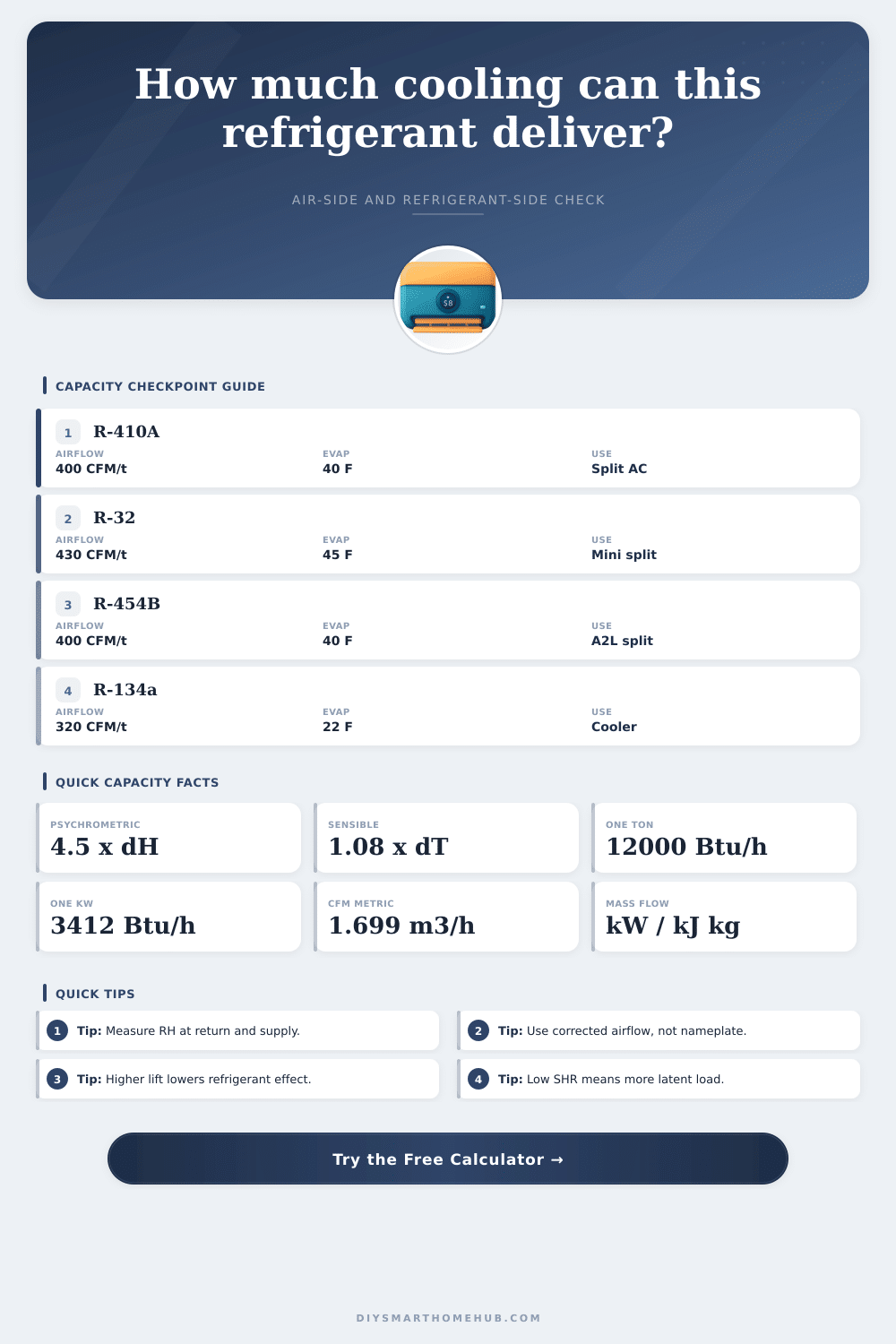
For instance, the standard split system may have an airflow per ton between 360 and 430 CFM. However, a walk in cooler may have a different airflow per ton of refrigeration. Another factor that will impact the cooling capacity of the split system is the type of refrigerant that is used in the system.
Different type of refrigerants will provide different amounts of energy in the refrigerant per kilogram of that refrigerant. For instance, R-410A may provide a certain amount of cooling effect, but the refrigerant R-32 may provide a higher cooling effect per kilogram of refrigerant. Because the cooling effect is higher for R-32, less of that refrigerant would of been required to achieve the same cooling effect as compared to R-410A.
However, if the temperature of the refrigerant significantly increase between the condenser and the evaporator, such as if the condenser is dirty or located on a hot roof, the higher condensing temperature will reduce the cooling effect of the refrigerant. Elevation is another factor that should be considered when determining the cooling capacity. At elevations above 500 feet above sea level, the air density of the atmosphere are lower.
This lower air density will impact calculations of the capacity of the split system. Therefore, if an HVAC technician is working at elevations above 500 feet above sea level, those calculation will have to be adjusted to account for the lower air density. The change in enthalpy of the air can be used to calculate the total capacity of the split system.
The total capacity of the split system relates to the change in enthalpy of the air. The sensible cooling capacity relates to the change in the dry bulb temperature of the air. If you multiply the change in enthalpy by 4.5, the resulting number is a quick check of the total capacity of the split system in tons of refrigeration.
If the change in the temperature of the air is multiplied by 1.08, the result will be the sensible cooling capacity of the split system. By calculating both of these numbers, and by measuring the relative humidity of the return and supply air, it is possible to determine whether the split system is correctly provide the number of tons of refrigeration that is required by the space. Any difference between the capacity that is calculated for the split system and the profile of the tonnage that is required in the space can help diagnose problem with the system.