Propane Boiler Size Calculator
Model room shape, design weather, envelope quality, emitters, and domestic hot water load to estimate a realistic propane boiler size, propane draw, and storage endurance.
📌Project Presets
⚙Boiler Sizing Inputs
Boiler Sizing Results
Run the calculator to size output, boiler input, and propane use from the same design conditions.
📊Boiler Platform Comparison Grid
Wall-Hung Mod-Con
Typical 10:1 turn-down and low water temperature reset for panel radiators or mixed zones.
Floor Mod-Con
Higher water content and strong shoulder-season control for larger radiant or multi-zone loops.
Cast-Iron Sectional
Simple sizing path for higher temperature emitters, but no real modulation at part load.
Combi Boiler
Pairs space heat with domestic hot water priority and needs extra attention to DHW recovery load.
Radiant-Optimized
Best for low-temperature slabs where long cycles and mild water temperatures improve propane use.
Hydro-Air
Common when a propane boiler feeds an air handler coil and needs a higher delivery temperature.
Low Return Water
Return water below about 130 F helps condensing propane boilers stay in their high-efficiency range.
Tank Planning
Holding a reserve improves regulator stability and leaves room for delivery scheduling in cold weather.
📘Reference Tables
| Envelope Level | UA / sq ft / F | Typical Design Band | What It Means |
|---|---|---|---|
| High-Performance Shell | 0.14 | 12-18 BTU / sq ft | Air sealed shell with high attic and wall insulation. |
| Code-Level 2 x 6 Wall | 0.18 | 18-24 BTU / sq ft | Modern windows and moderate infiltration at design conditions. |
| Average 1990s House | 0.24 | 24-34 BTU / sq ft | Balanced baseline for many retrofit propane boiler projects. |
| Older 1970s Retrofit | 0.31 | 32-42 BTU / sq ft | Mixed insulation upgrades with noticeable window and rim leakage. |
| Poorly Insulated Shell | 0.40 | 40-55 BTU / sq ft | Uninsulated or very leaky sections that drive larger propane demand. |
This table guides the envelope portion of the load. Infiltration still matters, especially in tall or windy buildings.
| Boiler Type | AFUE | Turn-Down | Best Emitters | Sizing Note |
|---|---|---|---|---|
| Wall-Hung Mod-Con | 95% | 10:1 | Panel radiators, mixed zoning | Usually easiest to right-size because the minimum fire rate is low. |
| Floor Mod-Con | 94% | 8:1 | Radiant floors, larger loops | Good for higher flow rates while preserving efficient propane combustion. |
| Cast-Iron Sectional | 86% | 1:1 | Fin-tube, cast radiators | Needs closer load matching because part-load oversizing cannot modulate away. |
| Combi Boiler | 93% | 7:1 | Baseboard, domestic hot water | DHW priority often pushes input size above pure space-heating demand. |
| Radiant-Optimized | 95% | 20:1 | Low-temperature slab loops | Excellent where long cycles and low return temperatures are expected. |
| Hydro-Air Boiler | 90% | 4:1 | Air handler coils | Requires hotter supply water, so design output needs a modest uplift. |
| Propane Storage | Total Gallons | Usable at 80/10 | Approx Cold Vapor Range | Best Match |
|---|---|---|---|---|
| 100 lb Cylinder | 23.6 gal | 16.5 gal | 55k-140k BTU/h | Small cabins or short test runs only. |
| 120 gal Tank | 120 gal | 84 gal | 100k-280k BTU/h | Compact homes with modest winter demand. |
| 250 gal Tank | 250 gal | 175 gal | 180k-560k BTU/h | Typical single-family propane boiler sizing baseline. |
| 500 gal Tank | 500 gal | 350 gal | 320k-1000k BTU/h | Whole-house heat plus appliances and longer delivery windows. |
| 1000 gal Tank | 1000 gal | 700 gal | 500k-1500k BTU/h | Large estates, shops, and multi-load propane systems. |
| Project | Area | Output Target | Nominal Input | Suggested Pairing |
|---|---|---|---|---|
| Tight Ranch | 1400 sq ft | 35k-42k BTU/h | 50k BTU/h | Wall-hung mod-con with panel radiators. |
| Combi Townhouse | 1600 sq ft | 45k-55k BTU/h | 60k BTU/h | Combi boiler with baseboard or panel radiators. |
| Drafty Farmhouse | 2400 sq ft | 70k-90k BTU/h | 100k BTU/h | Floor mod-con after envelope improvements are considered. |
| Radiant Workshop | 1800 sq ft | 55k-70k BTU/h | 80k BTU/h | Radiant-optimized boiler with slab reset control. |
| Whole House + DHW | 2800 sq ft | 90k-110k BTU/h | 120k BTU/h | Floor mod-con with indirect tank priority. |
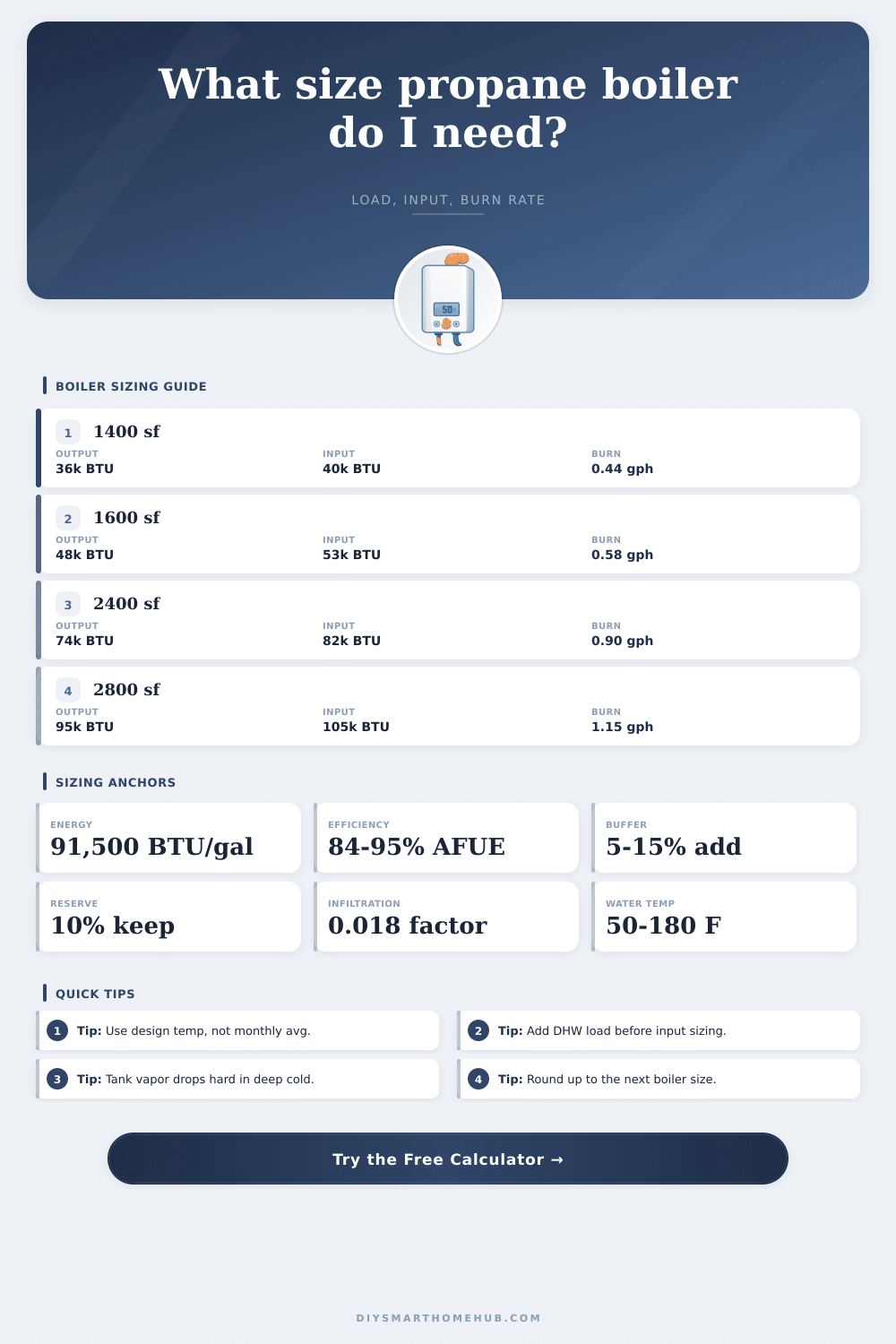
Use the coldest expected design temperature, not an average winter afternoon. Propane boilers that look oversized on mild days may still be correct when the local design delta is fully applied.
Small propane cylinders can hold enough fuel on paper but still fall short on vapor production during deep cold. Compare boiler input against vapor capacity before trusting runtime alone.
Propane boiler sizes must be select correctly because if a propane boiler is of the incorrect size for the home that it will be supplying with heat, then the boiler will not function efficient. If the propane boiler is too small for the size of the home, then it will not be able to provide enough heat to the home to keep the individuals within the home warm. If, however, the propane boiler that is selected is too large for the size of the home, then the propane boiler will experience short cycling.
Short-cycling is when the propane boiler will turn on and off very frequent within the home. Short-cycling is inefficient in that it waste propane gas with the starting and shutting off of the propane boiler, and also can lead to the shortening of the lifespan of the propane boiler. In order to calculate the size of the propane boiler that will be necessary for a given home, you must first determine the heat loss of the home.
How to Pick the Right Size Propane Boiler
Propane boilers provides 91,500 BTU per gallon of propane. The BTU energy provided by propane boilers is provided in the form of vapor, which is fed into the burner of the propane boiler. The size of the propane boiler can be calculated by determining the size of the building envelope of the home, as well as the outside temperature of the area where the home is construct.
The building envelope of a home includes the walls, the roof, and the windows of the home. Additionally, infiltration is also a factor in that cold air can enter the home through these envelope. Therefore, if a home is constructed with poor insulation, or if the building envelope is leaky, the home will lose more heat.
Consequently, a larger propane boiler will be required to compensate for the heat loss of the home. For instance, a home with high ceiling and drafty corners will lose more heat than a home with even ceilings and windows that do not allow for drafts within the home. Therefore, the home constructed with these feature will lose more heat energy, and a larger propane boiler will be required to compensate for such heat loss.
Another factor in determining the size of the propane boiler is the type of heat emitter that will be used within the home. Homes that utilize fin-tube baseboard heaters will require higher temperatures from the boiler to effectively heat the home. Fin-tube baseboard heaters typically require water temperatures of around 160 degree.
Radiant slab heating systems, however, work more efficient with a condensing propane boiler that provides water at temperatures of around 100 degree. Additionally, if the home utilizes a condensing propane boiler, it is important to ensure that the return water temperature from the radiant slabs is maintained at a temperature of 130 degrees or less. Low return water temperatures enable condensing boilers to save propane.
Additionally, if the home employs the use of a combination unit for heating the space within the home and providing domestic hot water, you must consider that domestic hot water in the calculations of the size of the propane boiler. Another consideration in the determination of the required size of the propane boiler is the amount of energy that is required to heat the water that will be used for domestic activities within the home. For instance, if the home utilizes an indirect tank to heat water for domestic use, the BTU requirements of the tank will also need to be added to the total heat load of the home.
If the domestic hot water requirements of the home are not accounted for in the calculations of the size of the propane boiler, it is possible that the domestic hot water will not be heated enough for the number of individuals that use the water in the home. In addition to considering the domestic hot water needs of the home, a pickup factor will need to be determined. A pickup factor is used to account for the heat that is used to restore water to its desired operating temperature after it has been heated to a higher temperature to provide domestic hot water for the home.
Finally, a buffer may also be added to the calculation. A buffer is an additional component of the system that provides the home with extra capacity to defend against the changes in the building envelope of the home or errors in the calculation of the size of the propane boiler that is required for that specific home. In addition to determining the size of the propane boiler for a home, you must also size the propane tank in which the propane fuel is stored appropriately to supply the amount of vapor that is required by the propane boiler.
The propane tank will store the propane in its liquid form. However, the propane boiler requires the propane to be in its vapor form. If the propane tank is too small for the requirements of the propane boiler, the tank may not be able to produce enough vapor to effectively heat the home during periods of extreme cold within the winter.
Even if the propane tank contains a substantial amount of propane gas (in gallons), it may not be able to supply the propane vapor required by the propane boiler if the tank is undersized for that propane boiler. Therefore, the vaporization limits of the propane tank should also be considered in the determination of the size of the propane boiler. For instance, if the propane tank has a low vaporization limit, it may not be able to supply propane vapor to the propane boiler during a period of blizzard.
To determine the size of the propane boiler that will best suit the requirements of a home, the design temperature of the area within which the home is constructed should first be determined. The design temperature will be the lowest temperature within the area during the winter month. This value should be the 99% winter low for the area rather than the average winter temperature of the area.
Additionally, you can calculate the amount of heat that will be lost by the home based off the square footage of the home and the quality of the building envelope of the home. Based upon the heat loss calculations, the recommended input for the propane boiler can be determined. The recommended input will then be rounded up to the next highest input of a standard propane boiler size.
For instance, if the calculations indicate that the input for the propane boiler should be 105,000 BTU, the size of the propane boiler should be one with an input of 120,000 BTU. By following these steps and factor in the determination of the size of a propane boiler, the propane boiler will be able to effectively supply heat to the home and efficient consume the propane fuel that is provided to that appliance.