Propane Density Calculator
Estimate propane density as liquid or vapor, convert that density into total stored mass, equivalent gallons or cubic feet, and see how the same fuel translates into generator, heater, or appliance runtime.
📌Preset Scenarios
Density Snapshot
Run a calculation to compare corrected density, total propane mass, runtime, and how much of the selected cylinder or bulk tank that fuel represents.
💡Density Anchors
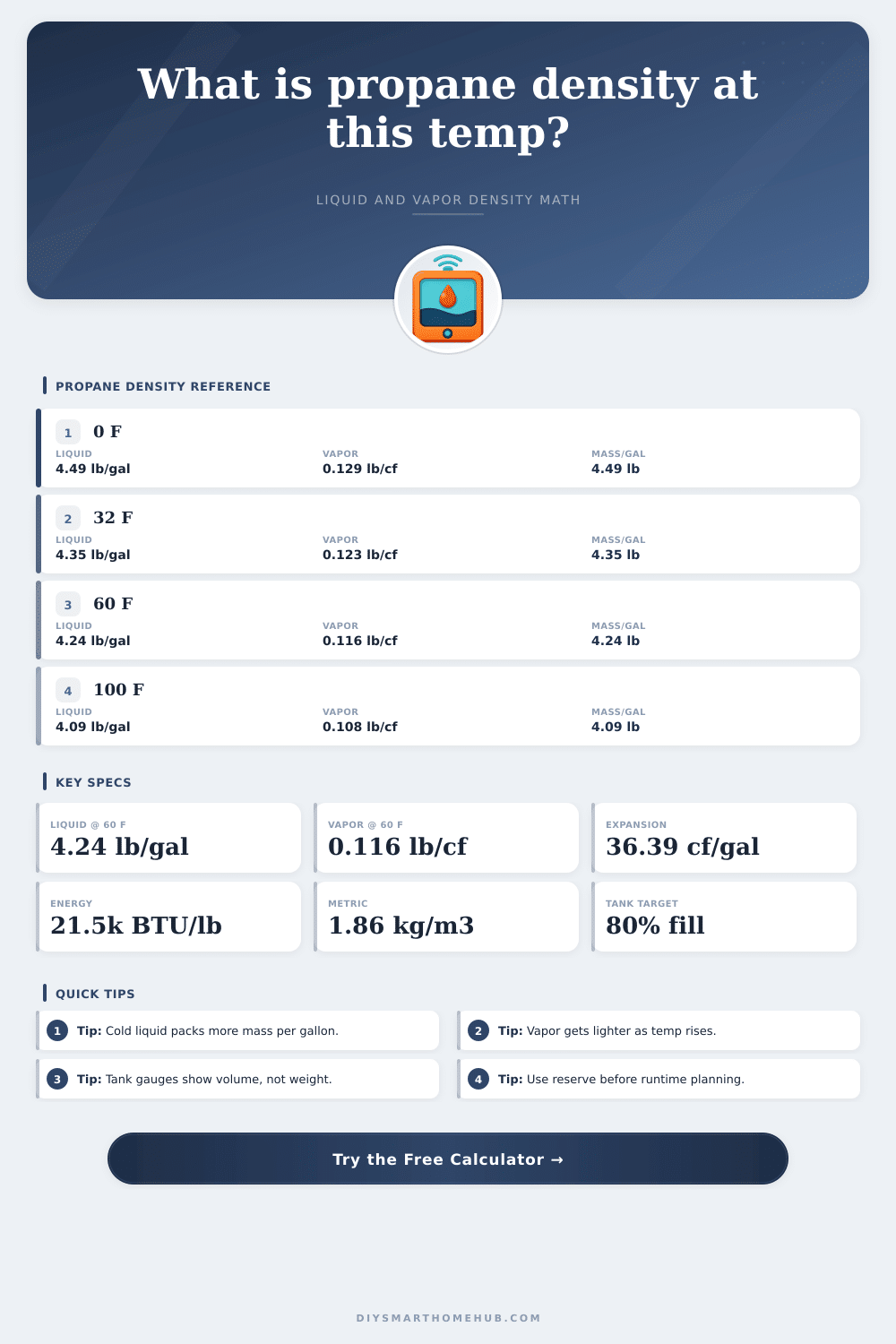
Liquid at 60°F
Good baseline for receipts, tank mass estimates, and quick propane gallon to pound conversions.
Vapor at 60°F
Approximate standard vapor density at atmospheric pressure before any compression correction.
Expansion Ratio
One liquid gallon becomes roughly 36.39 standard cubic feet of propane vapor.
Energy Content
Turns density into generator, heater, water-heater, or cooking runtime with a duty factor.
🌡Liquid Density by Temperature
These reference values are generated from the same liquid-density model used in the calculator, so your live result lines up with the table below.
| Temp | Density | Metric Density | 100 gal mass | Standard vapor |
|---|
💨Vapor Density at 60°F
Gauge pressure raises absolute pressure and pushes vapor density up. Relative density compares propane vapor against air at roughly 0.0765 lb/ft³.
| Gauge pressure | Absolute pressure | Density | Metric density | Relative to air |
|---|
🛢Tank and Cylinder Guide
Portable cylinders list a propane weight rating, while ASME tanks are usually discussed in gallons. This table shows their rough 60°F liquid and energy equivalents.
| Container | Nominal liquid | Mass at 60°F | Standard vapor | Energy |
|---|
📋Preset Scenario Snapshot
Each preset mixes a real cylinder or tank, weather condition, and appliance load. Use them as starting points, then fine-tune your own density assumptions above.
| Scenario | Phase and input | Density | Mass | Runtime basis |
|---|
A tank gauge can show the same volume in warm and cold weather, but the colder tank packs more pounds into each gallon and therefore slightly more BTUs into that visible fill.
If you measure propane as vapor volume, pressure and temperature correction are what separate a casual estimate from a usable mass and runtime calculation.
Propane density are another important concept in understanding propane, but it change based on the temperature and the pressures of the propane molecules. Propane is able to exist in both liquid and vapor form. In its liquid form, the density of propane increase with low temperatures and decrease with high temperatures.
Because the density of liquid propane changes with the changes in temperature, the amount of mass contained within a given volume of an propane tank will change. Thus, individuals must understand how propane density and propane mass can change with temperature and with the state of the propane in order to understand that the propane tank gauge will not provide accurately information regarding the weight of the propane in the tank. Propane can exist in two different phases within it’s environment.
How Propane Density and Temperature Affect How Long a Tank Lasts
Propane can exist in both liquid and vapor phase. In its liquid phase, its own vapor pressure stores propane in a tank and is very dense; meaning it can store a large amount of energy within a small amount of propane. One gallon of liquid propane at room temperature will weigh around four pound.
However, one gallon of liquid propane will weigh more than four pounds if the temperature of the propane is below freeze. In this same instance, the same amount of propane will contain more gallon of liquid propane in the summer than it will in the winter. However, in its vapor phase, propane will expand into the gas phase and will be much less dense than liquid propane.
The density of the propane vapor will depend upon the temperature at which the propane is store and the pressure within the tank. The higher the temperature of the propane or the lower the pressure within the tank, the less dense the propane vapor will be. In order to accurately calculate the length of time that a tank of propane will last, individuals must account for the density changes of propane.
In order to calculate the amount of propane in a tank by volume, individual might assume that the two measurement are the same. However, this assumption will lead to inaccuracy in the estimation of the length of time that a propane tank will last. In order to avoid this, individual can use pressure gauge to calculate the mass of the propane in the tank from the volume measurement of the propane vapor.
Furthermore, individuals must also take the duty factor of the appliances that will be using the propane into consideration. The duty factor is a measurement of the amount of time that an appliance will be running during a 24-hour period. Most appliance that use propane have duty factor of around 65%.
Thus, if individuals do not take the duty factor into consideration when calculating the length of time that a propane tank will last, the calculation will reflect that the propane will last longer than it actualy will. Individuals should also consider the size of the propane tanks and the rule regarding how full they should be filled with propane. Most portable propane tanks are filled to only 80% of the tank’s total capacity.
Propane tanks are filled to 80% of their capacity because the remaining 20% of the tank must be left as vapor space in order to allow for the liquid propane to expand. If a propane tank is too full of liquid propane, the liquid propane may expand and the tank may rupture. Additionally, there must also be a reserve of propane in the tank to allow for propane to be dispensed when need.
Tanks should have a minimum reserve of 10% to 20% of the tank filled with propane. Furthermore, individual should also know the grade of propane that is being used. Propane that is graded HD-5 contain at least 91% propane.
Commercial propane blend may contain other substance, such as butane. Thus, because the commercial propane tanks may contain less propane than HD-5 propane tanks, they may provide less energy. The temperature at which propane is stored will impact the amount of propane that is used in different season.
For instance, in the winter when propane is stored at colder temperature, the density of the liquid propane will be higher; meaning it will contain more mass for the same volume. Thus, tanks of propane that are stored at colder temperature in the winter will contain more runtime than tanks of propane that are stored at warmer temperature. In the summer, however, the liquid propane will be warmer so it will be less dense.
Thus, warmer tank will provide less runtime for appliances than tanks of propane that are stored at colder temperature. Individual should pay special consideration to the amount of propane in their tank during seasonal change in the temperature. The energy content of propane can also be used to calculate the length of time that tanks of propane will last.
Propane contain 21,500 BTUs per pound of propane. By multiplying the pounds of propane by the BTU rating of propane, individual can calculate the total amount of energy that is contain in the tank. Furthermore, by dividing that total energy by the BTU requirement of the appliance that will be using the propane each hour, and also by applying the duty factor to that requirement, individual will be able to calculate the length of time that the propane tank will last.
Thus, by understanding how propane density work, the impact of the temperature of the propane, and the duty factor for the appliances that use propane, individual will be able to effective plan for there needs in regard to propane fuel.