Propane Tank Fill Calculator
Estimate the safe refill target for grill cylinders, RV bottles, farm cylinders, or residential ASME tanks by translating gauge percent, measured gallons, or gross tank weight into gallons to add and fill-stop weight.
📌Preset Refill Scenarios
Use the stamped tare plus the current gauge if you want a quick fill target, or switch to gross-weight mode when the cylinder is on a scale during refill.
📋Tank and Fill Inputs
Calculated Fill Snapshot
These outputs show the practical stop point and the amount of propane still safe to add at the selected target.
📊Propane Fill Reference Grid
Leaving roughly 20 percent vapor space helps prevent hydrostatic expansion issues when liquid propane warms after delivery.
Energy added is calculated from the gallons to add times the standard lower heating value used by many propane appliance guides.
Scale-based fill estimates tighten up when weight is converted with a temperature-matched density instead of a flat rule of thumb.
Metric output is shown with every result so cylinder fills, RV bottles, and bulk deliveries can be compared across ticket formats.
📘Standard Tank Capacity Table
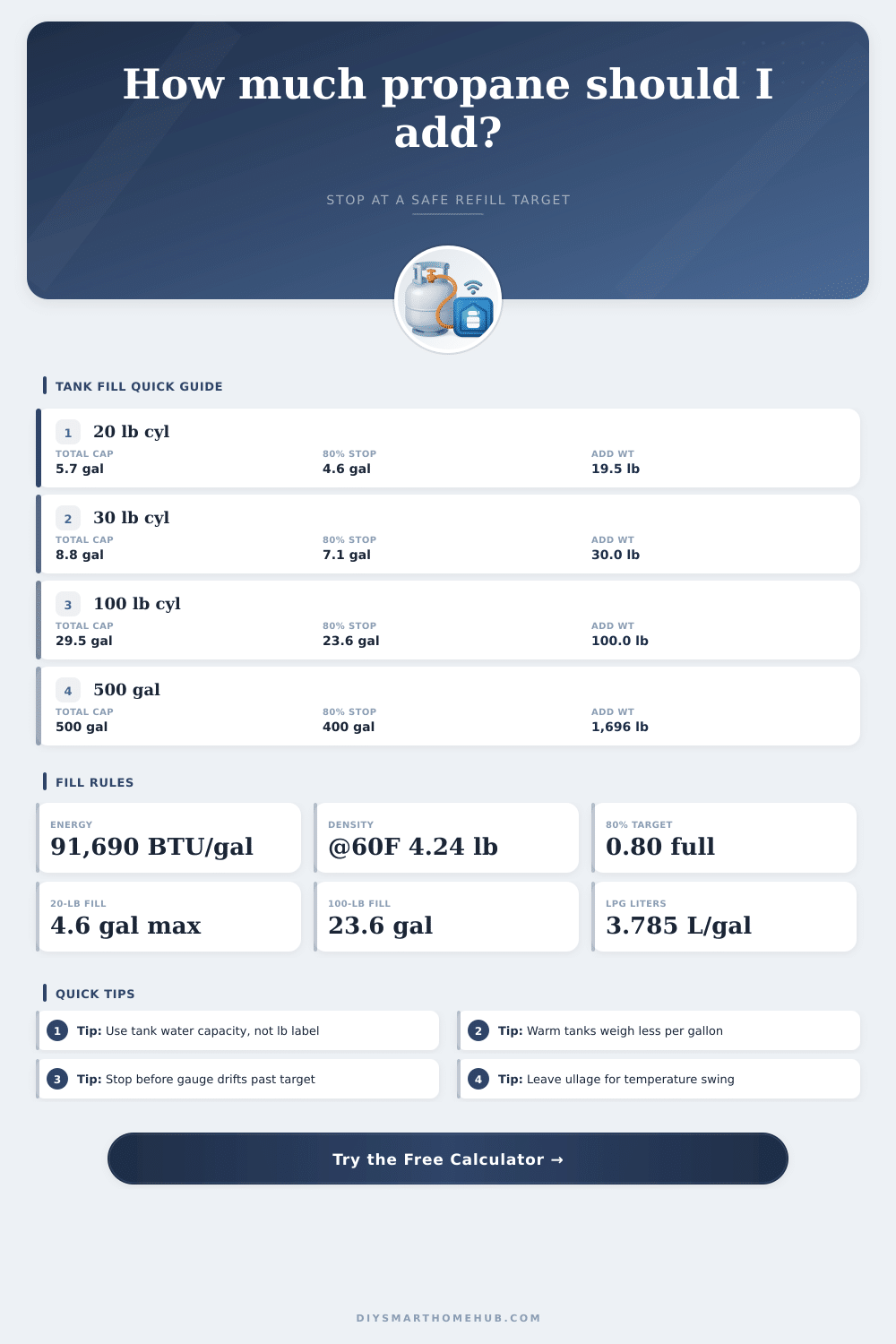
Water capacity is the total shell volume. The 80 percent column is the common liquid stop level before temperature expansion eats into vapor space.
| Tank class | Total water cap | 80 percent fill | Typical tare |
|---|---|---|---|
| 20 lb cylinder | 5.7 gal | 4.6 gal | 17 lb |
| 30 lb cylinder | 8.85 gal | 7.08 gal | 25 lb |
| 40 lb cylinder | 11.8 gal | 9.44 gal | 29 lb |
| 100 lb cylinder | 29.5 gal | 23.6 gal | 68 lb |
| 120 gal ASME | 120 gal | 96 gal | 290 lb |
| 250 gal ASME | 250 gal | 200 gal | 483 lb |
| 500 gal ASME | 500 gal | 400 gal | 950 lb |
🌡Temperature and Density Table
The calculator interpolates between these points when gross tank weight is used as the current reading method.
| Propane temp | Density | 20 lb cyl at 80% | Weight note |
|---|---|---|---|
| minus 20 F | 4.37 lb/gal | 19.9 lb fuel | Coldest, densest fill |
| 20 F | 4.28 lb/gal | 19.5 lb fuel | Typical winter delivery |
| 60 F | 4.24 lb/gal | 19.3 lb fuel | Standard handbook point |
| 100 F | 4.16 lb/gal | 19.0 lb fuel | Warm yard storage |
🔢Gauge Percent Quick Conversions
A float gauge reads percent of total tank volume. Multiply that percent by the total water capacity to estimate propane already on board.
| Gauge | 20 lb cyl | 100 lb cyl | 500 gal tank |
|---|---|---|---|
| 10% | 0.57 gal | 2.95 gal | 50 gal |
| 25% | 1.43 gal | 7.38 gal | 125 gal |
| 40% | 2.28 gal | 11.8 gal | 200 gal |
| 60% | 3.42 gal | 17.7 gal | 300 gal |
💡Fill Calculation Notes
A 30 percent reading on a 500 gallon tank means about 150 gallons in the shell, not 30 percent of the 400 gallon usable fill window.
Bulk ASME tanks are usually filled by percent gauge or liquid level valve, while DOT cylinders can be checked against stamped tare on a scale.
To properly fill a propane cylinder, it is first important to understands the difference between the weight of the propane that can be contained by the cylinder as opposed to the water capacity of the cylinder. The water capacity of a propane cylinder are the total volume of the propane cylinder if the propane cylinder were to be filled completely with water. It is important to note that you should not use the weight of the propane that is printed on the propane cylinder to determine the maximum amount of propane that should be added to the cylinder.
Instead, the water capacity of the propane cylinder should be multiplied by 0.80. The product of this multiplication represents the 80% target for filling the propane cylinder. This 80% target for propane cylinders are used to allow for a vapor space within the propane cylinder.
How to Fill a Propane Tank to 80% Safely
The propane within the cylinder can expand if the temperature of the propane increases. Propane increases in volume with an increase in temperature. The propane expand at a rate of 1.5% for every 10-degree increase in temperature.
If you pour propane into a propane cylinder to 100% of its capacity, the propane may expand if the temperature of the propane increases. This expansion can lead to increases in the pressure of the propane within the cylinder. Consequently, it is necesary to leave some empty space within the propane cylinder; this empty space is referred to as ullage.
Some portable propane cylinders includes an overfill prevention device. However, large bulk propane tanks use float gauges to measure the amount of propane within the tank. For instance, if the gauge read 30% on a 500-gallon propane tank, there are 150 gallons of propane in the tank.
However, it is not 30% of the usable capacity of the propane tank; the capacity of the tank is the total amount of liquid that the propane tank can hold. Another factor that can impact the propane within the tank is the fact that the density of the propane can change. The density of propane changes with the temperature of the propane.
For instance, at minus 20 degrees Fahrenheit, the density of propane is 4.37 pounds per gallon. However, at 100 degrees Fahrenheit, the density of propane is 4.16 pounds per gallon. Because the density of propane changes with the temperature of the propane, the propane in colder weather will be more denser than propane that is warmed.
Consequently, a propane tank will weigh more in the winter than it will in the summer if the same amount of propane is placed into each tank. When measuring the weight of propane at a propane refill station, the scale will measure the gross weight. The gross weight is the weight of the propane cylinder plus the weight of the propane.
To determine the weight of the propane, you should subtract the tare weight (the weight of the empty propane cylinder) from the gross weight. Another common mistake with propane tanks is considering the weight of the propane as the total capacity of the propane tank. For instance, a propane tank that weighs 20 pounds can hold 4.6 gallons of propane.
However, it does not have a capacity of 20 gallons of propane as some may consider from its weight. It is important to not consider propane tanks in the same manner than water tanks. Furthermore, it is always a good idea to provide a small amount of extra space within the propane tank when the propane is being filled.
This extra space or cushion is used to prevent the propane from being overfilled into the propane tank. A cushion of 0.2 gallons of propane is a helpful amount of space to provide because it will prevent the propane from overrunning the valve of the propane tank. There are different methods for each type of propane container.
Magnetic gauges can be used on grill propane tanks to determine the percentage of propane remaining within the propane tank. Scales can be used to weigh the propane tanks that contain 100 pounds of propane. In this instance, the total weight of the propane tank and propane can be determined; the tare weight can be subtracted from this total to determine the weight of the propane.
For 500-gallon propane tanks, dial gauges or delivery meters can be used to determine the amount of propane in gallon. In any case, the current volume of propane can be subtracted from the total target volume to determine the amount of propane required to refill the tank. Another factor that may affect the accuracy of propane tanks is the temperature; the scales within the tanks may provide inaccurate information regarding the amount of propane in the tank.
For instance, if the propane is filled to 20 pounds at 20 degrees Fahrenheit, the propane is losing 0.5 pounds of propane; at 100 degrees Fahrenheit, the propane may only weight 19 pounds. Most propane refill stations use 60 degrees Fahrenheit as the standard temperature; however, the actual temperature of the propane in the tanks at the residence should be use in the calculations. Failure to adjust for the temperature of the propane in the tanks may result in underfilling or overfilling of the propane tanks.
In addition to the temperature considerations, it may also be beneficial to consider the use of the propane tanks and how often they are used. For instance, if propane tanks are used to heat a grill once every week, filling the propane tank to 80% of its tanks may provide enough propane to last until the following weekly use of the grill. If propane tanks are used to heat an RV, it is common for automatic changeover systems to be present; in this instance, the empty propane tank should be filled to 80% of its capacity as opposed to 100%, but the other propane tank can remain filled.
For standby generators or farm equipment, it is common to fill the propane tanks to only 75% of its tanks. Filling these tanks to 75% ensures that there is a larger portion of propane that can be used to provide even heat for the propane appliances during volatile weather conditions. Propane contains a specific amount of energy; each gallon of propane contains 91,690 BTUs of energy.
This amount of energy can be used to calculate the length of time that an appliance will run using the propane tanks. Additionally, if more gallons of propane are added to these appliances, more BTUs will be added to the tanks. More BTUs will provide more time for the appliances to cook or heat the home.
Consequently, it is important for individuals to always respect the capacity of the propane tanks, to account for the temperature within the tanks, and to always watch the point at which propane should be filled to ensure the safety of the propane tanks.