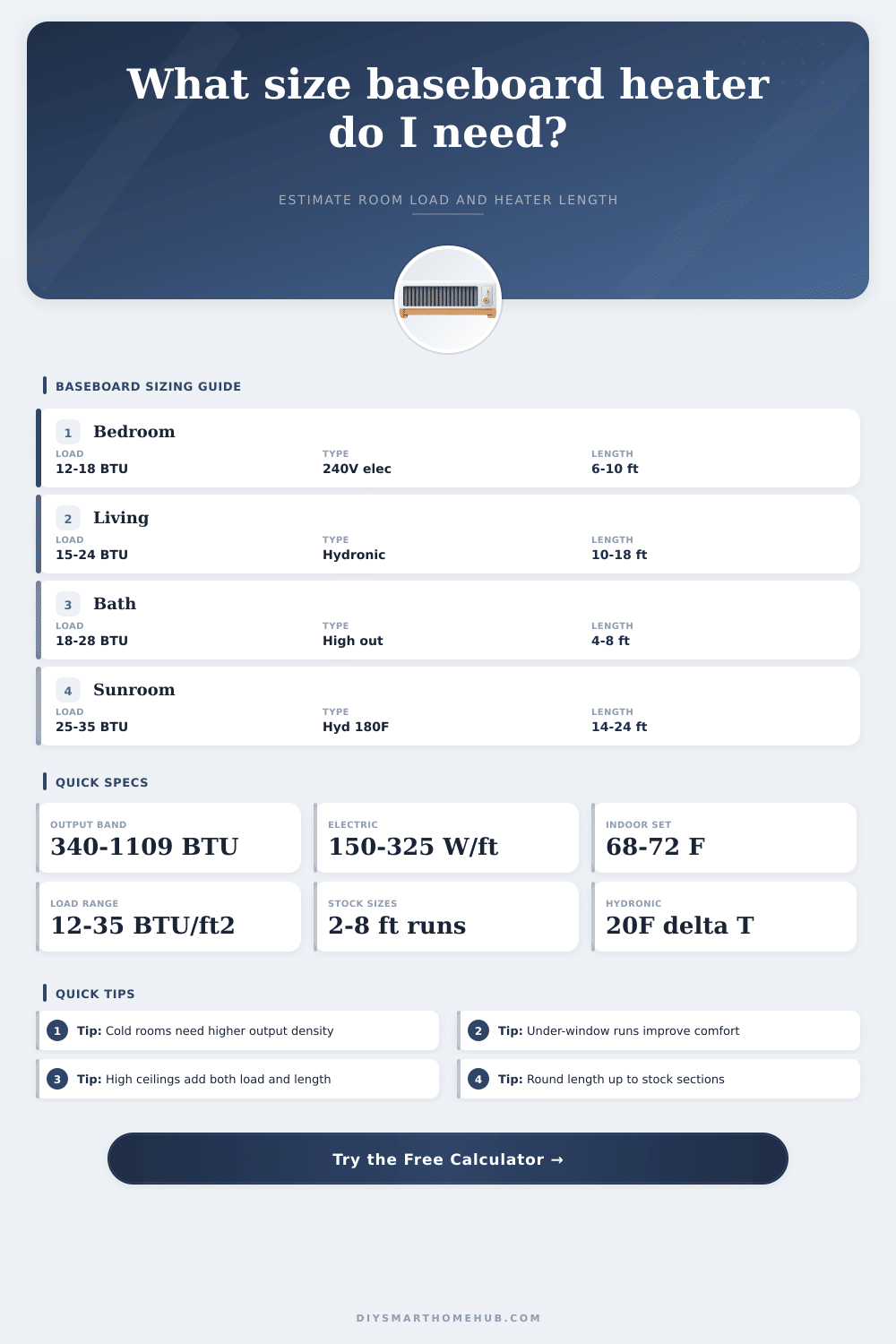
Baseboard Heater Size Calculator
Estimate room heat loss, required heater length, stock section planning, and electric or hydronic delivery from one room-by-room sizing tool.
Room Inputs
Calculated Sizing Results
Heater Profile Reference
Load Planning Table
| Condition | Typical delta T | Room load band | Planning note |
|---|---|---|---|
| Interior bedroom, good shell | 25-35 F | 12-18 BTU/ft2 | Standard 240V or 160F hydronic often fits under one window wall. |
| Living room with two exterior walls | 35-50 F | 15-24 BTU/ft2 | Split the run under glass if possible to smooth radiant comfort. |
| Bathroom or kitchen edge zone | 40-55 F | 18-28 BTU/ft2 | High-output electric or 180F hydronic helps when wall space is limited. |
| Sunroom or glass-heavy addition | 50-70 F | 25-35 BTU/ft2 | Expect longer runs, higher reserve, and more than one wall of emitter. |
Heater Comparison Table
| Profile | Output per ft | Supply basis | Best fit | Watch for |
|---|---|---|---|---|
| Electric compact 120V | 150 W / 512 BTU | 120V branch circuit | Small bedrooms, offices | Amp draw rises quickly on long runs |
| Electric standard 240V | 250 W / 853 BTU | 240V branch circuit | Typical retrofits | Usually needs 2-pole breaker planning |
| Electric high-output 240V | 325 W / 1109 BTU | 240V branch circuit | Bathrooms and short wall sections | Watch concentrated watt density |
| Electric 208V | 210 W / 716 BTU | 208V service | Condos and some commercial suites | Lower output than 240V at equal length |
| Hydronic fin-tube 180F | 610 BTU | 180F average water | Cold climates, short walls | Higher water temp reduces condensing hours |
| Hydronic fin-tube 160F | 460 BTU | 160F average water | Balanced boiler reset | Longer runs than 180F systems |
| Hydronic low-temp 140F | 340 BTU | 140F average water | Heat pump or aggressive reset | Needs substantial wall length |
| Cast iron baseboard 180F | 550 BTU | 180F average water | Renovations seeking stable comfort | Heavier emitter footprint |
Common Room Examples
| Room example | Heated area | Design load | Typical heater plan |
|---|---|---|---|
| 12 x 14 bedroom, 8 ft ceiling | 168 ft2 | 2,200-3,100 BTU/h | 4-6 ft of standard 240V electric or 6 ft of 160F hydronic |
| 18 x 22 living room, moderate glass | 396 ft2 | 6,500-9,000 BTU/h | 10-14 ft split under windows |
| 8 x 10 bathroom, two exterior walls | 80 ft2 | 1,700-2,400 BTU/h | 2-4 ft high-output electric when wall space is short |
| 14 x 18 sunroom, heavy glass | 252 ft2 | 6,500-8,800 BTU/h | 12-20 ft of 180F hydronic or mixed perimeter run |
Sizing Notes
Two rooms with the same floor area can need very different baseboard lengths if one has more glass, higher ceilings, or a larger exposed perimeter. Geometry and envelope details matter.
Baseboard cabinets are usually stocked in 2, 3, 4, 5, 6, and 8 ft sections. Rounding up and splitting long runs under windows usually gives smoother comfort than one concentrated section.
Choosing the right size for a heater is important for keeping a room comfortable. For rooms around 150 square feet will work well with a heater of 1500 watts or less. That depends on things like insulation and air flow of cold air.
Usually electric heaters require 10 watts each square foot of space for enough heat. Many electricians use that simple rule: 10 watts for one square foot. For instance for 1200 square feet in a basement needs 12,000 watts from heaters.
How to Choose the Right Heater Size
But if a kitchen has a window in the ceiling that is not very energy-saving, 10 watts each foot stays good base for estimate size of any heater.
Heaters are available in various lengths and powers. Lengths go usually in 12-inch steps, and watts in 250-watt steps. During buying you can mix sizes if the amount reaches or exceeds the needed heat power.
Wired in 240 volts, such a heater give 250 watts each foot. For count the power measure length in feet and multiply by 250. When result 6.84 feet round upward to a 7-foot heater.
Those standard models do not always have in precise length.
You commonly lays heaters against walls or in the bottom edge of rooms. They measure around 8-10 inches tall and 2-8 feet long according to size of the space. Runtal heaters have in heights 6, 9 or 12 inches with lengths of 2 until 14 feet.
If lacks the back plate at one bit measure of one end of the covered area until the another and subtract 1 inch. For lengths above 7 feet (or 6 for Basic series) you require several panels with links for reach the whole length.
It needs first do calculation of heat burden. It considers size of the room insulation intended internal temperature and outside cold. After BTU loss for hour is counted you chooses the involved amount of baseboard.
Because hydronic heaters divide the whole involved BTU of the room by means of 170. Hot water heaters delivers 1 EDR each 170 BTU. Other way: take total BTU divide by means of 600 for find feet of baseboard.