CFM to FPM Calculator
Convert airflow to duct velocity — or velocity to airflow — for smart home HVAC systems
Calculator
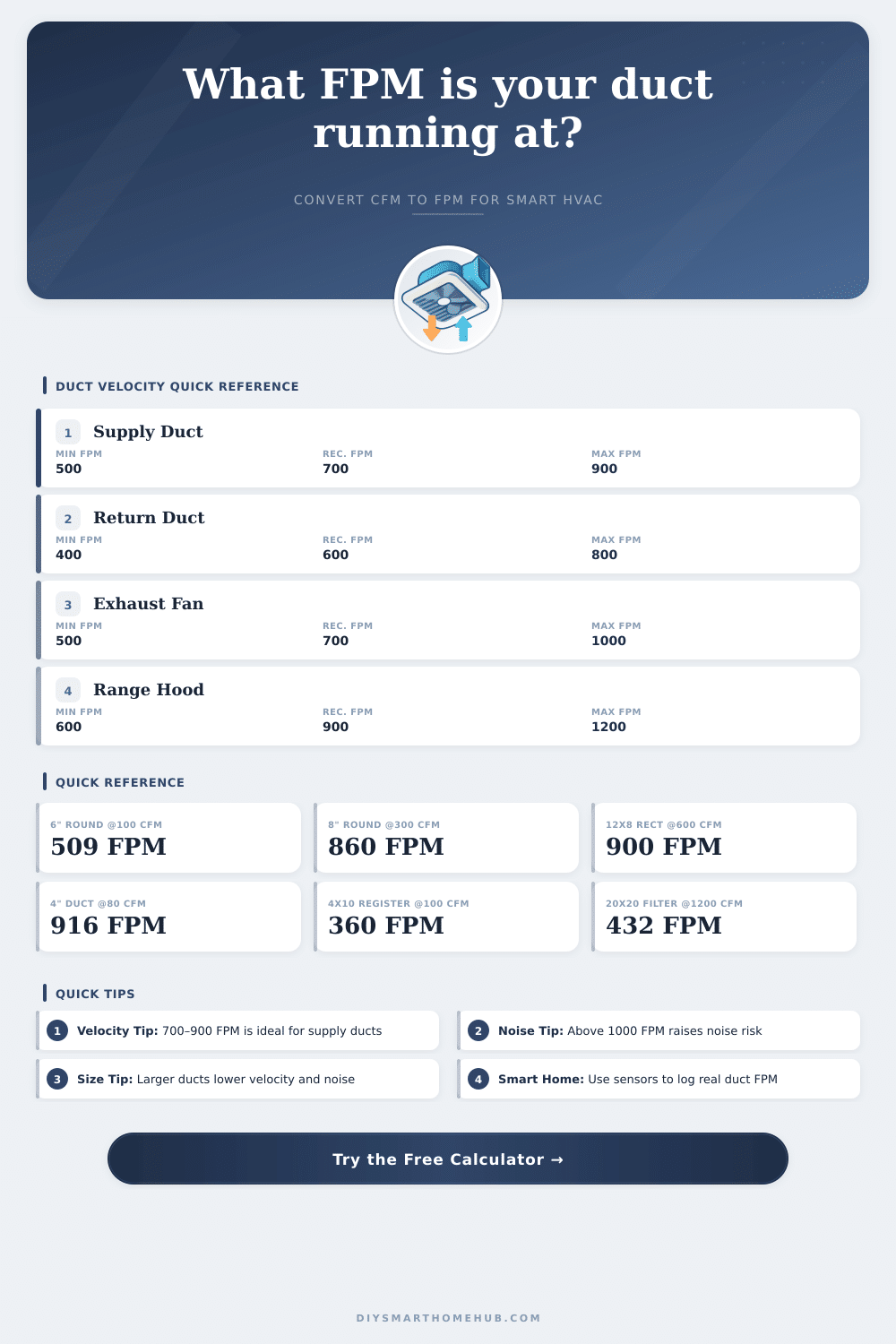
Velocity Reference by Application
| Application | Min FPM | Recommended FPM | Max FPM | Noise Risk |
|---|---|---|---|---|
| Supply Duct (main) | 500 | 700–900 | 1,000 | Low–Med |
| Return Duct | 400 | 600–800 | 900 | Low |
| Exhaust Fan | 500 | 700–900 | 1,100 | Med |
| Range Hood | 600 | 900–1,100 | 1,400 | Med–High |
| Bathroom Fan | 400 | 600–800 | 1,000 | Low–Med |
| Filter Face Velocity | 200 | 300–500 | 600 | Low |
| Grille / Register | 300 | 400–600 | 750 | Low |
| Flex Duct | 400 | 600–700 | 900 | Med |
Round Duct CFM Capacity by Size
| Diameter (in) | Area (sq ft) | CFM @ 500 FPM | CFM @ 700 FPM | CFM @ 900 FPM |
|---|---|---|---|---|
| 4" | 0.087 | 44 | 61 | 79 |
| 5" | 0.136 | 68 | 95 | 123 |
| 6" | 0.196 | 98 | 137 | 177 |
| 7" | 0.267 | 133 | 187 | 240 |
| 8" | 0.349 | 174 | 244 | 314 |
| 10" | 0.545 | 273 | 382 | 491 |
| 12" | 0.785 | 393 | 550 | 707 |
| 14" | 1.069 | 534 | 748 | 962 |
| 16" | 1.396 | 698 | 977 | 1,256 |
| 18" | 1.767 | 884 | 1,237 | 1,591 |
Typical Duct Specs — FPM & CFM at Standard Velocities
| Duct Size | Type | Area (sq ft) | Typical FPM | Typical CFM |
|---|---|---|---|---|
| 4" dia. | Round | 0.087 | 600 | 52 |
| 6" dia. | Round | 0.196 | 700 | 137 |
| 8" dia. | Round | 0.349 | 750 | 262 |
| 10" dia. | Round | 0.545 | 750 | 409 |
| 12" dia. | Round | 0.785 | 800 | 628 |
| 8x6 rect. | Rectangular | 0.333 | 700 | 233 |
| 12x8 rect. | Rectangular | 0.667 | 800 | 533 |
| 16x10 rect. | Rectangular | 1.111 | 850 | 944 |
When you work with ductwork and airflow systems, you commonly will meet the conversion between CFM and FPM. Although those two measures sound similar, they indeed measure entirely different things; and here many folks err CFM, or cubic feet per minute, point the total volume of air pushed through system. FPM, feet per minute, deal about speed…
How quickly the air indeed moves. You can easily confuse those two.
How to Convert Between CFM and FPM
The math behind that is honestly quite simple. You take the velocity measured in FPM and multiply it by the area of the duct in square feet, then you receive the CFM. So, the formula is: CFM = FPM × Area.
Want to reverse it? Simply divide the CFM by the area. Then you have FPM = CFM / area.
There is also another version of this formula that uses square inchess instead of square feet for the area. In that case, you would multiply the FPM by the area in square inches and later would divide the whole result by 144 to convert it to square feet. This number 144 appears because there are 144 square inches in one square foot, it is something that never changes.
We look at simple sample to make this concrete. Assume that you measured FPM of 20 and your duct area is 55 square feet. If you multiply those together, you receive 1,100 CFM.
That is everything.
Round ducts require a bit of geometry. To count the area of round tube, you use the radius. Specifically, area = π × (D/2)², where D is the diameter.
If you have duct with 14-inch diameter, you receive approximately 1.07 square feet of area. The radius squared, multiplied by 3.14 and later divided by 144, gives you that number in square feet.
The diameter of the duct genuinely is important here. Flow of 100 CFM through 8-inch tube gives around 285 FPM. But if you push those same 100 CFM through 6-inch tube, the speed jumps to approximately 526 FPM, because you press the same amount of air through much smaller opening.
With 6-inch tube, if you want 600 CFM, you will see more than 3,000 FPM. To reach 1,000 CFM using 8-inch round tube, you need very high speed of approximately 2,865 FPM. On the other hand, 8-inch tube at 2,000 FPM will deliver around 698 CFM.
Online calculators ease this, if you do not want to do the math manually. You only enter your FPM and the area in square feet, and it will give your CFM. These tools usually allow you to count any from the three values, CFM, FPM or area.
Whenever you know the other two.
The ideal FPM depends on what you design. Home supply ducts usually sit between 600 and 900 FPM. Commercial systems operate faster, between 1,000 and 1,800 FPM.
Return air paths usually are around 400 until 800 FPM, while exhaust systems range between 800 and 1,500 FPM. If you indeed must measure the speed on site, an anemometer does the work… A hot wire anemometer simplifies the conversion of pressure to FPM.
For round tubes, multiply the area by the FPM to receive your CFM. Only recall that if you measure at the grills with a meter, your numbers can rangeabit.