Cooling Tower Tonnage Calculator
Calculate cooling tower capacity, GPM requirements, and water usage for smart home HVAC and commercial systems.
Calculator Settings
Presets
Inputs
💧 Results
GPM Flow Rate Reference Grid
All values at 10°F temperature differential (standard design range).
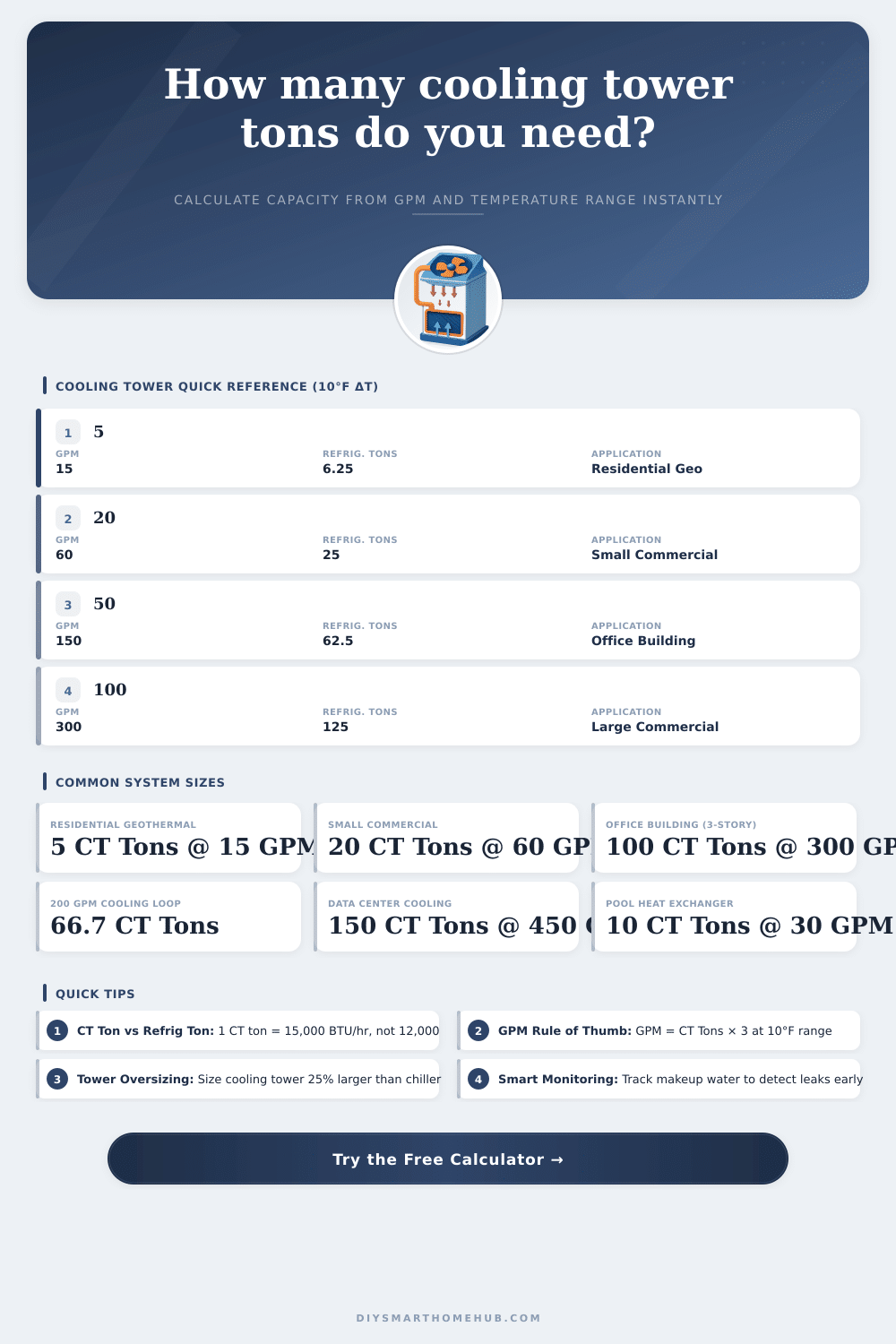
Tower Sizing Reference Table
| CT Tons | GPM at 10°F ΔT | Refrig. Tons Equiv. | BTU/hr | Typical Application |
|---|---|---|---|---|
| 3 | 9 | 3.75 | 45,000 | Smart home geothermal loop |
| 5 | 15 | 6.25 | 75,000 | Residential geothermal system |
| 10 | 30 | 12.5 | 150,000 | Pool heat exchanger / small HVAC |
| 20 | 60 | 25 | 300,000 | Small commercial building |
| 50 | 150 | 62.5 | 750,000 | Mid-size office / retail |
| 100 | 300 | 125 | 1,500,000 | Large office building (3–5 story) |
| 150 | 450 | 187.5 | 2,250,000 | Data center / server room |
| 200 | 600 | 250 | 3,000,000 | Large commercial / industrial |
CT Ton = 15,000 BTU/hr. Refrigeration Ton = 12,000 BTU/hr. CT tons are always larger than refrigeration tons for the same system.
Water Chemistry & Conservation Table
| Cycles of Concentration | Evaporation (% of Flow) | Blowdown Rate | Water Savings vs. 2 Cycles | Treatment Notes |
|---|---|---|---|---|
| 2 | ~1% per 10°F ΔT | Equal to evaporation | Baseline | Minimal treatment needed |
| 3 | ~1% per 10°F ΔT | 50% of evaporation | ~25% savings | Basic scale/biocide control |
| 4 | ~1% per 10°F ΔT | 33% of evaporation | ~38% savings | Regular water testing required |
| 5 | ~1% per 10°F ΔT | 25% of evaporation | ~45% savings | Chemical treatment program |
| 6 | ~1% per 10°F ΔT | 20% of evaporation | ~50% savings | Full water management program |
Higher cycles of concentration reduce makeup water usage but require more active water treatment to prevent scale and biological growth.
Integrate a flow meter and temperature sensors on both inlet and outlet lines of your geothermal or mini cooling tower loop. Log readings to a home automation hub (Home Assistant, SmartThings) to continuously track actual CT tons in real time. A sudden drop in calculated tons with no flow change can indicate scale buildup, fouled fill media, or failing pump — catching it early prevents costly repairs and keeps your system running at peak efficiency.
Always size your cooling tower approximately 25% larger than the chiller it serves. A 100-refrigeration-ton chiller requires a cooling tower rated for at least 125 CT tons. This accounts for the heat of compression added by the chiller compressor. Using the Mode C calculator above automatically applies this 1.25 multiplier so your tower is never undersized for the connected chiller load.
Cooling tower tonnage is the amount of heat that such tower can dump. It represents the energy needed to melt one ton of ice at 0 degrees Celsius within 24 hours It is very important to understand this concept when you choose the size of gear for a building or service.
Cooling tower tonnage is defined as 15,000 BTU each hour. That figure comes from the Cooling Tower Institute, which is the organization responsible for the development of the rating for all such towers. The 15,000 BTU/hr is made up of two parts: 12,000 BTU/hr of the refrigeration ton and 3,000 BTU/hr of the heat of the compressor.
What Cooling Tower Tonnage Means and How to Calculate It
For chillers, refrigeration ton is 12,000 BTU/hr, which is enough to melt one ton of ice in a day. The cooling tower ton is higher, because it also include the heat of the compressor of the chiller.
One cooling tower ton also equals 3,782 kilocalories each hour, 15,826 kJ/h or 4.396 kW. So, there are various ways to express the same amount, depending on what system is used.
In the language of cooling towers, nominal ton is defined as 3 GPM cooled from 95°F to 85°F at wet temperature of 78°F. According to a common formula, the need of a cooling tower is around 3 gallons each minute per ton. On the other hand, chillers use about 2.4 gallons each minute per ton. You can count the cooling tower tonnage by GPM multiplied by the temperature difference and divided by 30.
For chillers, the divisor is 24.
The wet temperature also is important. If the tower is rated for 78°F and the actual wet temperature is 75 degrees or less, the tower will work better than rated and will be able to handle a bigger load. Even so, if the outside temperature reaches 95°F, there is a bit of loss of capacity.
A bit of confusion happens when folks assume that they get a precise temperature fall, when indeed the result depends on the flow and local conditions. That is how it simply works in practice.
To figure out the choice of cooling tower, you can divide the heat load (BTU/hr) by 500 and then by the temperature range to find the GPM. For instance, a heat load of 6,250,000 BTU/hr divided by 500 and by a 15-degree range gives 835 GPM. Then you can choose the tower based on 835 GPM, cooling from 98°F to 83°F at a design wet temperature of 76°F. Higher tonnage means that you need bigger or more gear.
That tonnage affects the whole design of the system and how you determine the sizeof everything.