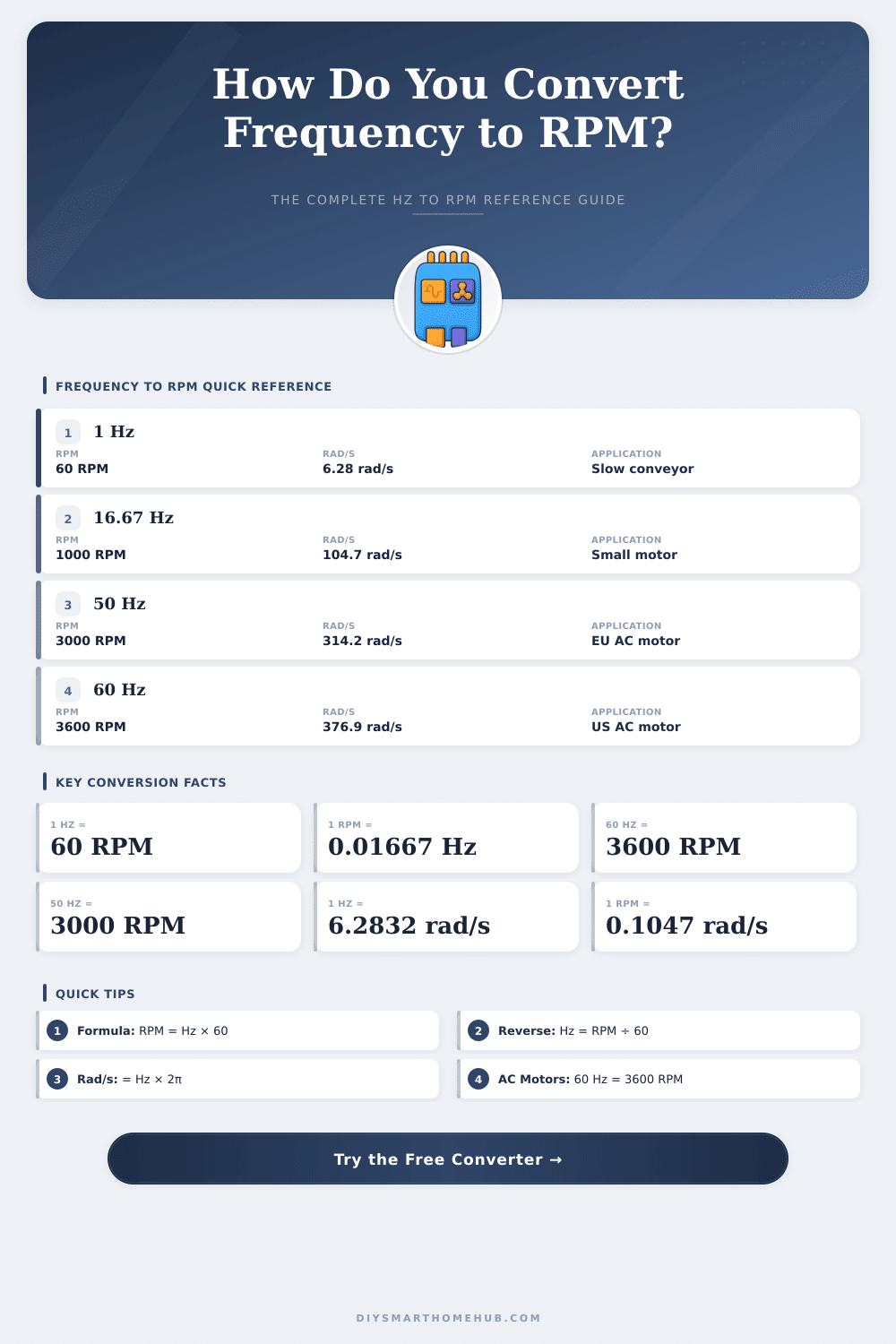
⚙️ Frequency to RPM Converter
Convert Hz ↔ RPM ↔ rad/s instantly. Works for motors, engines, turbines & more.
| Frequency (Hz) | RPM (×60) | rad/s (×2π) | Typical Application |
|---|---|---|---|
| 1 Hz | 60 RPM | 6.28 rad/s | Slow mechanical cycle |
| 5 Hz | 300 RPM | 31.4 rad/s | Low-speed motor |
| 10 Hz | 600 RPM | 62.8 rad/s | VFD low speed |
| 16.67 Hz | 1,000 RPM | 104.7 rad/s | Diesel idle speed |
| 25 Hz | 1,500 RPM | 157.1 rad/s | EU 50Hz (4-pole sync) |
| 30 Hz | 1,800 RPM | 188.5 rad/s | US 60Hz (4-pole sync) |
| 50 Hz | 3,000 RPM | 314.2 rad/s | EU mains frequency (2-pole) |
| 60 Hz | 3,600 RPM | 376.9 rad/s | US mains frequency (2-pole) |
| 90 Hz | 5,400 RPM | 565.5 rad/s | HDD 5400 RPM equiv. |
| 120 Hz | 7,200 RPM | 753.9 rad/s | HDD 7200 RPM equiv. |
| 200 Hz | 12,000 RPM | 1,256.6 rad/s | High-speed spindle |
| 400 Hz | 24,000 RPM | 2,513.3 rad/s | Aircraft electrical system |
| Poles | 60 Hz (US) RPM | 50 Hz (EU) RPM | Formula |
|---|---|---|---|
| 2 | 3,600 | 3,000 | 120 × Hz ÷ Poles |
| 4 | 1,800 | 1,500 | 120 × Hz ÷ Poles |
| 6 | 1,200 | 1,000 | 120 × Hz ÷ Poles |
| 8 | 900 | 750 | 120 × Hz ÷ Poles |
| 10 | 720 | 600 | 120 × Hz ÷ Poles |
| 12 | 600 | 500 | 120 × Hz ÷ Poles |
| 16 | 450 | 375 | 120 × Hz ÷ Poles |
| 24 | 300 | 250 | 120 × Hz ÷ Poles |
| From | To | Multiply By | Example |
|---|---|---|---|
| Hz | RPM | 60 | 50 Hz = 3,000 RPM |
| RPM | Hz | 1/60 = 0.016667 | 1,800 RPM = 30 Hz |
| Hz | rad/s | 2π = 6.28318 | 50 Hz = 314.16 rad/s |
| rad/s | Hz | 1/(2π) = 0.15915 | 314.16 rad/s = 50 Hz |
| RPM | rad/s | π/30 = 0.10472 | 1,800 RPM = 188.5 rad/s |
| rad/s | RPM | 30/π = 9.5493 | 188.5 rad/s = 1,800 RPM |
| Hz | Cycles/min | 60 | 1 Hz = 60 cycles/min |
| kHz | RPM | 60,000 | 1 kHz = 60,000 RPM |
| Application | Typical RPM | Frequency (Hz) | Notes |
|---|---|---|---|
| Car idle | 600–800 RPM | 10–13.3 Hz | Varies by engine |
| Car highway | 2,000–3,000 RPM | 33–50 Hz | Typical cruise |
| HDD (standard) | 5,400–7,200 RPM | 90–120 Hz | Magnetic hard drives |
| US AC motor (2-pole) | 3,600 RPM | 60 Hz | Synchronous speed |
| EU AC motor (2-pole) | 3,000 RPM | 50 Hz | Synchronous speed |
| Aircraft generator | 24,000 RPM | 400 Hz | 400 Hz system |
| Gas turbine | 3,000–3,600 RPM | 50–60 Hz | Grid-tied generators |
| CNC spindle | 6,000–24,000 RPM | 100–400 Hz | High-speed machining |
Common tools for convert RPM between herco and rotations are simple, two units that measure almost the same, but from different viewpoints. Herco measure cycles in second, during RPM point the number of whole revolutions per minute. The calculation for exchange them easy when one understands the basic idea.
How convert herco in RPM? Simply multiply by 60. Here everything.
How to Convert Herco and RPM
When something vibrates in 1 herco, that matches to 60 rotations each minute. The number 60 comes from the 60 seconds in one minute. The other way is equally simple, share RPM by 60 give the frequency in rotations for second.
For fast memory, 1 RPM matches with around 0.0167 herco.
Herco are the SI unit for frequency, and matter to recall, that misteaks in rounding can steal accuracy during conversions, so well doubly control the result. There are many online calculators and converters, that rush the process. One can enter his patterns and receive right away the answer, without need of calculator.
The cause becomes more interesting, when one address engines and generators. For detect RPM from frequency at engine, use this formula: RPM matches 120 times the frequency, later divided by the number of poles. That polar amount must be known.
Engine, that usually twists in around 3450 RPM? It is two-polar device. If it slows too approximately 1725 RPM, then deal about four-polar machine.
Two-polar generator, that turns in 60 herco, reaches 3600 RPM. Four-polar generator in 50 herco come to 1500 RPM. For engine in 50 herco, the basic formula is herco times 60.
Here how this apply in reality, more than one would imagine. Engineers and technicians rely on those conversions for matching motor revolutions, vibrations and control systems. RPM uses everywhere for estimate motor or tool paces.
The engine of your car maybe starts in 750 RPM, during circular saw turn much more quickly.
Most generators without inverters depend on the motor speed for control the product of frequency. They usually operate in 3000 RPM for 50 herco or 3600 RPM for 60 herco. The engine must keep steady revolution for standard frequency…
If the revolutions range, also the electricity does that. Generator heads are designed for certain herco and quickly lose efficiency, if one goes too far from their best level. Dropping 60-herco alternator from 3600 to 3000 RPM for reach 50 herco happen commonly, but bigger changes, as from 400 herco to 60 herco, arenot practical.
Understand the link between herco and RPM helps a lot, when one sets VFD for reach wanted speed.